

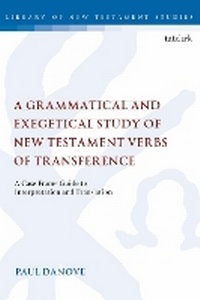
A Grammatical and Exegetical Study of New Testament Verbs of Transference
A Case Frame Guide to Interpretation and Translation
Published on 25. July 2019
Book
Paperback/Softback
258 pages
978-0-567-68971-9 (ISBN)
Description
This study continues the adaptation of the method of Case Frame analysis for the investigation of the Greek text of the New Testament. Case Frame analysis distinguishes the words of a language into two categories, predicators [words that require completion by other words for their correct grammatical use] and non-predicators [words that do not require such completion], and provides rigorous procedures for describing the syntactic, semantic, and lexical requirements that predicators impose on the words that complete their meaning. The inclusion of semantic function and feature descriptions in Case Frame analysis permits the development of a new genre of lexicon that specifies not only syntactic and lexical information (as do traditional dictionaries) but detailed semantic information. The resulting Case Frame lexicon entries are both more compact and more nuanced than traditional lexicon entries.
Danove conducts an exhaustive Case Frame analysis of the ditransitive verbs of transference in the New Testament. He uses this analysis to develop a set of descriptive guidelines for interpreting and translating the various usages of ditransitive verbs of transference and applies these rules in exegetical studies of the text of the New Testament to generate a Case Frame lexicon of the verbs of transference in the New Testament. This study will distinguish the requirements of the 127 New Testament verbs of transference according to four syntactic functions, twelve semantic functions, and 22 lexical realizations. This will permit a rigorous investigation of all occurrences of verbal complements with the same syntactic, semantic, and lexical attributes.
The study also will consider the influence of one semantic feature [an inherent quality of words that has implications for their lexical realization] and of the 'intrusion' of four grammatical constructions [inherent structuring templates of grammar that govern syntactic, semantic, and lexical attributes and modify meaning] on each category of complements with the same syntactic, semantic and lexical description. This will produce a rigorous description of meaning that becomes the basis for Danove's contributions to the linguistic study of biblical Greek and to the exegesis of biblical texts.
Danove conducts an exhaustive Case Frame analysis of the ditransitive verbs of transference in the New Testament. He uses this analysis to develop a set of descriptive guidelines for interpreting and translating the various usages of ditransitive verbs of transference and applies these rules in exegetical studies of the text of the New Testament to generate a Case Frame lexicon of the verbs of transference in the New Testament. This study will distinguish the requirements of the 127 New Testament verbs of transference according to four syntactic functions, twelve semantic functions, and 22 lexical realizations. This will permit a rigorous investigation of all occurrences of verbal complements with the same syntactic, semantic, and lexical attributes.
The study also will consider the influence of one semantic feature [an inherent quality of words that has implications for their lexical realization] and of the 'intrusion' of four grammatical constructions [inherent structuring templates of grammar that govern syntactic, semantic, and lexical attributes and modify meaning] on each category of complements with the same syntactic, semantic and lexical description. This will produce a rigorous description of meaning that becomes the basis for Danove's contributions to the linguistic study of biblical Greek and to the exegesis of biblical texts.
Reviews / Votes
"In this volume Danove, professor of NT studies at Villanova University in Philadelphia and author of Linguistics and Exegesis in the Gospel of Mark: Applications of a Case Frame Analysis (2001), develops and applies the method of case frame analysis to describe the 2177 occurrences of 104 NT verbs that at least on occasion designate transference (X transfers Y to/from Z). After an introduction to case frame analysis and description, he treats the following topics: usage, event, and semantic features; transference--active usages; transference--middle usages; transference/motion--passive usages; motion and relative motion--active usages; effect and its derivative events--all usages; composite events--all usages; and implications, applications, and conclusion. Also included are a case frame analysis and parsing guide, and four appendixes." -New Testament Abstracts, Vol. 54 'Danove states that there are '104 [Greek] New Testament verbs that, at least on occasion, designate transference (X transfers Y to/from Z)' (p. x). Danove's systematice analysis of each of the 45 uses of the 104 verbs is complete with detailed examples and thorough explanations for each use of the verb (which total 2, 177!) including an alphabetical listing of each verb and (chapter ten) an impressive concordance of each verb in the New Testament and how it is used.' Gregory S Paulson, University of Edinburgh -- Gregory S Paulson * Theological Book Review *More details
Series
Language
English
Place of publication
Edinburgh
United Kingdom
Publishing group
Bloomsbury Publishing PLC
Target group
College/higher education
Dimensions
Height: 234 mm
Width: 156 mm
Weight
367 gr
ISBN-13
978-0-567-68971-9 (9780567689719)
Copyright in bibliographic data and cover images is held by Nielsen Book Services Limited or by the publishers or by their respective licensors: all rights reserved.
Schweitzer Classification
Other editions
Additional editions
Paul L. Danove
A Grammatical and Exegetical Study of New Testament Verbs of Transference
A Case Frame Guide to Interpretation and Translation
E-Book
06/2009
1st Edition
T.& T.Clark Ltd
€38.49
Available for download
Person
Paul Danove is Professor of New Testament Studies at Villanova University, USA.
Content
Preface
Abbreviations
Chapter 1: Introduction to Case Frame Analysis and Description
Chapter 2: Usage, Event and Semantic Features
Chapter 3: Transference: Active Uses
Chapter 4: Transference: Middle Uses
Chapter 5: Transference/Motion: Passive Uses
Chapter 6: Motion and Relative Motion: Active Uses
Chapter 7: Effect and its Derivative Events: All Uses
Chapter 8: Composite Events: All Uses
Chapter 9: Implications, Applications and Conclusion Chapter 10: Case Frame Lexicon and Parsing Guide Appendices
Bibliography
Index of Authors
Abbreviations
Chapter 1: Introduction to Case Frame Analysis and Description
Chapter 2: Usage, Event and Semantic Features
Chapter 3: Transference: Active Uses
Chapter 4: Transference: Middle Uses
Chapter 5: Transference/Motion: Passive Uses
Chapter 6: Motion and Relative Motion: Active Uses
Chapter 7: Effect and its Derivative Events: All Uses
Chapter 8: Composite Events: All Uses
Chapter 9: Implications, Applications and Conclusion Chapter 10: Case Frame Lexicon and Parsing Guide Appendices
Bibliography
Index of Authors