

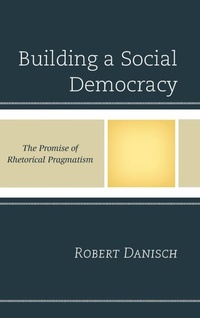
Building a Social Democracy
The Promise of Rhetorical Pragmatism
Published on 6. November 2015
Book
Hardback
342 pages
978-1-4985-1777-5 (ISBN)
Description
Building a Social Democracy offers an alternative intellectual history of American pragmatism, one that tries to reclaim the middle of the twentieth century in order to push neo-pragmatism beyond its philosophical limitations. Danisch argues that the major entailment of the invention of American pragmatism at the beginning of the twentieth century is that rhetorical practices are the rightful object of study and means of improving democratic life. Pragmatism entails a commitment to rhetoric. Rhetorical pragmatism is intended to be more faithful to the project of first generation pragmatism, to offer insight into the ways in which rhetoric operates in contemporary democratic cultures, to recommend practices, methods, and modes of action for improving contemporary democratic cultures, and to subordinate philosophy to rhetoric by reimagining appropriate ways for pragmatist scholarship and social research to advance.
Reviews / Votes
In this accessible yet learned study, Robert Danisch provides a stimulating account of the relationship-in theory and, he hopes, in practice-between the traditions of rhetoric and pragmatism and the flourishing of a democratic public conversation marked by inclusive participation and social hope. Beginning with a distinction between philosophical and rhetorical pragmatism, Danisch offers acute analyses of the major figures in pragmatist thought and shows how by remaining largely on the level of theory, several of them (including me) block the realization of the political/social program implicit in the writings of Dewey and James. A must read for students of rhetoric and American philosophy. -- Stanley Fish, Florida International University and Benjamin Cardozo Law School Robert Danisch brings together a deep understanding of both pragmatist philosophy and rhetorical theory with a clear and persuasive account of politics as a social democracy. Danisch uses pragmatism and pragmatists to offer the grounds for a political theory of rhetoric which transcends strategy and function, and shows the path to a rhetoric which is at once constitutive and primed for action. -- William Keith, University of Wisconsin-Milwaukee, author of Democracy as Discussion: Civic Education and the American Forum Movement, Lexington Books Danisch performs intellectual alchemy, changing the philosophical questions of recent pragmatism into the gold of rhetorical concepts vital to the pursuit of a flourishing democracy. Majestic in its scope, his book represents a prescient reminder that how we have received pragmatism is not the only way to think through its complexities and potentials. Put simply, Building a Social Democracy is one of the most useful and thought-provoking works to emerge out of the meeting of the pragmatist and rhetorical traditions. -- Scott R. Stroud, University of Texas at AustinMore details
Language
English
Place of publication
United States
Publishing group
Bloomsbury Publishing Plc
Target group
College/higher education
Dimensions
Height: 235 mm
Width: 157 mm
Thickness: 25 mm
Weight
707 gr
ISBN-13
978-1-4985-1777-5 (9781498517775)
Copyright in bibliographic data and cover images is held by Nielsen Book Services Limited or by the publishers or by their respective licensors: all rights reserved.
Schweitzer Classification
Other editions
Additional editions
E-Book
11/2015
1st Edition
Lexington Books
€124.99
Available for download
E-Book
11/2015
1st Edition
Lexington Books
€124.99
Available for download
Person
Robert Danisch is associate professor in the Department of Drama and Speech Communication at the University of Waterloo.
Content
Chapter One: Richard Rorty and the Limits of the Linguistic Turn
Chapter Two: Stanley Fish and the Limits of Anti-Foundationalism
Chapter Three: Cornel West and the Quest for Deep Democracy
Chapter Four: Richard McKeon's Philosophy of Rhetoric
Chapter Five: Hugh Duncan's Sociology of Rhetoric and Kenneth Burke's Rhetoric of Identification
Chapter Six: Social Democracy, Deliberative Ecologies, and Rhetorical Structures
Chapter Seven: Artistry, Inquiry, and Rhetorical Citizenship
Chapter Eight: Pluralism, Prudence, and Rhetorical Leadership
Chapter Two: Stanley Fish and the Limits of Anti-Foundationalism
Chapter Three: Cornel West and the Quest for Deep Democracy
Chapter Four: Richard McKeon's Philosophy of Rhetoric
Chapter Five: Hugh Duncan's Sociology of Rhetoric and Kenneth Burke's Rhetoric of Identification
Chapter Six: Social Democracy, Deliberative Ecologies, and Rhetorical Structures
Chapter Seven: Artistry, Inquiry, and Rhetorical Citizenship
Chapter Eight: Pluralism, Prudence, and Rhetorical Leadership