

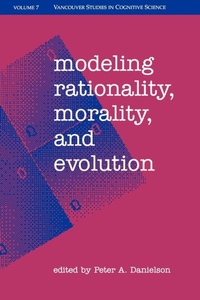
Modeling Rationality, Morality, and Evolution
Published on 6. May 1999
Book
Paperback/Softback
480 pages
978-0-19-512550-4 (ISBN)
Description
This collection focuses on questions that arise when morality is considered from the perspective of recent work on rational choice and evolution. Linking questions like "Is it rational to be moral?" to the evolution of cooperation in "The Prisoners Dilemma," the book brings together new work using models from game theory, evolutionary biology, and cognitive science, as well as from philosophical analysis. Among the contributors are leading figures in these fields, including David Gauthier, Paul M. Churchland, Brian Skyrms, Ronald de Sousa, and Elliot Sober.
Reviews / Votes
Brings together leading figures in a line of great contemporary interest. * Alexander Rosenberg, Philosophy, University of Georgia *More details
Series
Language
English
Place of publication
New York
United States
Target group
Professional and scholarly
Illustrations
line figures
Dimensions
Height: 229 mm
Width: 152 mm
Thickness: 28 mm
Weight
766 gr
ISBN-13
978-0-19-512550-4 (9780195125504)
Copyright in bibliographic data and cover images is held by Nielsen Book Services Limited or by the publishers or by their respective licensors: all rights reserved.
Schweitzer Classification
Other editions
Additional editions

Peter Danielson
Modeling Rationality, Morality, and Evolution
Book
01/2000
Oxford University Press Inc
€56.50
Shipment within 15-20 days
Peter Danielson
Modeling Rationality, Morality, and Evolution
E-Book
12/1998
1st Edition
Oxford University Press
€56.49
Available for download
Person
Content
Acknowledgments
Contributors
1: Peter A. Danielson: Introduction
Rationality
2: Edward F. Mc Clennen: Rationality and Rules
3: David Gauthier: Intention and Deliberation
4: Michael E. Bratman: Following Through with One's Plans: Reply to David Gauthier
5: A. D. Irvine: How Breass' Paradox Solves Newcomb's Problem
6: Bryan R. Routledge: Economics of the Prisoner's Dilemma: A Background
7: Ronald de Sousa: Modeling Rationality: Normative or Descriptive?
Modeling Social Interaction
8: Leslie Burkholder: Theorem 1
9: Louis Marinoff: The Failure of Success: Intrafamilial Exploitation in the Prisoner's Dilemma
10: Peter Kollock: Transforming Social Dilemmas: Group Identity and Co-Operation
11: Bernardo A. Huberman and Natalie S. Glance: Beliefs and Co-Operation
12: Paul M. Churchland: The Neutral Representation of the Social World
Morality
13: David Schmidtz
14: Duncan MacIntosh: Categorically Rational Preferences and the Structure of Morality
15: William J. Talbott: Why We Need a Moral Equilibrium Theory
16: Chantale LaCasse and Don Ross: Moralty's Last Chance
Evolution
17: Brian Skyrms: Mutual Aid: Darwin Meets The Logic of Decision
18: Elliott Sober: Three Differences between Deliberation and Evolution
19: Peter A. Danielson: Evolutionary Models of Co-Operative Mechanisms: Artificial Morality and Genetic Programming
20: Giovanni Dosi, Luigi Marengo, Andrea Bassanini and Marco Valente: Norms as Emergent Properties of Adaptive Learning: The Case of Economic Routines
Contributors
1: Peter A. Danielson: Introduction
Rationality
2: Edward F. Mc Clennen: Rationality and Rules
3: David Gauthier: Intention and Deliberation
4: Michael E. Bratman: Following Through with One's Plans: Reply to David Gauthier
5: A. D. Irvine: How Breass' Paradox Solves Newcomb's Problem
6: Bryan R. Routledge: Economics of the Prisoner's Dilemma: A Background
7: Ronald de Sousa: Modeling Rationality: Normative or Descriptive?
Modeling Social Interaction
8: Leslie Burkholder: Theorem 1
9: Louis Marinoff: The Failure of Success: Intrafamilial Exploitation in the Prisoner's Dilemma
10: Peter Kollock: Transforming Social Dilemmas: Group Identity and Co-Operation
11: Bernardo A. Huberman and Natalie S. Glance: Beliefs and Co-Operation
12: Paul M. Churchland: The Neutral Representation of the Social World
Morality
13: David Schmidtz
14: Duncan MacIntosh: Categorically Rational Preferences and the Structure of Morality
15: William J. Talbott: Why We Need a Moral Equilibrium Theory
16: Chantale LaCasse and Don Ross: Moralty's Last Chance
Evolution
17: Brian Skyrms: Mutual Aid: Darwin Meets The Logic of Decision
18: Elliott Sober: Three Differences between Deliberation and Evolution
19: Peter A. Danielson: Evolutionary Models of Co-Operative Mechanisms: Artificial Morality and Genetic Programming
20: Giovanni Dosi, Luigi Marengo, Andrea Bassanini and Marco Valente: Norms as Emergent Properties of Adaptive Learning: The Case of Economic Routines