

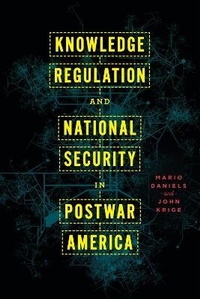
Knowledge Regulation and National Security in Postwar America
Published on 3. May 2022
Book
Hardback
432 pages
978-0-226-81748-4 (ISBN)
Description
The first historical study of export control regulations as a tool for the sharing and withholding of knowledge.
In this groundbreaking book, Mario Daniels and John Krige set out to show the enormous political relevance that export control regulations have had for American debates about national security, foreign policy, and trade policy since 1945. Indeed, they argue that from the 1940s to today the issue of how to control the transnational movement of information has been central to the thinking and actions of the guardians of the American national security state. The expansion of control over knowledge and know-how is apparent from the increasingly systematic inclusion of universities and research institutions into a system that in the 1950s and 1960s mainly targeted business activities. As this book vividly reveals, classification was not the only-and not even the most important-regulatory instrument that came into being in the postwar era.
In this groundbreaking book, Mario Daniels and John Krige set out to show the enormous political relevance that export control regulations have had for American debates about national security, foreign policy, and trade policy since 1945. Indeed, they argue that from the 1940s to today the issue of how to control the transnational movement of information has been central to the thinking and actions of the guardians of the American national security state. The expansion of control over knowledge and know-how is apparent from the increasingly systematic inclusion of universities and research institutions into a system that in the 1950s and 1960s mainly targeted business activities. As this book vividly reveals, classification was not the only-and not even the most important-regulatory instrument that came into being in the postwar era.
Reviews / Votes
"Daniels and Krige's attempt is remarkable because of the breadth of the research required, but also because it breaks new ground. . . . This is a necessary, useful, and foundational book for aspects of twen-tieth- and twenty-first-century US policy that in combination typically get short shrift. For scholars interested in Cold War foreign policy, the history of technology and institutions, sociology, or twentieth-century intellectual history, this will be a book to have." * Technology and Culture * "This is a terrific and important book. To make sense of our current moment of post-neoliberal revirement, we need new, engaged, and detailed political histories of state institutions. Daniels and Krige show us what that might look like." * H-Diplo Roundtable XXIV-8 * "A valuable and much-needed addition to the literature on export controls. This book will easily become a main reference for anyone trying to understand the development of the US export control system and the central role that knowledge flow controls have played in that process." -- Sam Weiss Evans, Harvard University "An excellent book. It will provide an opening to a critical conversation that is needed in the United States right now on the relationship among export controls, national security, economic competitiveness, and academic freedom. This conversation will only grow in the coming decade, and this book will provide a touchstone for it." -- Michael A. Dennis, United States Naval War CollegeMore details
Language
English
Place of publication
Chicago
United States
Publishing group
The University of Chicago Press
Target group
Professional and scholarly
Illustrations
8 tables
Dimensions
Height: 229 mm
Width: 152 mm
Thickness: 33 mm
Weight
739 gr
ISBN-13
978-0-226-81748-4 (9780226817484)
Copyright in bibliographic data and cover images is held by Nielsen Book Services Limited or by the publishers or by their respective licensors: all rights reserved.
Schweitzer Classification
Other editions
Additional editions
Daniels Mario Daniels | Krige John Krige
Knowledge Regulation and National Security in Postwar America
E-Book
04/2022
University of Chicago Press
€48.99
Available for download
Persons
Mario Daniels is the DAAD Fachlektor at the Duitsland Instituut at the University of Amsterdam. John Krige is the Kranzberg Professor Emeritus in the School of History and Sociology at the Georgia Institute of Technology. He is the author of several books, including Sharing Knowledge, Shaping Europe, and the editor of Knowledge Flows in a Global Age: A Transnational Approach, also published by the University of Chicago Press.
Content
List of Abbreviations
Chapter 1. Introduction: What Are Export Controls, and Why Do They Matter?
Part 1
Chapter 2. The Invention of Export Controls over Unclassified Technological Data and Know-How (1917-45)
Chapter 3. The Cold War National Security State and the Export Control Regime
Part 2
Chapter 4. The Recalibration of American Power, the Bucy Report, and the Reshaping of Export Controls in the 1970s
Chapter 5. The Reagan Administration's Attempts to Control Soviet Knowledge Acquisition in Academia
Chapter 6. Academia Fights Back: The Corson Panel and the Fundamental Research Exclusion
Part 3
Chapter 7. "Economic Security" and the Politics of Export Controls over Technology Transfers to Japan in the 1980s
Chapter 8. Paradigm Shifts in Export Control Policies by Reagan, Bush, and Clinton and the Evolving US-China Relations
Chapter 9. The Conflict over Technology Sharing in Clinton's Second Term: The Cox Report and the Use of Chinese Launchers
Part 4
Chapter 10. Epilogue: Export Controls, US Academia, and the Chinese-American Clash during the Trump Administration
Notes
Index
Chapter 1. Introduction: What Are Export Controls, and Why Do They Matter?
Part 1
Chapter 2. The Invention of Export Controls over Unclassified Technological Data and Know-How (1917-45)
Chapter 3. The Cold War National Security State and the Export Control Regime
Part 2
Chapter 4. The Recalibration of American Power, the Bucy Report, and the Reshaping of Export Controls in the 1970s
Chapter 5. The Reagan Administration's Attempts to Control Soviet Knowledge Acquisition in Academia
Chapter 6. Academia Fights Back: The Corson Panel and the Fundamental Research Exclusion
Part 3
Chapter 7. "Economic Security" and the Politics of Export Controls over Technology Transfers to Japan in the 1980s
Chapter 8. Paradigm Shifts in Export Control Policies by Reagan, Bush, and Clinton and the Evolving US-China Relations
Chapter 9. The Conflict over Technology Sharing in Clinton's Second Term: The Cox Report and the Use of Chinese Launchers
Part 4
Chapter 10. Epilogue: Export Controls, US Academia, and the Chinese-American Clash during the Trump Administration
Notes
Index