

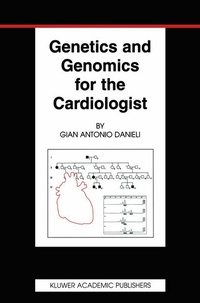
Genetics and Genomics for the Cardiologist
Published on 30. November 2002
Book
Hardback
XIII, 227 pages
978-1-4020-7309-0 (ISBN)
Description
Genetics and Genomics for the Cardiologist
is a concise, but comprehensive volume for the clinical cardiologist or medical student interested in learning how molecular genetics is now being applied to prevention and treatment of heart diseases, from DNA tests to pharmacogenomics and gene-based therapeutics. The volume, written in a plain language, contains detailed figures. A rich glossary, three appendices, many references and several URLs provide additional sources of information.
More details
Series
Edition
2002 ed.
Language
English
Place of publication
New York
United States
Target group
College/higher education
Professional and scholarly
Research
Illustrations
XIII, 227 p.
Dimensions
Height: 241 mm
Width: 160 mm
Thickness: 18 mm
Weight
535 gr
ISBN-13
978-1-4020-7309-0 (9781402073090)
DOI
10.1007/978-1-4615-1025-3
Schweitzer Classification
Other editions
Additional editions
Gian Antonio Danieli
Genetics and Genomics for the Cardiologist
Book
10/2012
Springer
€106.99
Shipment within 7-9 days
Content
1: The Human Genome.- 1.1 Size and characteristics of nuclear and mitochondrial genome in humans.- 1.2 Structural and functional organization of human chromosomes.- 1.3 Structural and functional organization of human genes.- 1.4 Artificial banding of human chromosomes.- 1.5 Replication of human DNA and the origin of new mutations.- 1.6 Effects of mutations in DNA sequences.- 1.7 DNA markers.- 1.8 Chromosomal basis of inheritance.- 1.9 The main reference database for human disease genes.- 1.10 The Human Mutation Database and the nomenclature for human mutations.- 2: From Genome to Clinical Phenotype.- 2.1 Analyzing the human transcriptome.- 2.2 The differential expression of human genes.- 2.3 From transcriptome to proteome and metabolome.- 2.4 The transcriptome of the human heart.- 2.5 Genotype and phenotype.- 2.6 Molecular explanation of dominance of some mutations.- 2.7 Gene dosage.- 2.8 Peculiarity of phenotypes due to mutations in mitochondrial DNA.- 2.9 Multi-factorial diseases.- 3: Identifying Disease Genes in Humans.- 3.1 Starting with the family.- 3.2 The positional candidate gene approach.- 3.3 Linkage analysis in Mendelian diseases.- 3.4 Linkage analysis in multifactorial diseases.- 3.5 Detecting pathogenic mutations.- 3.6 Establishing the pathogenic role of specific mutations.- 3.7 Establishing genotype-phenotype correlations.- 4: Inherited Structural and Functional Defects of Myocardium.- 4.1 Cardiomyopathies.- 4.2 Genetic heterogeneity of cardiomyopathies and the "final common pathway" hypothesis.- 4.3 Arrhythmic disorders.- 4.4 Genetic basis of congenital heart defects in humans.- 4.5 Transgenic animals and the genetic dissection of developmental phenotypes.- 4.6 Understanding cardiovascular development.- 5: Inherited Cardiovascular Disorders.- 5.1Structural defects of vessels.- 5.2 Coronary atherosclerosis and myocardial infarction.- 5.3 Genetics of hypertension.- 5.4 Understanding hypertension through animal models.- 6: Genetics and Genomics Applied to Diagnosis and Therapy.- 6.1 Growing interest for genetic tests.- 6.2 Purposes and methods of genetic testing.- 6.3 Novel genetic tests.- 6.4 Genetic risk assessment.- 6.5 Genetic tests: some ethical and legal aspects.- 6.6 Genetics and genomics applied to drug therapy: pharmacogenetics and pharmacogenomics.- 6.7 Pharmacogenetics in Cardiology.- 6.8 Pharmacogenomics and beyond.- 6.9 Gene-based therapeutics.- Conclusion.- References.- Appendix I: Updated information from the Web.- Appendix II: OMIM IDs for monogenic disorders relevant to Cardiology.- Appendix III: Genes encoding ionic channels and expressed in human heart.- Credits.