

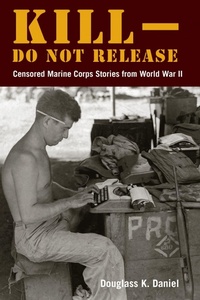
Kill-Do not Release
Censored Marine Corps Stories from World War II
Published on 5. August 2025
Book
Paperback/Softback
320 pages
978-1-5315-1040-4 (ISBN)
Description
"Fighter-Writer" reports from major battles in the Pacific highlight what America's Marines endured in World War II
Douglass K. Daniel presents a fascinating trove of previously classified material withheld from the public because of government and public relations concerns at the time, including tactical details that could inadvertently aid the enemy, battlefield gore that could disturb readers, and the gamut of issues of taste. Navy censors in the field and editors at Marine Corps headquarters in Washington were also on alert for any material that could negatively affect the Corps itself or the overall war effort. Soul-searching stories that questioned the nature of war were rejected lest they sow doubt stateside about the cause for which so many lives were being lost.
Behind the bylines was a new breed of storytellers. Considered "fighter-writers," Marine combat correspondents, or CCs, carried typewriters as well as weapons. The Marine Corps Division of Public Relations recruited them from America's newsrooms to join the fight that stretched from Guadalcanal and the bloody assault on Tarawa to the black sands of Iwo Jima and the dense jungles of Okinawa. Their approved work appeared in civilian newspapers, magazines, and other national and local media.
This collection also highlights the unique efforts of the CCs and the public relations officers who commanded them. While they were assigned to report and write, they were Marines first. They eagerly put aside their notebooks to take up arms against the enemy as needed. Many were wounded in battle, and more than a dozen were killed, giving their lives to get the story behind the most significant conflict in human history.
Douglass K. Daniel presents a fascinating trove of previously classified material withheld from the public because of government and public relations concerns at the time, including tactical details that could inadvertently aid the enemy, battlefield gore that could disturb readers, and the gamut of issues of taste. Navy censors in the field and editors at Marine Corps headquarters in Washington were also on alert for any material that could negatively affect the Corps itself or the overall war effort. Soul-searching stories that questioned the nature of war were rejected lest they sow doubt stateside about the cause for which so many lives were being lost.
Behind the bylines was a new breed of storytellers. Considered "fighter-writers," Marine combat correspondents, or CCs, carried typewriters as well as weapons. The Marine Corps Division of Public Relations recruited them from America's newsrooms to join the fight that stretched from Guadalcanal and the bloody assault on Tarawa to the black sands of Iwo Jima and the dense jungles of Okinawa. Their approved work appeared in civilian newspapers, magazines, and other national and local media.
This collection also highlights the unique efforts of the CCs and the public relations officers who commanded them. While they were assigned to report and write, they were Marines first. They eagerly put aside their notebooks to take up arms against the enemy as needed. Many were wounded in battle, and more than a dozen were killed, giving their lives to get the story behind the most significant conflict in human history.
More details
Series
Edition
New edition
Language
English
Place of publication
New York
United States
Target group
College/higher education
Edition type
New edition
Product notice
Paperback (trade)
Illustrations
18 b/w illustrations
Dimensions
Height: 228 mm
Width: 153 mm
Thickness: 22 mm
Weight
474 gr
ISBN-13
978-1-5315-1040-4 (9781531510404)
Copyright in bibliographic data and cover images is held by Nielsen Book Services Limited or by the publishers or by their respective licensors: all rights reserved.
Schweitzer Classification
Person
Douglass K. Daniel has practiced journalism and studied and written about media and history. He was a reporter and editor for the Associated Press for nearly three decades. Daniel also taught journalism as an assistant professor at Kansas State University and Ohio University. He is the author of several books, including biographies of the 60 Minutes correspondent Harry Reasoner, Oscar-winning writer and director Richard Brooks, and celebrated actress Anne Bancroft.
Content
Introduction 1
1 A Dangerous Publicity Campaign 7
2 In the Jungles of Guadalcanal 23
3 Somewhere in the South Pacific 45
4 Four Bloody Days on Tarawa 71
5 From New Britain to the Marshalls 97
6 Sweeping the Marianas: Saipan, Guam, and Tinian 122
7 Payback at Peleliu 149
8 Invisible Heroes: Black Marines and Sailors in the Pacific 161
9 Thirty-Six Days on Iwo Jima 182
10 Okinawa and Imperial Japan's Last Stand 202
11 Life in the Marine Corps 219
Epilogue 239
Acknowledgments 249
Notes 251
Bibliography 275
Index 279
Photos follow page 148
1 A Dangerous Publicity Campaign 7
2 In the Jungles of Guadalcanal 23
3 Somewhere in the South Pacific 45
4 Four Bloody Days on Tarawa 71
5 From New Britain to the Marshalls 97
6 Sweeping the Marianas: Saipan, Guam, and Tinian 122
7 Payback at Peleliu 149
8 Invisible Heroes: Black Marines and Sailors in the Pacific 161
9 Thirty-Six Days on Iwo Jima 182
10 Okinawa and Imperial Japan's Last Stand 202
11 Life in the Marine Corps 219
Epilogue 239
Acknowledgments 249
Notes 251
Bibliography 275
Index 279
Photos follow page 148