

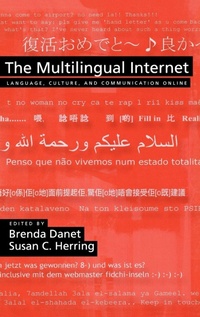
The Multilingual Internet
Language, Culture, and Communication Online
Published on 7. June 2007
Book
Hardback
464 pages
978-0-19-530479-4 (ISBN)
Description
Two thirds of global Internet users are non-English speakers. Despite this, most scholarly literature on the Internet and computer-mediated-communication (CMC) focuses exclusively on English. This is the first book devoted to analyzing Internet related CMC in languages other than English.
The volume collects 18 new articles on facets of language and Internet use, all of which revolve around several central topics: writing systems, the structure and features of local languages and how they affect internet use, code switching between multiple languages, gender issues, public policy issues, and so on. The scope of languages discussed in the volume is unusually broad, including non-native English, French, Arabic, Chinese, Greek, Spanish, Japanese, Thai, and Portuguese. This book will be of great interest to anyone studying linguistics, applied linguistics, communication, anthropology and information sciences.
The volume collects 18 new articles on facets of language and Internet use, all of which revolve around several central topics: writing systems, the structure and features of local languages and how they affect internet use, code switching between multiple languages, gender issues, public policy issues, and so on. The scope of languages discussed in the volume is unusually broad, including non-native English, French, Arabic, Chinese, Greek, Spanish, Japanese, Thai, and Portuguese. This book will be of great interest to anyone studying linguistics, applied linguistics, communication, anthropology and information sciences.
More details
Language
English
Place of publication
New York
United States
Target group
College/higher education
Professional and scholarly
Dimensions
Height: 240 mm
Width: 161 mm
Thickness: 29 mm
Weight
857 gr
ISBN-13
978-0-19-530479-4 (9780195304794)
Copyright in bibliographic data and cover images is held by Nielsen Book Services Limited or by the publishers or by their respective licensors: all rights reserved.
Schweitzer Classification
Other editions
Additional editions
Brenda Danet | Susan C. Herring
The Multilingual Internet
Language, Culture, and Communication Online
Book
06/2007
Oxford University Press Inc
€49.20
Shipment within 15-20 days
Brenda Danet | Susan C. Herring
The Multilingual Internet
Language, Culture, and Communication Online
E-Book
06/2007
1st Edition
OUP eBook
€18.99
Available for download
Brenda Danet | Susan C. Herring
The Multilingual Internet
Language, Culture, and Communication Online
E-Book
06/2007
1st Edition
OUP USA
€18.49
Available for download
Persons
Content
Chapter 1: Introduction: Welcome to the Multilingual Internet: Brenda Danet and Susan C. Herring:
Part I: Writing Systems and the Internet
Chapter 2: "A Funky Language for Teenzz to Use:" Representing Gulf Arabic in Instant Messaging: David Palfreyman and Muhamed Al Khalil:
Chapter 3: The Multilingual and Multi-Orthnographic Taiwan-Based Internet: Creative Uses of Writing Systems on College Affiliated BBSs: Hsi-Yao Su:
Chapter 4: Neography: Unconventional Spelling in French SMS Text Messages: Jacques Anis:
Chapter 5: "It's all Greeklish to me!:" Linguistic and Sociocultural Perspectives on Roman-alphabeted Greek in Asynchronous Computer-Mediated Communication: Theodora Tseliga:
Chapter 6: Greeklish and Greekness: Trends and Discourses of "Glocalness": Dimitris Koutsogiannis and Bessie Mitsikopoulou:
Part II: Linguistic Discourse Features of Internet Communication in Languages Other than English
Chapter 7: Linguistic Innovations and Interactional Features of Japanese BBS Communication: Yukiko Nishimura:
Chapter 8: Linguistic Features of Email and ICQ Instant Messaging in Hong Kong: Carmen K. M. Lee:
Chapter 9: Can Machine Translation Enhance the Status of Catalan versus Spanish in Online Academic Forums?: Salvador Climent, Joaquim Mor='e, Antoni Oliver, M='iriam Salvatierra, Imma Sanchez, and Mariona Taul=e:
Part III: Gender and Culture
Chapter 10: Gender and Turn Allocation in a Thai Chat Room: Siriporn Panyametheekul and Susan C. Herring:
Chapter 11: Breaking Conversational Norms of a Portuguese Users Network: Men as Adjudicators of Politeness?: Sandi Michele de Oliveira:
Chapter 12: Kaomoji and Expressivity in a Japanese Housewives' Chatroom: Hirofumi Katsuno and Christine Yano:
Part IV: Language Choice and Code-switching
Chapter 13: Language Choice Online: Globalization and Identity in Egypt: Mark Warschauer, Ghada R. El Said, and Ayman Zohry:
Chapter 14: Language Choice on a Swiss Mailing List: Mercedes Durham:
Chapter 15: Language Choice and Code-Switching in German-Based Diasporic Web Forums: Jannis Androutsopoulos:
Chapter 16: Anyone Speak Swedish? Tolerance for Language Shifting in Graphical Multi-User Virtual Environments: Ann-Sofie Axelsson, Asa Abelin, and Ralph Schroeder:
Part V: Broader Perspectives: Language Diversity
Chapter 17: The European Union in Cyberspace: Democratic Participation via Online Multilingual Discussion Boards: Ruth Wodak and Scott Wright:
Chapter 18: How Much Multilingualism? Language Diversity on the Internet: John C. Paolillo:
Index
Part I: Writing Systems and the Internet
Chapter 2: "A Funky Language for Teenzz to Use:" Representing Gulf Arabic in Instant Messaging: David Palfreyman and Muhamed Al Khalil:
Chapter 3: The Multilingual and Multi-Orthnographic Taiwan-Based Internet: Creative Uses of Writing Systems on College Affiliated BBSs: Hsi-Yao Su:
Chapter 4: Neography: Unconventional Spelling in French SMS Text Messages: Jacques Anis:
Chapter 5: "It's all Greeklish to me!:" Linguistic and Sociocultural Perspectives on Roman-alphabeted Greek in Asynchronous Computer-Mediated Communication: Theodora Tseliga:
Chapter 6: Greeklish and Greekness: Trends and Discourses of "Glocalness": Dimitris Koutsogiannis and Bessie Mitsikopoulou:
Part II: Linguistic Discourse Features of Internet Communication in Languages Other than English
Chapter 7: Linguistic Innovations and Interactional Features of Japanese BBS Communication: Yukiko Nishimura:
Chapter 8: Linguistic Features of Email and ICQ Instant Messaging in Hong Kong: Carmen K. M. Lee:
Chapter 9: Can Machine Translation Enhance the Status of Catalan versus Spanish in Online Academic Forums?: Salvador Climent, Joaquim Mor='e, Antoni Oliver, M='iriam Salvatierra, Imma Sanchez, and Mariona Taul=e:
Part III: Gender and Culture
Chapter 10: Gender and Turn Allocation in a Thai Chat Room: Siriporn Panyametheekul and Susan C. Herring:
Chapter 11: Breaking Conversational Norms of a Portuguese Users Network: Men as Adjudicators of Politeness?: Sandi Michele de Oliveira:
Chapter 12: Kaomoji and Expressivity in a Japanese Housewives' Chatroom: Hirofumi Katsuno and Christine Yano:
Part IV: Language Choice and Code-switching
Chapter 13: Language Choice Online: Globalization and Identity in Egypt: Mark Warschauer, Ghada R. El Said, and Ayman Zohry:
Chapter 14: Language Choice on a Swiss Mailing List: Mercedes Durham:
Chapter 15: Language Choice and Code-Switching in German-Based Diasporic Web Forums: Jannis Androutsopoulos:
Chapter 16: Anyone Speak Swedish? Tolerance for Language Shifting in Graphical Multi-User Virtual Environments: Ann-Sofie Axelsson, Asa Abelin, and Ralph Schroeder:
Part V: Broader Perspectives: Language Diversity
Chapter 17: The European Union in Cyberspace: Democratic Participation via Online Multilingual Discussion Boards: Ruth Wodak and Scott Wright:
Chapter 18: How Much Multilingualism? Language Diversity on the Internet: John C. Paolillo:
Index