

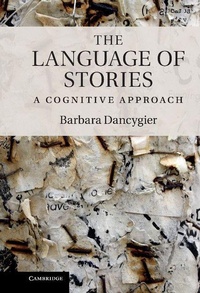
The Language of Stories
A Cognitive Approach
Published on 13. October 2011
Book
Hardback
242 pages
978-1-107-00582-2 (ISBN)
Description
How do we read stories? How do they engage our minds and create meaning? Are they a mental construct, a linguistic one or a cultural one? What is the difference between real stories and fictional ones? This book addresses such questions by describing the conceptual and linguistic underpinnings of narrative interpretation. Barbara Dancygier discusses literary texts as linguistic artifacts, describing the processes which drive the emergence of literary meaning. If a text means something to someone, she argues, there have to be linguistic phenomena that make it possible. Drawing on blending theory and construction grammar, the book focuses its linguistic lens on the concepts of the narrator and the story, and defines narrative viewpoint in a new way. The examples come from a wide spectrum of texts, primarily novels and drama, by authors such as William Shakespeare, Margaret Atwood, Philip Roth, Dave Eggers, Jan Potocki and Mikhail Bulgakov.
Reviews / Votes
'Drawing on key developments in cognitive linguistics, including construction grammar and blending theory, this accessible, well-organized, and richly synthetic study outlines exciting new directions for research on narrative.' David Herman, Ohio State University 'For anyone who still needs to be convinced of the rich value of the cognitive turn in arts and humanities, this book provides it. It is erudite and elegant, readable and significant, and it succeeds by the force of its argument and the texture of its analysis. It is both precise and breathtaking in its range.' Peter Stockwell, Chair in Literary Linguistics, University of Nottingham 'A brilliant and original book on language and stories as twin creations of the human mind. Dancygier elegantly offers new insights into the way we think.' Mark Turner, Institute Professor and Professor of Cognitive Science, Case Western Reserve University 'Barbara Dancygier's new approach to defining narrative viewpoint presented in her book The Language of Stories: A Cognitive Approach is very convincing and comprehensible. This book makes an important contribution to literary linguistics and at the same time outlines innovative directions for research on narrative. Dancygier's study is of interest to linguists and literary scholars, is suitable for scientists and for students. It's a remarkable and highly recommendable book.' Natalia Shchyhlevska, Language and Dialogue 'What I appreciated most in The Language of Stories [was] Dancygier's attention to small lexical and grammatical textual choices and her rigorous attempt to follow the effect of these details through to the macro-level of meaning construction.' Elke D'hoker, English Text ConstructionMore details
Language
English
Place of publication
Cambridge
United Kingdom
Target group
Professional and scholarly
Illustrations
20 Line drawings, unspecified
Dimensions
Height: 235 mm
Width: 157 mm
Thickness: 18 mm
Weight
507 gr
ISBN-13
978-1-107-00582-2 (9781107005822)
Copyright in bibliographic data and cover images is held by Nielsen Book Services Limited or by the publishers or by their respective licensors: all rights reserved.
Schweitzer Classification
Other editions
Additional editions
Book
10/2015
Cambridge University Press
€51.60
Shipment within 15-20 days
E-Book
11/2011
1st Edition
Cambridge University Press
€36.99
Available for download
E-Book
10/2011
Cambridge University Press
€31.99
Available for download
Person
Barbara Dancygier is an Associate Professor in the Department of English at the University of British Columbia, Canada. Her publications include Conditionals and Prediction (Cambridge, 1999) and Mental Spaces in Grammar (with Eve Sweetser, Cambridge, 2005).
Content
1. Language and literary narratives; 2. Blending, narrative spaces, and the emergent story; 3. Stories and their tellers; 4. Viewpoint: representation and compression; 5. Referential expressions and narrative spaces; 6. Fictional minds and embodiment in drama and fiction; 7. Spoken discourse and thought in literary discourse; 8. Stories in the mind.