

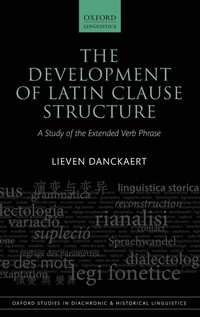
The Development of Latin Clause Structure
A Study of the Extended Verb Phrase
Published on 22. June 2017
Book
Hardback
384 pages
978-0-19-875952-2 (ISBN)
Description
This book examines Latin word order, and in particular the relative ordering of i) lexical verbs and direct objects (OV vs VO) and ii) auxiliaries and non-finite verbs (VAux vs AuxV). In Latin these elements can freely be ordered with respect to each other, whereas the present-day Romance languages only allow for the head-initial orders VO and AuxV. Lieven Danckaert offers a detailed, corpus-based description of these two word order alternations, focusing on their diachronic development in the period from c. 200 BC until 600 AD. The corpus data reveal that some received wisdom needs to be reconsidered: there is in fact no evidence for any major increase in productivity of the order VO during the eight centuries under investigation, and the order AuxV only becomes more frequent in clauses with a modal verb and an infinitive, not in clauses with a BE-auxiliary and a past participle. The book also explores a more fundamental question about Latin syntax, namely whether or not the language is configurational, in the sense that a phrase structure grammar (with 'higher-order constituents' such as verb phrases) is needed to describe and analyse Latin word order patterns. Four pieces of evidence are presented that suggest that Latin is indeed a fully configurational language, despite its high degree of word order flexibility. Specifically, it is shown that there is ample evidence for the existence of a verb phrase constituent. The book thus contributes to the ongoing debate regarding the status of configurationality as a language universal.
Reviews / Votes
... the book is a powerful vindication of the configurational approach to Latin word order and presents a challenge that those of us who prefer to think of Latin clause structure in less strictly configurational terms must rise to. * Dag Haug, Gnomon * Danckaert's work is a very deep research with important analyses and is definitely a must-read for linguists interested in diachronic studies of Latin, especially those working on generative approaches. * Bruno O. Maroneze, LinguistList * Danckaert in this volume has given us new knowledge about the development of word order in the constructions that he has chosen to study. This contribution is very important and valuable-and will be appreciated even by those who do not share his convictions about his theoretical framework. * Gerd V. M. Haverling, Bryn Mawr Classical Review *More details
Series
Language
English
Place of publication
Oxford
United Kingdom
Target group
College/higher education
Professional and scholarly
Dimensions
Height: 240 mm
Width: 161 mm
Thickness: 25 mm
Weight
740 gr
ISBN-13
978-0-19-875952-2 (9780198759522)
Copyright in bibliographic data and cover images is held by Nielsen Book Services Limited or by the publishers or by their respective licensors: all rights reserved.
Schweitzer Classification
Other editions
Additional editions
E-Book
06/2017
1st Edition
OUP eBook
€60.99
Available for download
Person
Lieven Danckaert is a researcher at CNRS adn the University of Lille 3. He was previously employed at Ghent University, where he obtained his PhD in 2011. His research focuses on Latin syntax, particularly word order and the use of quantitative, corpus-based methods. His work has been published in journals including Lingua and Transactions of the Philological Society, and in several edited volumes. He is the author of Latin Embedded Clauses: The Left Periphery (John Benjamins, 2012).
Content
Series preface
Acknowledgements
Abbreviations
A note on glossing conventions
1: What is at stake: Word order, configurationality, and the potential for structural ambiguity
2: Latin corpus linguistics and the study of language change: Methods, problems and prospect
3: Multiple object positions and how to diagnose them
4: VOAux: A typologically rare word order pattern
5: Changing EPP parameters: Clause structure in Classical and Late Latin
6: The development of BE-periphrases
Epilogue. : Variable direction of complementation in the Latin clause: A synthesis
Glossary
References
Acknowledgements
Abbreviations
A note on glossing conventions
1: What is at stake: Word order, configurationality, and the potential for structural ambiguity
2: Latin corpus linguistics and the study of language change: Methods, problems and prospect
3: Multiple object positions and how to diagnose them
4: VOAux: A typologically rare word order pattern
5: Changing EPP parameters: Clause structure in Classical and Late Latin
6: The development of BE-periphrases
Epilogue. : Variable direction of complementation in the Latin clause: A synthesis
Glossary
References