

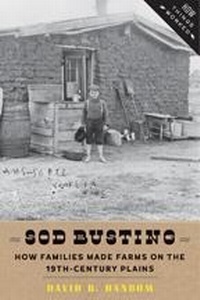
Sod Busting
How Families Made Farms on the Nineteenth-Century Plains
Published on 27. October 2014
Book
Paperback/Softback
144 pages
978-1-4214-1451-5 (ISBN)
Description
Prairie busting is central to the lore of westward expansion, but how was it actually accomplished with little more than animal and human power? In Sod Busting, David B. Danbom tells the story of Great Plains settlement in a way it has seldom been told before. Stretching beyond the sweeping accounts typical of standard textbooks, Danbom challenges students to think about the many practicalities of surviving on the Great Plains in the late nineteenth century by providing a detailed account of how settlers acquired land and made homes, farms, and communities. He examines the physical and climatic obstacles of the plains-perhaps America's most inhospitable frontier-and shows how settlers sheltered themselves, gained access to fuel and water, and broke the land for agriculture. Treating the Great Plains as a post-industrial frontier, Danbom delves into the economic motivations of settlers, as well as the physically and economically difficult process of farm making. He explains how settlers got the capital they needed to succeed and how they used the labor of the entire family to survive until farms returned profits.
He examines closely the business decisions that determined the success or failure of these farmers in a boom-and-bust economy; details the creation of churches, schools, and service centers that enriched the social and material lives of the settlers; and shows how the support of government, railroads, and other businesses contributed to the success of plains settlement. Based on contemporary accounts, settlers' reminiscences, and the work of other historians, Sod Busting dives deeply into the practical realities of how things worked to make vivid one of the quintessentially American experiences, breaking new land.
He examines closely the business decisions that determined the success or failure of these farmers in a boom-and-bust economy; details the creation of churches, schools, and service centers that enriched the social and material lives of the settlers; and shows how the support of government, railroads, and other businesses contributed to the success of plains settlement. Based on contemporary accounts, settlers' reminiscences, and the work of other historians, Sod Busting dives deeply into the practical realities of how things worked to make vivid one of the quintessentially American experiences, breaking new land.
Reviews / Votes
A fine recommendation for any American history collection. Midwest Book Review Danbom provides the reader with more than a conventional understanding of the region, whether it be pointing out some of the myths about homesteading or the role of the independent woman homesteader. Thus, it is an excellent undergraduate resource. Highly recommended. Choice An excellent introduction to the challenges and opportunities of agricultural life in a difficult region for farming... Danbom's Sod Busting is an outstanding survey of farm making on the Great Plains. This elegantly written, well-researched volume will find an audience with students, historians, and general readers. Those with an interest in Iowa history will find much useful information here that helps to explain settlement in the western part of the state. Anyone teaching or studying the Great Plains will want to add this book to their library. -- Jeff Bremer Annals of Iowa In a short space, Danborn synthesizes the information that might be gained from a half dozen monographs. Undergraduates and upper-level high school students will find the work readable and useful. -- Alexandra Kindell Western Historical Quarterly Danbom presents a cogent and engaging portrait of the real lives of those who settled the Great Plains... If you want not only solid history, but economics, geography, ethnic and gender studies, psychology, and sociology this short book will serve you well. Nebraska History This outstanding work is a masterpiece of both conciseness and comprehensiveness. Great Plains QuarterlyMore details
Series
Language
English
Place of publication
Baltimore, MD
United States
Target group
College/higher education
Product notice
Paperback (trade)
Illustrations
12 s/w Photographien bzw. Rasterbilder
12 Halftones, black and white
Dimensions
Height: 237 mm
Width: 143 mm
Thickness: 5 mm
Weight
209 gr
ISBN-13
978-1-4214-1451-5 (9781421414515)
DOI
10.1353/book.47650
Copyright in bibliographic data and cover images is held by Nielsen Book Services Limited or by the publishers or by their respective licensors: all rights reserved.
Schweitzer Classification
Other editions
Additional editions
E-Book
10/2014
Johns Hopkins University Press
€14.99
Available for download
Book
10/2014
Johns Hopkins University Press
€48.50
Shipment within 10-20 days
Person
David B. Danbom is a retired professor of history. His many books include Born in the Country: A History of Rural America, also published by Johns Hopkins.
Content
Preface
Prologue
1. How They Acquired Land
2. How They Built Farms
3. How They Got Credit
4. How They Built Communities
5. How the Plains Matured
Epilogue
Notes
Selected Further Reading
Index
Prologue
1. How They Acquired Land
2. How They Built Farms
3. How They Got Credit
4. How They Built Communities
5. How the Plains Matured
Epilogue
Notes
Selected Further Reading
Index