

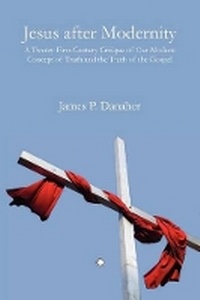
Jesus after Modernity
A Twenty-First-Century Critique of Our Modern Concept of Truth and the Truth of the Gospel
Published on 31. May 2012
Book
Paperback/Softback
156 pages
978-0-227-68001-8 (ISBN)
Description
During the seventeenth and eighteenth centuries, modern thinkers came to believe that our notion of truth should be objective, certain, and precise. Mathematics became the model for how truth should be conceptualized, and we sought to eliminate ideas that were vague, ambiguous, or contradictory. The teachings of Jesus, however, are often vague, ambiguous, and even contradictory. Fortunately, a twenty-first century understanding of the human condition has debunked the modern notion of truth, showing it to be truncated at best.
We are now free to rethink our notion of truth in a way that is compatible with the things that Jesus said and did, and equally compatible with what we now know to be our access to truth given the limits of our human condition. This volume sets out to explore these issues in depth and examine what it might mean for us to speak of the truth of the Gospel in a twenty-first century context.
We are now free to rethink our notion of truth in a way that is compatible with the things that Jesus said and did, and equally compatible with what we now know to be our access to truth given the limits of our human condition. This volume sets out to explore these issues in depth and examine what it might mean for us to speak of the truth of the Gospel in a twenty-first century context.
Reviews / Votes
'...the distinction he makes between an unattainable and objective certainty in the gospels and the gospel as a faith-filled journey is epistemologically stimulating. [...]Danaher's book is thought-provoking and profoundly positive.'Ben D. Craver, Reviews in Religion and Theology, Vol.21, No.1, January 2014
"We in religion concentrate so much on what we know for certain, but there has always been too little self critique about 'How do we know what we think we know?' This clear and well-written book is both very honest and very helpful on the subject. No one will lose their faith here -- perhaps many will find it for the first time! I am happy someone has written this much-needed book, and I hope it is used in classrooms, by many seekers, and in the churches."
Richard Rohr OFM, Center for Action and Contemplation
"...there are many Christians for whom this is just the book to start them on a journey away from simplistic biblical fundamentalisms and towards a humbler, more realistic understanding of how we can relate to Jesus."
Jonathan Clatworthy, in Modern Believing, Vol 53, Issue 1
"... a helpful introduction to postmodern engagement of Scripture and Christian life."
Nicholas Daniels, Regent University, in Theological Book Review , Vol 25, No 1
"Jesus after Modernity is an accessible and thought-provoking book, which attempts to bridge the disciplines of philosophy and theology...Much of this short book is written in an engaging style, with no dense footnotes to deter the non-academic reader. Yet, it manages to draw upon various significant thinkers (including Plato, Aristotle, Augustine, Aquinas, Descartes, Kant, Hegel, and Heidegger) in an accessible way."
Jonathan Burroughs, Irish Theological Quarterly, August 2015
More details
Language
English
Place of publication
Cambridge
United Kingdom
Target group
College/higher education
Dimensions
Height: 229 mm
Width: 153 mm
Weight
244 gr
ISBN-13
978-0-227-68001-8 (9780227680018)
Copyright in bibliographic data and cover images is held by Nielsen Book Services Limited or by the publishers or by their respective licensors: all rights reserved.
Schweitzer Classification
Other editions
Additional editions

James P. Danaher
Jesus after Modernity
A Twenty-First-Century Critique of Our Modern Concept of Truth and the Truth of the Gospel
E-Book
05/2012
James Clarke & Co Ltd
€16.99
Available for download
Person
James P. Danaher is Professor of Philosophy and Head of the Philosophy Department at Nyack College. He is the author of Eyes that See, Ears that Hear: Perceiving Jesus in a Postmodern Context (2006), and Postmodern Christianity and the Reconstruction of the Christian Mind (2001).
Content
Preface
Acknowledgments
1 Introduction
2 Objectivity
3 A Phenomenal Understanding
4 The Phenomenal Nature of Spiritual Experience
5 The Quest for Certainty
6 A Mechanical Universe
7 The Nature of the Gospel Journey
8 Modern Reason
9 The Other Logic
10 Reasoning about God
11 The Gospel after Modernity
12 Understanding Our God Experiences
Bibliography
Index
Acknowledgments
1 Introduction
2 Objectivity
3 A Phenomenal Understanding
4 The Phenomenal Nature of Spiritual Experience
5 The Quest for Certainty
6 A Mechanical Universe
7 The Nature of the Gospel Journey
8 Modern Reason
9 The Other Logic
10 Reasoning about God
11 The Gospel after Modernity
12 Understanding Our God Experiences
Bibliography
Index