

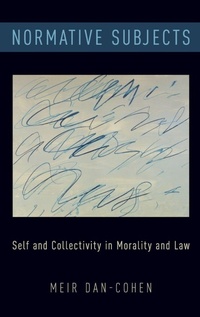
Normative Subjects
Self and Collectivity in Morality and Law
Published on 30. August 2016
Book
Hardback
272 pages
978-0-19-998520-3 (ISBN)
Description
Normative Subjects alludes to the fields of morality and law, as well as to the entities, self and collectivity, addressed by these clusters of norms. The book explores connections between the two. The conception of self that informs this book is the joint product of two multifaceted philosophical strands, the constructivist and the hermeneutical. Various schools of thought view human beings as self creating: by pursuing our goals and promoting our projects,
and so while abiding by the various norms that guide us in these endeavors, we also determine human identity. The result is an emphasis on a reciprocal relationship between law and morality on the one side and the composition and boundaries of the self on the other.
In what medium does this self creation take place, and who exactly is the "we " engaged in it? The answer suggested by the hermeneutical tradition provides the book with its second main theme. Like plays and novels, human beings are constituted by meaning, and these meanings vary in their level of abstraction. Self creation is a matter of fixing and elaborating these meanings at different levels of abstraction: the individual, the collective, and the universal. A key implication of this
picture, explored in the book, is a conception of human dignity as accruing to us qua authors of the values and norms by which we define our selves individually and collectively.
and so while abiding by the various norms that guide us in these endeavors, we also determine human identity. The result is an emphasis on a reciprocal relationship between law and morality on the one side and the composition and boundaries of the self on the other.
In what medium does this self creation take place, and who exactly is the "we " engaged in it? The answer suggested by the hermeneutical tradition provides the book with its second main theme. Like plays and novels, human beings are constituted by meaning, and these meanings vary in their level of abstraction. Self creation is a matter of fixing and elaborating these meanings at different levels of abstraction: the individual, the collective, and the universal. A key implication of this
picture, explored in the book, is a conception of human dignity as accruing to us qua authors of the values and norms by which we define our selves individually and collectively.
Reviews / Votes
Meir Dan-Cohen's book is challenging and philosophically rich in all the best ways. Its more ethereal Kantian aspects are leavened by his lawyerly knowledge, and its sensible humanism is deepened by his capacity for trenchant philosophical analysis. One hopes that its essays will provide opportunities for careful critique and its book-like qualities will invite ambitious philosophical theory constructors in years to come. * Benjamin C. Zipursky, Notre Dame Philosophical Reviews *More details
Other editions
Additional editions
E-Book
08/2016
1st Edition
OUP eBook
€19.99
Available for download
E-Book
08/2016
1st Edition
OUP eBook
€16.49
Available for download
Person
Meir Dan-Cohen is Milo Reese Robbins Chair in Legal Ethics, School of Law and Affiliated Professor, Department of Philosophy, at the University of California, Berkeley. He is the author of Harmful Thoughts: Essays on Law, Self and Morality (2002).