

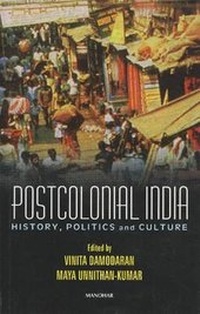
Post Colonial India
History, Politics & Culture
Published on 1. January 2000
Book
Hardback
376 pages
978-81-7304-381-9 (ISBN)
Description
This book surveys and analyses the economic, political and cultural changes which have taken place in India since its Independence. It explores some of the defining moments in the history of post-colonial India, and brings together recent works of scholars of different disciplines to provide dynamic new insights into the half-century since Independence. The effects of decolonisation, modernisation, and industrialisation are given special attention, particularly in relation to the impacts felt by women and minorities both in the country and the city. The colossal effects of state projects on the environment are also considered. An important focus of the papers is examining the discourses of modernity and the state and the effects they have had on shifting notions of identity. India is today faced with a crisis in the attempts made by the government to accommodate global capitalism in a highly traditional society. Papers in this volume underline two aspects of the current crisis; the deeply worrying failure of liberalisation to stem poverty, and the equally dangerous climate of hostility to secularism. However, the work presented here tries to suggest some possible paths away from the predicaments of communalism and mass poverty.
More details
Language
English
Place of publication
New Delhi
India
Target group
College/higher education
Professional and scholarly
Dimensions
Height: 225 mm
Width: 145 mm
Weight
626 gr
ISBN-13
978-81-7304-381-9 (9788173043819)
Copyright in bibliographic data and cover images is held by Nielsen Book Services Limited or by the publishers or by their respective licensors: all rights reserved.
Schweitzer Classification
Persons
Vinita Damodaran is a Lecturer in South Asian History at the University of Sussex in England. She is a specialist on the history of ethnicity, nationalism and environmental change and culture. Her past publications include: Broken Promises: Popular Protest, Indian Nationalism and the Congress Party in Bihar 1935-46 and Nature and the Orient: The Environmental History of South and Southeast Asia. Maya Unnithan-Kumar is a Lecturer in Social Anthropology at the University of Sussex. Her major monograph to date has been Identity, Gender and Poverty: New Perspectives on Caste and Tribe in Rajasthan. Her current research is in the field of medical anthropology, and she has published many articles on the anthropology of reproduction and health policy.
Content
Preface; Emerging Perspectives on Postcolonial India; Children of a Lesser God: Experiences of Partition; Gandhis Swaraj or Hindu Raj?: The Making of the Post-Independence Policy; Nation & Identity in the Narratives of Partition; The State & Democracy in India; Scheduled Caste, Dalit & the Bahujan: Political Mobilization & Electoral Politics among the Former Untouchables & the Case of Uttar Pradesh; Women, Islam & Nationhood in Hyderabad; Poverty & Public Policy in India since Independence; Indias Adjustment Experience 1991 to 1999; Participation or Empowerment of the Rural Poor: The Case of the Panchayats in India; The State & Womens Empowerment in Rajasthan: A Historical Perspective; Women Facing Submergence: Displacement & Resistance in the Narmada Valley; Architecture & Anxiety: The Problem of Pastiche in Recent Indian Design; Indian Art Today; Indian Cinema: A Perspective by Shyam Benegal; Miraculous Realities: Postcolonial Identity & the Limits of Form in the Work of Salman Rushdie & Intizar Husain; Downsizing the Nation: Divided Identities in Postcolonial India; Bibliography; Index.