

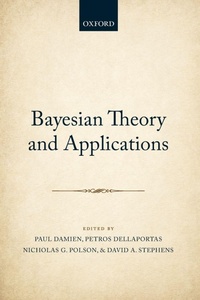
Bayesian Theory and Applications
Published on 26. February 2015
Book
Paperback/Softback
718 pages
978-0-19-873907-4 (ISBN)
Description
The development of hierarchical models and Markov chain Monte Carlo (MCMC) techniques forms one of the most profound advances in Bayesian analysis since the 1970s and provides the basis for advances in virtually all areas of applied and theoretical Bayesian statistics.
This volume guides the reader along a statistical journey that begins with the basic structure of Bayesian theory, and then provides details on most of the past and present advances in this field. The book has a unique format. There is an explanatory chapter devoted to each conceptual advance followed by journal-style chapters that provide applications or further advances on the concept.
Thus, the volume is both a textbook and a compendium of papers covering a vast range of topics. It is appropriate for a well-informed novice interested in understanding the basic approach, methods and recent applications. Because of its advanced chapters and recent work, it is also appropriate for a more mature reader interested in recent applications and developments, and who may be looking for ideas that could spawn new research.
Hence, the audience for this unique book would likely include academicians/practitioners, and could likely be required reading for undergraduate and graduate students in statistics, medicine, engineering, scientific computation, business, psychology, bio-informatics, computational physics, graphical models, neural networks, geosciences, and public policy.
The book honours the contributions of Sir Adrian F. M. Smith, one of the seminal Bayesian researchers, with his papers on hierarchical models, sequential Monte Carlo, and Markov chain Monte Carlo and his mentoring of numerous graduate students -the chapters are authored by prominent statisticians influenced by him.
Bayesian Theory and Applications should serve the dual purpose of a reference book, and a textbook in Bayesian Statistics.
This volume guides the reader along a statistical journey that begins with the basic structure of Bayesian theory, and then provides details on most of the past and present advances in this field. The book has a unique format. There is an explanatory chapter devoted to each conceptual advance followed by journal-style chapters that provide applications or further advances on the concept.
Thus, the volume is both a textbook and a compendium of papers covering a vast range of topics. It is appropriate for a well-informed novice interested in understanding the basic approach, methods and recent applications. Because of its advanced chapters and recent work, it is also appropriate for a more mature reader interested in recent applications and developments, and who may be looking for ideas that could spawn new research.
Hence, the audience for this unique book would likely include academicians/practitioners, and could likely be required reading for undergraduate and graduate students in statistics, medicine, engineering, scientific computation, business, psychology, bio-informatics, computational physics, graphical models, neural networks, geosciences, and public policy.
The book honours the contributions of Sir Adrian F. M. Smith, one of the seminal Bayesian researchers, with his papers on hierarchical models, sequential Monte Carlo, and Markov chain Monte Carlo and his mentoring of numerous graduate students -the chapters are authored by prominent statisticians influenced by him.
Bayesian Theory and Applications should serve the dual purpose of a reference book, and a textbook in Bayesian Statistics.
More details
Language
English
Place of publication
Oxford
United Kingdom
Target group
College/higher education
Professional and scholarly
Illustrations
121 b/w line drawings & 21 b/w halftones
Dimensions
Height: 234 mm
Width: 156 mm
Thickness: 38 mm
Weight
1071 gr
ISBN-13
978-0-19-873907-4 (9780198739074)
Copyright in bibliographic data and cover images is held by Nielsen Book Services Limited or by the publishers or by their respective licensors: all rights reserved.
Schweitzer Classification
Persons
Paul Damien is a Professor at the McCombs School of Business, University of Texas in Austin.
Petros Dellaportas is a Professor at the Athens University of Economics and Business.
Nicholas G Polson is Professor of Econometrics and Statistics at Chicago Booth, University of Chicago.
David M Stephens is a Professor in the Department of Mathematics and Statistics at McGill University, Canada.
Petros Dellaportas is a Professor at the Athens University of Economics and Business.
Nicholas G Polson is Professor of Econometrics and Statistics at Chicago Booth, University of Chicago.
David M Stephens is a Professor in the Department of Mathematics and Statistics at McGill University, Canada.
Content
I EXCHANGEABILITY; II HIERARCHICAL MODELS; III MARKOV CHAIN MONTE CARLO; IV DYNAMIC MODELS; V SEQUENTIAL MONTE CARLO; VI NONPARAMETRICS; VII SPLINE MODELS AND COPULAS; VIII MODEL ELABORATION AND PRIOR DISTRIBUTIONS; IX REGRESSIONS AND MODEL AVERAGING; X FINANCE AND ACTUARIAL SCIENCE; XI MEDICINE AND BIOSTATISTICS; XII INVERSE PROBLEMS AND APPLICATIONS