

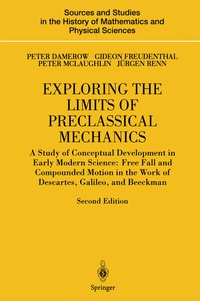
Exploring the Limits of Preclassical Mechanics
A Study of Conceptual Development in Early Modern Science: Free Fall and Compounded Motion in the Work of Descartes, Galileo and Beeckman
2nd Edition
Published on 9. October 2011
Book
Paperback/Softback
XX, 414 pages
978-1-4419-1917-5 (ISBN)
Description
The question of when and how the basic concepts that characterize modern science arose in Western Europe has long been central to the history of science. This book examines the transition from Renaissance engineering and philosophy of nature to classical mechanics oriented on the central concept of velocity. For this new edition, the authors include a new discussion of the doctrine of proportions, an analysis of the role of traditional statics in the construction of Descartes' impact rules, and go deeper into the debate between Descartes and Hobbes on the explanation of refraction. They also provide significant new material on the early development of Galileo's work on mechanics and the law of fall.
More details
Series
Edition
Second Edition 2004
Language
English
Place of publication
New York
United States
Target group
Professional and scholarly
Research
Illustrations
38 s/w Abbildungen
XX, 414 p. 38 illus.
Dimensions
Height: 235 mm
Width: 155 mm
Thickness: 24 mm
Weight
657 gr
ISBN-13
978-1-4419-1917-5 (9781441919175)
DOI
10.1007/978-1-4757-3992-3
Schweitzer Classification
Other editions
Additional editions
Peter Damerow | Gideon Freudenthal | Peter McLaughlin
Exploring the Limits of Preclassical Mechanics
A Study of Conceptual Development in Early Modern Science: Free Fall and Compounded Motion in the Work of Descartes, Galileo and Beeckman
Book
03/2004
2nd Edition
Springer
€149.79
Shipment within 5-7 days
Content
1: Concept and Inference: Descartes and Beeckman on the Fall of Bodies.- 2: Conservation and Contrariety: The Logical Foundations of Cartesian Physics.- 3: Proofs and Paradoxes: Free Fall and Projectile Motion in Galileo's Physics.- 4. Epilogue.- 5. Documents.- Index locorum.