

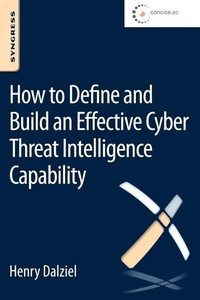
How to Define and Build an Effective Cyber Threat Intelligence Capability
Published on 9. January 2015
Book
Paperback/Softback
42 pages
978-0-12-802730-1 (ISBN)
Description
Intelligence-Led Security: How to Understand, Justify and Implement a New Approach to Security is a concise review of the concept of Intelligence-Led Security. Protecting a business, including its information and intellectual property, physical infrastructure, employees, and reputation, has become increasingly difficult. Online threats come from all sides: internal leaks and external adversaries; domestic hacktivists and overseas cybercrime syndicates; targeted threats and mass attacks. And these threats run the gamut from targeted to indiscriminate to entirely accidental.
Among thought leaders and advanced organizations, the consensus is now clear. Defensive security measures: antivirus software, firewalls, and other technical controls and post-attack mitigation strategies are no longer sufficient. To adequately protect company assets and ensure business continuity, organizations must be more proactive. Increasingly, this proactive stance is being summarized by the phrase Intelligence-Led Security: the use of data to gain insight into what can happen, who is likely to be involved, how they are likely to attack and, if possible, to predict when attacks are likely to come. In this book, the authors review the current threat-scape and why it requires this new approach, offer a clarifying definition of what Cyber Threat Intelligence is, describe how to communicate its value to business, and lay out concrete steps toward implementing Intelligence-Led Security.
Among thought leaders and advanced organizations, the consensus is now clear. Defensive security measures: antivirus software, firewalls, and other technical controls and post-attack mitigation strategies are no longer sufficient. To adequately protect company assets and ensure business continuity, organizations must be more proactive. Increasingly, this proactive stance is being summarized by the phrase Intelligence-Led Security: the use of data to gain insight into what can happen, who is likely to be involved, how they are likely to attack and, if possible, to predict when attacks are likely to come. In this book, the authors review the current threat-scape and why it requires this new approach, offer a clarifying definition of what Cyber Threat Intelligence is, describe how to communicate its value to business, and lay out concrete steps toward implementing Intelligence-Led Security.
More details
Language
English
Place of publication
Rockland, MA
United States
Target group
Professional and scholarly
Product notice
Paperback (trade)
Unsewn / adhesive bound
Dimensions
Height: 228 mm
Width: 153 mm
Thickness: 15 mm
Weight
102 gr
ISBN-13
978-0-12-802730-1 (9780128027301)
Copyright in bibliographic data and cover images is held by Nielsen Book Services Limited or by the publishers or by their respective licensors: all rights reserved.
Schweitzer Classification
Other editions
Additional editions
Henry Dalziel | Eric Olson | James Carnall
How to Define and Build an Effective Cyber Threat Intelligence Capability
E-Book
12/2014
Syngress
€31.95
Available for download
Persons
Henry Dalziel is a serial education entrepreneur, founder of Concise Ac Ltd, online cybersecurity blogger and e-book author. He writes for the Concise-Courses.com blog and has developed numerous cybersecurity continuing education courses and books. Concise Ac Ltd develops and distributes continuing education content [books and courses] for cybersecurity professionals seeking skill enhancement and career advancement. The company was recently accepted onto the UK Trade & Investment's (UKTI) Global Entrepreneur Programme (GEP). Eric Olson is Vice President, Product Strategy at Cyveillance, where he is responsible for the management of Cyveillance's entire portfolio of Enterprise and OEM services. He oversees new product development, messaging and positioning, pricing strategy and profitability for each service line. James Carnall is Vice President, Cyber Intelligence Division at Cyveillance, where he is responsible for Brand Protection, Cyber Security and Anti-Phishing services. James also manages our Cyber Intelligence Analyst team and security as well as our Global Intelligence and Legal Advisory teams.
Content
Chapter 1: Introduction
Chapter 2: A Problem Well-Defined is Half-Solved
Chapter 3: Defining Business Objectives ("Start With Why")
Chapter 4: Common Objectives of a Threat Intelligence Program
Chapter 5: Translating Objectives in Needs ("Why DRIVES What")
Chapter 6: How Technology Models Operationalize Threat Data
Chapter 7: Who You Can Ask Where to Get It
Chapter 8: Conclusion and Recap
Chapter 2: A Problem Well-Defined is Half-Solved
Chapter 3: Defining Business Objectives ("Start With Why")
Chapter 4: Common Objectives of a Threat Intelligence Program
Chapter 5: Translating Objectives in Needs ("Why DRIVES What")
Chapter 6: How Technology Models Operationalize Threat Data
Chapter 7: Who You Can Ask Where to Get It
Chapter 8: Conclusion and Recap