

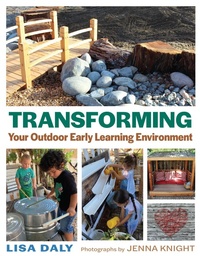
Transforming Your Outdoor Early Learning Environment
Description
Transforming Your Outdoor Early Learning Environment invites center and home-based educators to reimagine and reconstruct their image of conventional children’s play yards as they know them and to create beautiful outdoor learning spaces on a limited budget with natural elements and loose parts that offer children opportunity for irresistible engaging explorations.
Ideas, inspiration, and benefits for changing outdoor environments are provided along with the basics for designing, transforming, and maintaining 11 specific outdoor play zones.
Transforming Your Outdoor Early Learning Environment offers an approach that:
- Requires minimal financial resources
- Features loose parts and upcycled materials
- Integrates nature
- Includes inspiring photos of before and after transformations
- Offers design tips and material lists
- Describes how play in each area fosters children’s competencies, development, and learning in the areas of social and emotional, language and communication, cognitive, physical, and expressive arts
More details
Person
Lisa Daly is passionate about transforming early learning to deepen meaningful experiences and connections, innovation, creativity, and reflection. Her professional work is centered around collaborating with educators to shift teaching approaches and transform learning environments to support children's identities, inquiry, and engagement. Lisa is professor emerita of early childhood education at Folsom Lake College, a child and family advocate, author, consultant, and presenter. Lisa has over 40 years of service as a classroom educator and administrator in preschool, parent co-operative, and college lab settings. She has co-authored Early Learning Theories Made Visible and the award-winning Loose Parts series with Redleaf Press.
Content
- Introduction of Transforming Outdoor Learning Environments
- Chapter 1 The What, Why, and How of Transforming Outdoor Learning Environments
- Chapter 2 Art Studios
- Chapter 3 Clay Studios
- Chapter 4 Sound Gardens
- Chapter 5 Mud Kitchens
- Chapter 6 Small Worlds
- Chapter 7 Cozy Areas and Hiding Places
- Chapter 8 Construction Areas
- Chapter 9 Trajectory Areas
- Chapter 10 Sand Areas
- Chapter 11 Water Areas
- Chapter 12 Large Motor Areas
- Chapter 13 Non-Mobile Infant Areas
- Appendices
- References