

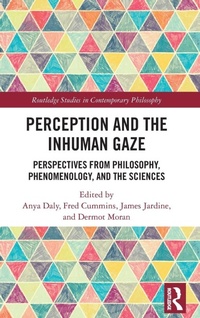
Perception and the Inhuman Gaze
Perspectives from Philosophy, Phenomenology, and the Sciences
1st Edition
Published on 6. July 2020
Book
Hardback
348 pages
978-0-367-40562-5 (ISBN)
Description
The diverse essays in this volume speak to the relevance of phenomenological and psychological questioning regarding perceptions of the human. This designation, human, can be used beyond the mere identification of a species to underwrite exclusion, denigration, dehumanization and demonization, and to set up a pervasive opposition in Othering all deemed inhuman, nonhuman, or posthuman. As alerted to by Merleau-Ponty, one crucial key for a deeper understanding of these issues is consideration of the nature and scope of perception. Perception defines the world of the perceiver, and perceptual capacities are constituted in engagement with the world - there is co-determination. Moreover, the distinct phenomenology of perception in the spectatorial mode in contrast to the reciprocal mode, deepens the intersubjective and ethical dimensions of such investigations.
Questions motivating the essays include: Can objectification and an inhuman gaze serve positive ends? If so, under what constraints and conditions? How is an inhuman gaze achieved and at what cost? How might the emerging insights of the role of perception into our interdependencies and essential sociality from various domains challenge not only theoretical frameworks, but also the practices and institutions of science, medicine, psychiatry and justice? What can we learn from atypical social cognition, psychopathology and animal cognition? Could distortions within the gazer's emotional responsiveness and habituated aspects of social interaction play a role in the emergence of an inhuman gaze?
Perception and the Inhuman Gaze will interest scholars and advanced students working in phenomenology, philosophy of mind, psychology, psychiatry, sociology and social cognition.
Questions motivating the essays include: Can objectification and an inhuman gaze serve positive ends? If so, under what constraints and conditions? How is an inhuman gaze achieved and at what cost? How might the emerging insights of the role of perception into our interdependencies and essential sociality from various domains challenge not only theoretical frameworks, but also the practices and institutions of science, medicine, psychiatry and justice? What can we learn from atypical social cognition, psychopathology and animal cognition? Could distortions within the gazer's emotional responsiveness and habituated aspects of social interaction play a role in the emergence of an inhuman gaze?
Perception and the Inhuman Gaze will interest scholars and advanced students working in phenomenology, philosophy of mind, psychology, psychiatry, sociology and social cognition.
Reviews / Votes
"This volume brings together diverse areas of philosophical and interdisciplinary research around the richly ambiguous theme of 'the inhuman gaze,' which raises fruitful questions concerning the status of the transcendental subject in phenomenology, the nature of embodiment and perception, our understanding of psychopathology, the meaning of objectivity, and our ethical relationships to others like and unlike ourselves. It is a timely and exciting volume of essays with both a compelling focus and an impressive scope." - Laura McMahon, Eastern Michigan University, USAMore details
Series
Language
English
Place of publication
London
United Kingdom
Publishing group
Taylor & Francis Ltd
Target group
College/higher education
Illustrations
12 s/w Abbildungen, 7 s/w Photographien bzw. Rasterbilder, 2 s/w Zeichnungen, 3 s/w Tabellen
3 Tables, black and white; 2 Line drawings, black and white; 7 Halftones, black and white; 12 Illustrations, black and white
Dimensions
Height: 235 mm
Width: 157 mm
Thickness: 24 mm
Weight
675 gr
ISBN-13
978-0-367-40562-5 (9780367405625)
Copyright in bibliographic data and cover images is held by Nielsen Book Services Limited or by the publishers or by their respective licensors: all rights reserved.
Schweitzer Classification
Other editions
Additional editions
Anya Daly | Fred Cummins | James Jardine
Perception and the Inhuman Gaze
Perspectives from Philosophy, Phenomenology, and the Sciences
Book
08/2022
1st Edition
Routledge
€68.50
Shipment within 15-20 days
Anya Daly | Fred Cummins | James Jardine
Perception and the Inhuman Gaze
Perspectives from Philosophy, Phenomenology, and the Sciences
E-Book
06/2020
1st Edition
Routledge
€60.49
Available for download
Anya Daly | Fred Cummins | James Jardine
Perception and the Inhuman Gaze
Perspectives from Philosophy, Phenomenology, and the Sciences
E-Book
06/2020
1st Edition
Routledge
€60.49
Available for download
Persons
Anya Daly is Honorary Fellow at the University of Melbourne, Australia and a former IRC Fellow at University College Dublin, Ireland.
Fred Cummins is Associate Professor of Cognitive Science in the School of Computer Science at University College Dublin, Ireland.
James Jardine is Postdoctoral Fellow at the University of Jyvaeskylae, Finland and a former IRC Fellow at University College Dublin, Ireland.
Dermot Moran is the inaugural holder of the Joseph Chair in Catholic Philosophy at Boston College, USA and Full Professor of Philosophy at University College Dublin, Ireland.
Fred Cummins is Associate Professor of Cognitive Science in the School of Computer Science at University College Dublin, Ireland.
James Jardine is Postdoctoral Fellow at the University of Jyvaeskylae, Finland and a former IRC Fellow at University College Dublin, Ireland.
Dermot Moran is the inaugural holder of the Joseph Chair in Catholic Philosophy at Boston College, USA and Full Professor of Philosophy at University College Dublin, Ireland.
Content
Introduction
Part I. The Gaze in Classical Phenomenology: Perspectives on Objectification
1. Defending the Objective Gaze as a Self-transcending Capacity of Human Subjects
Dermot Moran
2. Two Orders of Bodily Objectification: The Look and the Touch
Sara Heinaemaa
3. On Eliminativism's Transient Gaze
Timothy Mooney
4. Not wholly human. Reading Maurice Merleau-Ponty with Jacques Lacan.
Dorothee Legrand
5. Disclosure and the Gendered Gaze in Simone de Beauvoir's Ethics
Christinia Landry
Part II. Vision, Perception and Gazes
6. Inside the gaze
Shaun Gallagher
7. Perception and its Objects.
Maurita Harney
8. Technological Gaze: Understanding How Technologies Transform Perception
Richard Lewis
9. The Inhuman Gaze and Perceptual Gestalts: The Making and Unmaking of Others and Worlds
Anya Daly
Part III. Psychiatry, Psychopathology and Inhuman Gazes
10. Values and Values-based Practice in Psychopathology: Combining Analytic and Phenomenological Approaches
G Stanghellini and K.W.M. (Bill) Fulford
11. The Inhuman and Human Gaze in Psychiatry, Psychopathology and Schizophrenia.
Matthew Broome
12. Overcoming the Gaze: Psychopathology, Affect, and Narrative.
Anna Bortolan
13. From excess to exhaustion : The rise of burnout in a post-modern achievement society.
Philippe Wuyts
14. Blackout Rages: The Inhibition of Episodic Memory in Extreme Berserker Episodes
John Protevi
Part IV. Beyond the Human: Divine, Posthuman and Animal Gazes
15. Wondering at the Inhuman Gaze
Sean. D. Kelly
16. What Counts as Human/ Inhuman Right Now?
Rosi Braidotti
17. Beyond Human and Animal: Metamorphosis in Merleau-Ponty
Dylan Trigg
Part V. Sociality and Boundaries of the Human
18. Voice and gaze considered together in 'languaging'.
Fred Cummins
19. Ethics Beyond the Human: Disability and The Inhuman
Jonathan Mitchell
20. Social Invisibility and Emotional Blindness
James Jardine
21. What are you looking at? Dissonance as a window on the autonomy of participatory sense-making frames.
Mark James
Part I. The Gaze in Classical Phenomenology: Perspectives on Objectification
1. Defending the Objective Gaze as a Self-transcending Capacity of Human Subjects
Dermot Moran
2. Two Orders of Bodily Objectification: The Look and the Touch
Sara Heinaemaa
3. On Eliminativism's Transient Gaze
Timothy Mooney
4. Not wholly human. Reading Maurice Merleau-Ponty with Jacques Lacan.
Dorothee Legrand
5. Disclosure and the Gendered Gaze in Simone de Beauvoir's Ethics
Christinia Landry
Part II. Vision, Perception and Gazes
6. Inside the gaze
Shaun Gallagher
7. Perception and its Objects.
Maurita Harney
8. Technological Gaze: Understanding How Technologies Transform Perception
Richard Lewis
9. The Inhuman Gaze and Perceptual Gestalts: The Making and Unmaking of Others and Worlds
Anya Daly
Part III. Psychiatry, Psychopathology and Inhuman Gazes
10. Values and Values-based Practice in Psychopathology: Combining Analytic and Phenomenological Approaches
G Stanghellini and K.W.M. (Bill) Fulford
11. The Inhuman and Human Gaze in Psychiatry, Psychopathology and Schizophrenia.
Matthew Broome
12. Overcoming the Gaze: Psychopathology, Affect, and Narrative.
Anna Bortolan
13. From excess to exhaustion : The rise of burnout in a post-modern achievement society.
Philippe Wuyts
14. Blackout Rages: The Inhibition of Episodic Memory in Extreme Berserker Episodes
John Protevi
Part IV. Beyond the Human: Divine, Posthuman and Animal Gazes
15. Wondering at the Inhuman Gaze
Sean. D. Kelly
16. What Counts as Human/ Inhuman Right Now?
Rosi Braidotti
17. Beyond Human and Animal: Metamorphosis in Merleau-Ponty
Dylan Trigg
Part V. Sociality and Boundaries of the Human
18. Voice and gaze considered together in 'languaging'.
Fred Cummins
19. Ethics Beyond the Human: Disability and The Inhuman
Jonathan Mitchell
20. Social Invisibility and Emotional Blindness
James Jardine
21. What are you looking at? Dissonance as a window on the autonomy of participatory sense-making frames.
Mark James