

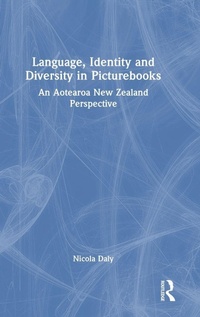
Language, Identity and Diversity in Picturebooks
An Aotearoa New Zealand Perspective
1st Edition
Published on 28. October 2024
Book
Hardback
130 pages
978-1-032-53404-6 (ISBN)
Description
This book presents a range of perspectives on the way language, diversity, and identity are reflected in New Zealand children's literature, based on the published research of Nicola Daly, an associate professor in the Division of Education of the University of Waikato, and her colleagues.
The book is organised into two sections. The first section examines the use of Te Reo Maori and English in the text of New Zealand picturebooks, exploring the linguistic landscape of Maori-English bilingual picturebooks. The second section, The Pedagogical Potential of Picturebooks, explores how picturebooks featuring Maori, English, New Zealand Sign Language (NZSL), and Pacific languages reflect identity and support diversity in society. Research from several educational contexts, ranging from kindergarten to university, where picturebooks are used to support learning language and learning about language is also discussed. Themes of language, identity, and diversity are explored throughout the two sections and brought together in the concluding chapter's discussion of the power of picturebooks.
This book will be of interest to scholars in children's literature and education; it may also be relevant to scholars in linguistics library and information studies, cultural studies, and media and communication studies.
The book is organised into two sections. The first section examines the use of Te Reo Maori and English in the text of New Zealand picturebooks, exploring the linguistic landscape of Maori-English bilingual picturebooks. The second section, The Pedagogical Potential of Picturebooks, explores how picturebooks featuring Maori, English, New Zealand Sign Language (NZSL), and Pacific languages reflect identity and support diversity in society. Research from several educational contexts, ranging from kindergarten to university, where picturebooks are used to support learning language and learning about language is also discussed. Themes of language, identity, and diversity are explored throughout the two sections and brought together in the concluding chapter's discussion of the power of picturebooks.
This book will be of interest to scholars in children's literature and education; it may also be relevant to scholars in linguistics library and information studies, cultural studies, and media and communication studies.
More details
Language
English
Place of publication
London
United Kingdom
Publishing group
Taylor & Francis Ltd
Target group
College/higher education
Professional and scholarly
Academic, Postgraduate, and Undergraduate Advanced
Illustrations
3 s/w Tabellen, 12 s/w Abbildungen, 12 s/w Photographien bzw. Rasterbilder
3 Tables, black and white; 12 Halftones, black and white; 12 Illustrations, black and white
Dimensions
Height: 240 mm
Width: 161 mm
Thickness: 12 mm
Weight
385 gr
ISBN-13
978-1-032-53404-6 (9781032534046)
Copyright in bibliographic data and cover images is held by Nielsen Book Services Limited or by the publishers or by their respective licensors: all rights reserved.
Schweitzer Classification
Other editions
Additional editions
E-Book
10/2024
1st Edition
Routledge
€51.49
Available for download
Book
10/2024
1st Edition
Routledge
€60.50
Shipment within 10-20 days
E-Book
10/2024
1st Edition
Routledge
€51.49
Available for download
Person
Nicola Daly is a sociolinguist and associate professor in the Division of Education, University of Waikato, where she teaches children's literature. Her research focus is multilingual picturebooks and their role in perpetuating and challenging language attitudes. She was a Fulbright New Zealand Scholar at the University of Arizona, USA, 2019/2020.
Content
Tahi- 1. He Timatatanga- Introduction. Part 1. Linguistic Landscapes and Language Hierarchies. Rua- 2. Nga kupu-Words. Toru- 3. Nga Reo-Languages. Wha- 4. Linguistic Landscapes and Language Hierarchies. Part 2. The Pedagogical Potential of Picturebooks. Rima- 5. Supporting Identity and Diversity. Ono- 6. Dual language Picturebooks and Adults. Whitu. 7. Dual language Picturebooks and Children. Waru- 8. He Mutunga-A Conclusion. References