

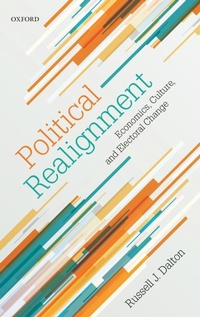
Political Realignment
Economics, Culture, and Electoral Change
Published on 31. October 2018
Book
Hardback
286 pages
978-0-19-883098-6 (ISBN)
Description
The process of electoral change is accelerating in contemporary democracies, and this book explains why. The emergence of Green parties in the 1980s and recent far right parties, Brexit and Trump's 2016 victory are parts of this overall process.
Political Realignment tracks the evolution of citizen and elite opinions on economic and cultural issues from the 1970s to the 2010s-and the impact of these changes on electoral politics and public policy. Citizen positions on these cleavages have realigned over time, producing a similar realignment in the structure of the party systems to represent these demands. Economic issues remain important, now joined by divisions on cultural issues as a backlash to modernization. Assembling an unprecedented time series of empirical evidence, this study explains the new forces of elector change in both Europe and the United States.
Political Realignment tracks the evolution of citizen and elite opinions on economic and cultural issues from the 1970s to the 2010s-and the impact of these changes on electoral politics and public policy. Citizen positions on these cleavages have realigned over time, producing a similar realignment in the structure of the party systems to represent these demands. Economic issues remain important, now joined by divisions on cultural issues as a backlash to modernization. Assembling an unprecedented time series of empirical evidence, this study explains the new forces of elector change in both Europe and the United States.
Reviews / Votes
... an extremely innovative approach...brings new perspectives to an important debate in contemporary political science...a fundamental work for anyone wishing to understand the dilemmas faced by democracies in an increasingly complex and pluralized world. * Julian Borba, Universidade Federal de Santa Catarina * This book should be read by scholars interested in learning about the deeper historical, social, and political forces that are triggering tectonic shifts in many governments party systems. * R. P. Seyb, Skidmore College *More details
Language
English
Place of publication
Oxford
United Kingdom
Target group
Professional and scholarly
Dimensions
Height: 240 mm
Width: 161 mm
Thickness: 20 mm
Weight
599 gr
ISBN-13
978-0-19-883098-6 (9780198830986)
Copyright in bibliographic data and cover images is held by Nielsen Book Services Limited or by the publishers or by their respective licensors: all rights reserved.
Schweitzer Classification
Other editions
Additional editions
E-Book
11/2018
1st Edition
OUP eBook
€31.49
Available for download
E-Book
10/2018
1st Edition
OUP eBook
€25.49
Available for download
Person
Russell Dalton is Research Professor of Political Science at the Centre for the Study of Democracy at UC Irvine. Dalton has been awarded a Fulbright Research Fellowship, Scholar-in-Residence at the Barbra Streisand Center, German Marshall Fund Research Fellowship, and the POSCO Fellowship at the East West Center in Hawaii. His research focuses on the role of citizens in the political process. Previous publications include The Participation Gap (OUP, 2017), Political Parties and Democratic Linkage: How Parties Organize Democracy (OUP, 2011), and Citizens, Context and Choice: How Context Shapes Citizens' Electoral Choices (OUP, 2011).
Content
Introduction
1: The Evolution of Political Competition
Social Structure and Political Cleavages
2: Citizens, Issues, and Political Cleavages
3: The Social Distribution of Cleavage Positions
4: Cleavage Patterns across Nations
5: Elites, Issues, and Political Cleavages
Political Cleavages and Party Alignments
6: Placing Parties in the Political Space
7: Voters and Parties
8: Congruence and Representation
9: The American Experience
Conclusion
10: Realignment and Beyond
Appendices
A: Issue Questions from the European Election Studies
B: Citizen Issue Structures by Nation
C: Identifying Party Positions
D: Party Cleavage Positions
E: Party Cleavage Polarization Scores
F: The Complexity of Measurement
G: Construction of Economic and Cultural Indices in the United States
1: The Evolution of Political Competition
Social Structure and Political Cleavages
2: Citizens, Issues, and Political Cleavages
3: The Social Distribution of Cleavage Positions
4: Cleavage Patterns across Nations
5: Elites, Issues, and Political Cleavages
Political Cleavages and Party Alignments
6: Placing Parties in the Political Space
7: Voters and Parties
8: Congruence and Representation
9: The American Experience
Conclusion
10: Realignment and Beyond
Appendices
A: Issue Questions from the European Election Studies
B: Citizen Issue Structures by Nation
C: Identifying Party Positions
D: Party Cleavage Positions
E: Party Cleavage Polarization Scores
F: The Complexity of Measurement
G: Construction of Economic and Cultural Indices in the United States