

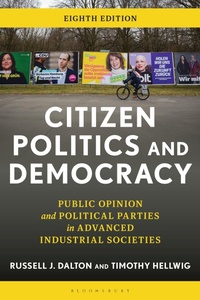
Citizen Politics and Democracy
Public Opinion and Political Parties in Advanced Industrial Societies
8th Edition
Will be published approx. on 9. July 2026
Book
Paperback/Softback
376 pages
979-8-8818-0032-1 (ISBN)
Description
Since its first edition in 1988, Citizen Politics has provided a concise examination of citizens' political behavior and politicians' responses in advanced industrial democracies. It communicates findings from state-of-the-art research on parties, public opinion, and voters in a way that is at once accessible and comprehensive. It argues that ordinary people do, in fact, have what it takes to meet the demands of their roles as citizens in representative democracies.
Informed by evidence from cross-national public opinion surveys, past editions of the book offered a tone of moderation-or perhaps guarded optimism-that leans against the more extreme, attention-grabbing approach of the 24-hour news cycle. The eighth edition will continue in this vein. The text will focus on opinion, voter choice, and political representation by comparing recent elections in the UK, France, Germany, and the United States. This four-nation comparison strikes the right balance between depth and breadth and does so in the space of 300 pages. The basic chapter structure will continue, with updated results from several new elections in each of the four core nations, new surveys, and new literature. This is essential to capture student and instructor interest.
This new edition will focus more on the contemporary challenges facing democracies and their citizens. The attack at the U.S. Capitol on January 6, 2021, brought to the fore how much democratic stability requires the consent of the governed and respect for established rules and norms by citizens and elites. This and other events have pushed researchers to revisit foundational questions about the role of the citizen in a democracy. One innovation is that the new edition will focus more on how citizens' participation, values, opinions, and assessments contribute to how democracy does (or does not) work. Thus, we will rebrand the eighth edition as Citizen Politics and Democracy, to emphasize both continuity and change in mass politics.
Informed by evidence from cross-national public opinion surveys, past editions of the book offered a tone of moderation-or perhaps guarded optimism-that leans against the more extreme, attention-grabbing approach of the 24-hour news cycle. The eighth edition will continue in this vein. The text will focus on opinion, voter choice, and political representation by comparing recent elections in the UK, France, Germany, and the United States. This four-nation comparison strikes the right balance between depth and breadth and does so in the space of 300 pages. The basic chapter structure will continue, with updated results from several new elections in each of the four core nations, new surveys, and new literature. This is essential to capture student and instructor interest.
This new edition will focus more on the contemporary challenges facing democracies and their citizens. The attack at the U.S. Capitol on January 6, 2021, brought to the fore how much democratic stability requires the consent of the governed and respect for established rules and norms by citizens and elites. This and other events have pushed researchers to revisit foundational questions about the role of the citizen in a democracy. One innovation is that the new edition will focus more on how citizens' participation, values, opinions, and assessments contribute to how democracy does (or does not) work. Thus, we will rebrand the eighth edition as Citizen Politics and Democracy, to emphasize both continuity and change in mass politics.
Reviews / Votes
"Citizen Politics has been the mainstay of my teaching for over 20 years. It is not only by far the best available text on comparative political behaviour but also makes a scholarly contribution to current knowledge. Each new edition engages with current political events and incorporates the latest research, whilst using the most recently available evidence for its always accessible figures and tables. The literary style has also remained clear and informative. On this occasion, there is also the addition of an excellent new co-author, Tim Hellwig. This edition should be even better!" * Geoffrey Evans, Professor in the Sociology of Politics, Nuffield College, University of Oxford, UK * "A much-needed, extended and updated version of the classic book Citizen Politics. A core textbook for students and researchers of political behavior in Western societies." * Roi Zur, Lecturer, Department of Government, University of Essex, UK * "Citizen Politics offers a clear and concise synthesis of current scholarship that identifies patterns of behavior across different democracies. Dalton and Hellwig offer both an introduction to the subject for new students while engaging current questions and challenges in the field. The book serves as an excellent text for undergraduate courses in comparative politics or political behavior." * Nicholas Clark, Professor of Political Science, Susquehanna University, USA * "I've long used Citizen Politics as the main textbook in university courses on comparative political behaviour at different levels. It works very well! I'm excited about the new edition, which retains the successful framework and structure, while also offering significant updates and engagement with current worries about political and democratic challenges. I strongly recommend this book." * Staffan Kumlin, Professor of Political Science, University of Oslo, Norway *More details
Edition
8th edition
Language
English
Place of publication
London
United Kingdom
Publishing group
Bloomsbury Publishing PLC
Target group
College/higher education
Illustrations
64 b/w illustrations; 27 tables
Dimensions
Height: 226 mm
Width: 152 mm
Thickness: 24 mm
Weight
560 gr
ISBN-13
979-8-8818-0032-1 (9798881800321)
Copyright in bibliographic data and cover images is held by Nielsen Book Services Limited or by the publishers or by their respective licensors: all rights reserved.
Schweitzer Classification
Other editions
Additional editions
Russell J. Dalton | Timothy Hellwig
Citizen Politics and Democracy
Public Opinion and Political Parties in Advanced Industrial Societies
E-Book
04/2026
8th Edition
Bloomsbury Academic
€41.49
Available for download
Russell J. Dalton | Timothy Hellwig
Citizen Politics and Democracy
Public Opinion and Political Parties in Advanced Industrial Societies
E-Book
04/2026
8th Edition
Bloomsbury Academic
€41.49
Available for download
Persons
Russell J. Dalton is a professor at the University of California, Irvine and former director of the Center for the Study of Democracy. His research and teaching focuses on the changing nature of citizen politics in contemporary democracies. He has received numerous awards and fellowships, including a Fulbright Research Fellowship, a German Marshall Fund Fellowship, Barbra Streisand Center Fellowship and POSCO Research Fellowship. He has served on the boards of the American National Election Study, the British Election Study and the Comparative Study of Electoral Systems. He has also appeared in eleven feature-length Hollywood movies.
Timothy T. Hellwig is a professor of political science at the University at Buffalo, SUNY, where he specializes in comparative politics and mass political behavior. He is the author or editor of 4 previous books.
Timothy T. Hellwig is a professor of political science at the University at Buffalo, SUNY, where he specializes in comparative politics and mass political behavior. He is the author or editor of 4 previous books.
Content
1. Introduction
Comparing Public Opinion across Nations
Choosing Nations to Compare: Supply, Demand and Citizen Politics
A New Style of Citizen Politics
Citizen Politics and Democracy in the 21st Century
Suggested Readings
PART I: POLITICS AND THE PUBLIC
2. The Nature of Mass Beliefs
The Supercitizen
Reality Versus a Theoretical Ideal
Elitist Theory of Democracy
Political Sophistication Reconsidered
Politics and the Public
Suggested Readings
3. How We Participate
Modes of Participation
Voting
Campaign Activity
Direct Contacting
Communal Activity
Protest and Contentious Action
Online Activism
Changing Publics and Political Participation
Suggested Readings
4. Who Participates?
The Civic Voluntarism Model
Who Votes?
Campaign Activity
Direct Contacting
Communal Activity
Who Protests?
Online Activism
Comparing the Correlates of Different Activities
Participation and the Democratic Process
Suggested Readings
PART II. POLITICAL ORIENTATIONS
5. Values in Change
The Nature of Value Change
The Distribution of Values
How Values Change
The Consequences of Value Change
Looking Toward the Future
Suggested Readings
6. Issues and Ideological Orientations
Socioeconomic Issues and the State
Cultural Issues
Foreign Policy Opinions
Left/Right Orientations
Public Opinion and Political Change
Suggested Readings
PART III. THE ELECTORAL CONNECTION
7. Elections and Political Parties
The History of Party Systems
Four Contemporary Party Systems
The Structure of Political Alignments
The U.S. Political Space
The Political Space Cross-nationally
Party Systems Today
Suggested Readings
8. The Social Bases of Party Support
The Logic of Social Group Voting
Social Class and the Vote
The Realignment of the Class Cleavage
Religion and the Vote
Other Social Group Differences
The Transformation of Social Cleavages
Suggested Readings
9. Partisanship and Voting
A Sociopsychological Model of Voting
Partisan Attitudes
The Consequences of Partisanship
Partisan Dealignment
Causes of Dealignment
The Consequences of Dealignment
Cognitive Mobilization and Apartisans
Politics in a Dealigned Era
Suggested Readings
10. Attitudes and Voting Choice
Principles of Issue Voting
Position Issues and the Vote
Policy Cleavages and the Vote
Performance Issues and the Vote
Candidate Images and the Vote
The End of the Causal Funnel
One Electorate or Many?
Citizen Politics and Voting Behavior
Suggested Readings
11. Political Representation
Representation as Supply and Demand
Dyadic Correspondence
The Party Government Model
The Impact of Representation
Suggested Readings
PART IV. DEMOCRACY AND THE FUTURE
12. Citizens and the Democratic Process
The Types of Political Support
Declining Confidence in Authorities
Views of Political Institutions
Support for a Democratic Regime
Community Support
Dissatisfied Democrats
The New Style of Democratic Politics
Citizen Politics and Democracy
Suggested Readings
Appendix A: Statistical Primer
Appendix B: Major Data Sources
Comparing Public Opinion across Nations
Choosing Nations to Compare: Supply, Demand and Citizen Politics
A New Style of Citizen Politics
Citizen Politics and Democracy in the 21st Century
Suggested Readings
PART I: POLITICS AND THE PUBLIC
2. The Nature of Mass Beliefs
The Supercitizen
Reality Versus a Theoretical Ideal
Elitist Theory of Democracy
Political Sophistication Reconsidered
Politics and the Public
Suggested Readings
3. How We Participate
Modes of Participation
Voting
Campaign Activity
Direct Contacting
Communal Activity
Protest and Contentious Action
Online Activism
Changing Publics and Political Participation
Suggested Readings
4. Who Participates?
The Civic Voluntarism Model
Who Votes?
Campaign Activity
Direct Contacting
Communal Activity
Who Protests?
Online Activism
Comparing the Correlates of Different Activities
Participation and the Democratic Process
Suggested Readings
PART II. POLITICAL ORIENTATIONS
5. Values in Change
The Nature of Value Change
The Distribution of Values
How Values Change
The Consequences of Value Change
Looking Toward the Future
Suggested Readings
6. Issues and Ideological Orientations
Socioeconomic Issues and the State
Cultural Issues
Foreign Policy Opinions
Left/Right Orientations
Public Opinion and Political Change
Suggested Readings
PART III. THE ELECTORAL CONNECTION
7. Elections and Political Parties
The History of Party Systems
Four Contemporary Party Systems
The Structure of Political Alignments
The U.S. Political Space
The Political Space Cross-nationally
Party Systems Today
Suggested Readings
8. The Social Bases of Party Support
The Logic of Social Group Voting
Social Class and the Vote
The Realignment of the Class Cleavage
Religion and the Vote
Other Social Group Differences
The Transformation of Social Cleavages
Suggested Readings
9. Partisanship and Voting
A Sociopsychological Model of Voting
Partisan Attitudes
The Consequences of Partisanship
Partisan Dealignment
Causes of Dealignment
The Consequences of Dealignment
Cognitive Mobilization and Apartisans
Politics in a Dealigned Era
Suggested Readings
10. Attitudes and Voting Choice
Principles of Issue Voting
Position Issues and the Vote
Policy Cleavages and the Vote
Performance Issues and the Vote
Candidate Images and the Vote
The End of the Causal Funnel
One Electorate or Many?
Citizen Politics and Voting Behavior
Suggested Readings
11. Political Representation
Representation as Supply and Demand
Dyadic Correspondence
The Party Government Model
The Impact of Representation
Suggested Readings
PART IV. DEMOCRACY AND THE FUTURE
12. Citizens and the Democratic Process
The Types of Political Support
Declining Confidence in Authorities
Views of Political Institutions
Support for a Democratic Regime
Community Support
Dissatisfied Democrats
The New Style of Democratic Politics
Citizen Politics and Democracy
Suggested Readings
Appendix A: Statistical Primer
Appendix B: Major Data Sources