

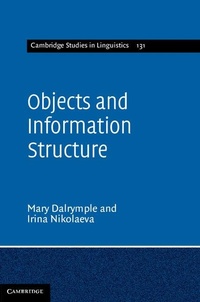
Objects and Information Structure
Published on 2. June 2011
Book
Hardback
262 pages
978-0-521-19985-8 (ISBN)
Description
In many languages, the objects of transitive verbs are either marked by grammatical case or agreement on the verb, or they remain unmarked: this is differential object marking. This book is a cross-linguistic study of how differential object marking is affected by information structure, the structuring of the utterance in accordance with the informational value of its elements and contextual factors. Marked objects tend to be associated with old information or information that the sentence is about, while unmarked objects tend to express new information. The book also sheds light on grammatical patterning in languages with differential object marking: in some languages marked and unmarked objects have identical grammatical properties, whereas in other languages marked objects are more active in syntax. Finally, it provides a theory of the historical changes that lead to the emergence of various patterns of differential object marking.
More details
Series
Language
English
Place of publication
Cambridge
United Kingdom
Target group
Professional and scholarly
Dimensions
Height: 235 mm
Width: 157 mm
Thickness: 19 mm
Weight
535 gr
ISBN-13
978-0-521-19985-8 (9780521199858)
Copyright in bibliographic data and cover images is held by Nielsen Book Services Limited or by the publishers or by their respective licensors: all rights reserved.
Schweitzer Classification
Other editions
Additional editions
Mary Dalrymple | Irina Nikolaeva
Objects and Information Structure
Book
06/2014
Cambridge University Press
€48.90
Shipment within 15-20 days
Mary Dalrymple | Irina Nikolaeva
Objects and Information Structure
E-Book
03/2012
1st Edition
Cambridge University Press
€27.99
Available for download
Persons
Mary Dalrymple is Professor of Syntax in the Faculty of Linguistics, Philology and Phonetics at the University of Oxford. Irina Nikolaeva is a Lecturer in Endangered Languages in the Department of Linguistics at the School of Oriental and African Studies, University of London.
Content
1. Introduction; 2. Syntactic assumptions; 3. Information structure in grammar; 4. Syntax and information structure; 5. Topicality and grammatical marking; 6. Topical marking of nonsubjects; 7. Topicality and DOM; 8. Primary and secondary objecthood and DOM; 9. Multiple objects and grammatical alignment; 10. Semantic features, topicality and grammaticalisation; 11. Conclusion.