

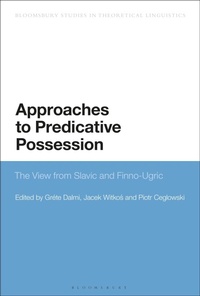
Approaches to Predicative Possession
The View from Slavic and Finno-Ugric
Published on 20. February 2020
Book
Hardback
240 pages
978-1-350-06246-7 (ISBN)
Description
This book discusses existential and possessive constructions in two important, yet under-studied, language families, Slavic and Finno-Ugric. Using data from the Slavic languages of Polish, Belarusian and Russian, and the Finno-Ugric languages of Finnish, Hungarian, Meadow Mari, Komi-Permiyak and Udmurt, as well as the closely related Selkup of the Samoyedic family, the chapters in this volume analyse predicative possession in current syntactic terms.
Seeking an answer to the theoretical question of whether BE-possessives and HAVE-possessives are just accidental values of the 'Possessive Parameter' or are intrinsically related, this book takes a comparative approach to a whole range of syntactic and semantic phenomena that appear in these constructions, including the definiteness restriction, genitive of negation, person/number agreement, argument structure and extractability. The individual case studies can be easily integrated into the Principles & Parameters framework in terms of parametric variation. Approaches to Predicative Possession is an important contribution to our understanding of predicative possession across languages, with findings that can be fruitfully extended to other language families. It is an equally useful source of information for theoretical linguists, typologists, and graduate students of linguistics.
Seeking an answer to the theoretical question of whether BE-possessives and HAVE-possessives are just accidental values of the 'Possessive Parameter' or are intrinsically related, this book takes a comparative approach to a whole range of syntactic and semantic phenomena that appear in these constructions, including the definiteness restriction, genitive of negation, person/number agreement, argument structure and extractability. The individual case studies can be easily integrated into the Principles & Parameters framework in terms of parametric variation. Approaches to Predicative Possession is an important contribution to our understanding of predicative possession across languages, with findings that can be fruitfully extended to other language families. It is an equally useful source of information for theoretical linguists, typologists, and graduate students of linguistics.
Reviews / Votes
An excellent volume presenting a set of interesting studies. Highly recommended for researchers and students of under-represented languages, language contact, language typology and generative grammar. * Edith Moravcsik, Professor Emerita of Linguistics, University of Wisconsin-Milwaukee, USA *More details
Series
Language
English
Place of publication
London
United Kingdom
Publishing group
Bloomsbury Publishing PLC
Target group
College/higher education
Dimensions
Height: 240 mm
Width: 161 mm
Thickness: 17 mm
Weight
526 gr
ISBN-13
978-1-350-06246-7 (9781350062467)
Copyright in bibliographic data and cover images is held by Nielsen Book Services Limited or by the publishers or by their respective licensors: all rights reserved.
Schweitzer Classification
Other editions
Additional editions
Grete Dalmi | Jacek Witkos | Piotr Ceglowski
Approaches to Predicative Possession
The View from Slavic and Finno-Ugric
E-Book
02/2020
1st Edition
Bloomsbury Academic
€36.49
Available for download
Persons
Grete Dalmi is Lecturer at the University of Technology, Budapest, Hungary.
Jacek Witkos is Professor at the Adam Mickiewicz University, Poznan, Poland.
Piotr Ceglowski is Associate Professor at the Adam Mickiewicz University, Poznan, Poland.
Jacek Witkos is Professor at the Adam Mickiewicz University, Poznan, Poland.
Piotr Ceglowski is Associate Professor at the Adam Mickiewicz University, Poznan, Poland.
Content
1. Introduction, Grete Dalmi (University of Technology, Hungary)
2. Genitive of negation in Polish possessive and locative existential sentences: A testing tool for Case Overwriting and Case Projections and derivational phases, Jacek Witkos (Adam Mickiewicz University, Poland)
3. Extraction of possessive NP-complements and the structure of the nominal domain in Polish, Piotr Ceglowski (Adam Mickiewicz University, Poland)
4. The definiteness effect in Russian existential and possessive sentences, Olga Kagan (Ben Gurion University, Israel)
5. Predicative possession in Belarusian, a mixed BE/HAVE language, Egor Tsedryk (Saint Mary's University, Canada)
6. Predicative possession as a clause type in Finnish, Maria Vilkuna (University of Helsinki, Helsinki, Finland)
7. The argument structure of BE-possessives in Hungarian, Grete Dalmi (University of Technology, Hungary)
8. Predicative possession in Permic, Nikolett F. Gulyas (Eoetvoes Lorand University, Hungary)
9. Existential possession in Meadow Mari, Alexandra Simonenko (University of Ghent, Belgium)
10. Predicative possessive constructions in Selkup dialects, Beata Wagner-Nagy (University of Hamburg, Germany)
11. Conclusion, Jacek Witkos (Adam Mickiewicz University, Poland)
Index
2. Genitive of negation in Polish possessive and locative existential sentences: A testing tool for Case Overwriting and Case Projections and derivational phases, Jacek Witkos (Adam Mickiewicz University, Poland)
3. Extraction of possessive NP-complements and the structure of the nominal domain in Polish, Piotr Ceglowski (Adam Mickiewicz University, Poland)
4. The definiteness effect in Russian existential and possessive sentences, Olga Kagan (Ben Gurion University, Israel)
5. Predicative possession in Belarusian, a mixed BE/HAVE language, Egor Tsedryk (Saint Mary's University, Canada)
6. Predicative possession as a clause type in Finnish, Maria Vilkuna (University of Helsinki, Helsinki, Finland)
7. The argument structure of BE-possessives in Hungarian, Grete Dalmi (University of Technology, Hungary)
8. Predicative possession in Permic, Nikolett F. Gulyas (Eoetvoes Lorand University, Hungary)
9. Existential possession in Meadow Mari, Alexandra Simonenko (University of Ghent, Belgium)
10. Predicative possessive constructions in Selkup dialects, Beata Wagner-Nagy (University of Hamburg, Germany)
11. Conclusion, Jacek Witkos (Adam Mickiewicz University, Poland)
Index