

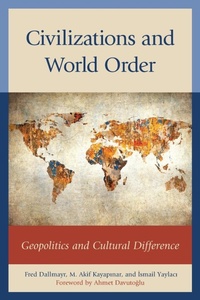
Civilizations and World Order
Geopolitics and Cultural Difference
Published on 29. August 2016
Book
Paperback/Softback
274 pages
978-1-4985-0154-5 (ISBN)
Description
Civilizations and World Order: Geopolitics and Cultural Difference examines the role of civilizations in the context of the existing and possible world order(s) from a cross-cultural and inter-disciplinary perspective. Contributions seek to clarify the meaning of such complex and contested notions as "civilization," "order," and "world order"; they do so by taking into account political, economic, cultural, and philosophical dimensions of social life. The book deals with its main theme from three angles or vectors: first, the geopolitical or power-political context of civilizations; secondly, the different roles of civilizations or cultures against the backdrop of "post-coloniality" and "Orientalism"; and thirdly, the importance of ideological and regional differences as factors supporting or obstructing world order(s). All in all, the different contributions demonstrate the impact of competing civilizational trajectories on the functioning or malfunctioning of contemporary world order.
Reviews / Votes
Every so often a book comes our way which challenges us to think outside the box. This rich collection of essays does just that. Each author, while reflecting his own distinctive philosophical and cultural standpoint, addresses two questions which go to the heart of our current predicament. Given the steady decline of Western political and cultural hegemony side by side with accelerating globalization, what are the prospects of constructing a relatively peaceful world order? Is civilizational difference part of the problem or part of the solution? The answers are diverse, often provocative, and invariably insightful. -- Joseph A. Camilleri, La Trobe University These chapters provide a single powerful message: to understand each other is often difficult and demanding, but it is by far the most profitable strategy for international politics. And it is ultimately intellectually rewarding. -- Daniele Archibugi, University of LondonMore details
Series
Language
English
Place of publication
United States
Publishing group
Bloomsbury Publishing Plc
Target group
Professional and scholarly
Illustrations
1 table
Dimensions
Height: 229 mm
Width: 152 mm
Thickness: 16 mm
Weight
452 gr
ISBN-13
978-1-4985-0154-5 (9781498501545)
Copyright in bibliographic data and cover images is held by Nielsen Book Services Limited or by the publishers or by their respective licensors: all rights reserved.
Schweitzer Classification
Other editions
Additional editions
Civilizations and World Order
Geopolitics and Cultural Difference
E-Book
09/2014
1st Edition
Lexington Books
€48.49
Available for download
Persons
Fred Dallmayr is Packey J. Dee Professor Emeritus in philosophy and political science at the University of Notre Dame.
Akif Kayapinar is assistant professor of political science and international relations at Istanbul Sehir University.
Ismail Yaylaci is a doctoral candidate in political science at the University of Minnesota, Twin Cities.
Akif Kayapinar is assistant professor of political science and international relations at Istanbul Sehir University.
Ismail Yaylaci is a doctoral candidate in political science at the University of Minnesota, Twin Cities.
Content
Foreword: Civilizational Revival in the Global Age
Ahmet Davutoglu
Introduction
Fred Dallmayr, M. Akif Kayapinar and Ismail Yaylaci
Part I: Geopolitics and World Order
1. Geopolitical Turmoil and Civilizational Pluralism
Richard Falk
2. Civilization as Instrument of World Order? The Role of the Civilizational Paradigm in the Absence of a Balance of Power
Hans Koechler
3. Power in the Analysis of World Orders
Raymond Duvall and Cigdem Cidam
4. International Society, Cultural Diversity, and the Clash (or Dialogue) of Civilizations
Chris Brown
Part II: Eurocentrism and Cultural Difference
5.The Formative Parameters of Civilizations: A Theoretical and Historical Framework
Ahmet Davutoglu
6.Western Democrats, Oriental Despots?
S. Sayyid
7.The Ottoman Empire and the Global Muslim Identity in the Formation of Eurocentric World Order, 1815-1919
Cemil Aydin
8.Beyond the "Enlightenment Mentality": An Anthropocosmic Perspective
Tu Weiming
Part III: Liberalism, Global and Regional Orders
9.Globalization, Civilizations, and World Order
Robert Gilpin
10.Liberalism of Restraint and Liberalism of Imposition: Liberal Values and World Order in the New Millennium
Georg Sorensen
11.The Rise of a Neo-medieval Order in Europe
Jan Zielonka
12.Illusions, Dreams and Nightmares: Japan, the United States, and the East Asian Renaissance in the First Decade of the New Century
John Welfield
Ahmet Davutoglu
Introduction
Fred Dallmayr, M. Akif Kayapinar and Ismail Yaylaci
Part I: Geopolitics and World Order
1. Geopolitical Turmoil and Civilizational Pluralism
Richard Falk
2. Civilization as Instrument of World Order? The Role of the Civilizational Paradigm in the Absence of a Balance of Power
Hans Koechler
3. Power in the Analysis of World Orders
Raymond Duvall and Cigdem Cidam
4. International Society, Cultural Diversity, and the Clash (or Dialogue) of Civilizations
Chris Brown
Part II: Eurocentrism and Cultural Difference
5.The Formative Parameters of Civilizations: A Theoretical and Historical Framework
Ahmet Davutoglu
6.Western Democrats, Oriental Despots?
S. Sayyid
7.The Ottoman Empire and the Global Muslim Identity in the Formation of Eurocentric World Order, 1815-1919
Cemil Aydin
8.Beyond the "Enlightenment Mentality": An Anthropocosmic Perspective
Tu Weiming
Part III: Liberalism, Global and Regional Orders
9.Globalization, Civilizations, and World Order
Robert Gilpin
10.Liberalism of Restraint and Liberalism of Imposition: Liberal Values and World Order in the New Millennium
Georg Sorensen
11.The Rise of a Neo-medieval Order in Europe
Jan Zielonka
12.Illusions, Dreams and Nightmares: Japan, the United States, and the East Asian Renaissance in the First Decade of the New Century
John Welfield