

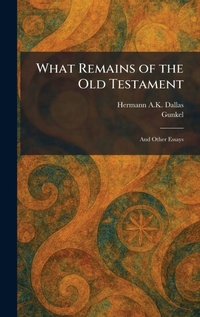
What Remains of the Old Testament
Description
"What Remains of the Old Testament: And Other Essays" is a profound collection of scholarly inquiries by Hermann Gunkel, one of the most influential figures in modern biblical criticism. In this work, Gunkel explores the enduring spiritual and historical significance of the Hebrew Bible, seeking to bridge the gap between ancient texts and contemporary religious life. As a pioneer of the form-critical method, the author examines the various literary genres within the scriptures, providing readers with a deeper understanding of the cultural and oral traditions that shaped these sacred writings.
The essays within this volume address vital questions regarding the role of the Old Testament in Christian theology and its status as a masterpiece of world literature. Gunkel evaluates the aesthetic and emotional power of biblical poetry and prose, arguing that the historical-critical study of the Bible does not diminish its value but rather enriches its message. Topics include the influence of the Ancient Near East on Israelite thought, the development of religious ideas, and the psychological dimensions of the prophetic experience. This collection serves as an essential resource for students of theology, historians of religion, and anyone interested in the legacy of biblical scholarship.
This work has been selected by scholars as being culturally important, and is part of the knowledge base of civilization as we know it. This work was reproduced from the original artifact, and remains as true to the original work as possible. Therefore, you may see the original copyright references, library stamps (as most of these works have been housed in our most important libraries around the world), and other notations in the work.
This work is in the public domain in the United States of America, and possibly other nations. Within the United States, you may freely copy and distribute this work, as no entity (individual or corporate) has a copyright on the body of the work.
As a reproduction of a historical artifact, this work may contain missing or blurred pages, poor pictures, errant marks, etc. Scholars believe, and we concur, that this work is important enough to be preserved, reproduced, and made generally available to the public. We appreciate your support of the preservation process, and thank you for being an important part of keeping this knowledge alive and relevant.