

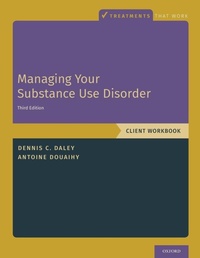
Managing Your Substance Use Disorder
Client Workbook
3rd Edition
Published on 15. November 2019
Book
Paperback/Softback
192 pages
978-0-19-092667-0 (ISBN)
Description
Managing Your Substance Use Disorder: Client Workbook is an interactive recovery guide that engages readers who have a substance use disorder in an active process of learning strategies to manage the daily challenges of sobriety and recovery and to reduce the risk of lapse and relapse. Designed to accompany Managing Substance Use Disorder: Practitioner Guide, this Workbook provides detailed information about substances of use, reader-friendly checklists, and engaging activities in order to personalize the reader's recovery plan. The book then reviews current trends in substance use and disorders, causes and effects of these disorders, substance related disorders, treatment approaches (medications and psychosocial), mutual support programs, and the impact of substance use on the family and concerned significant others, and integrates the best scientifically-supported interventions with the authors' extensive experiences as scientist-clinicians. This Workbook addresses the most common challenges faced by individuals with substance use disorders, such as managing cravings, resisting social pressures to use, coping with negative emotions and moods, building a social support network, involving family or concerned significant others, and reducing lapse and relapse risk.
Reviews / Votes
This is a terrific book by two authors, Dennis Daley and Antoine Douaihy, who are both well-known experts in the field. Its interactive nature, reader-friendly style, and up-to-date information about the best current evidence in the field, all add up to a valuable contribution to the literature. I highly recommend this book. * Roger D. Weiss, MD, Professor of Psychiatry, Harvard Medical School, Chief, Division of Alcohol and Drug Abuse, McLean Hospital *More details
Series
Edition
3rd Revised edition
Language
English
Place of publication
New York
United States
Edition type
Revised edition
Dimensions
Height: 280 mm
Width: 216 mm
Thickness: 10 mm
Weight
494 gr
ISBN-13
978-0-19-092667-0 (9780190926670)
Copyright in bibliographic data and cover images is held by Nielsen Book Services Limited or by the publishers or by their respective licensors: all rights reserved.
Schweitzer Classification
Other editions
Additional editions
E-Book
09/2019
3rd Edition
OUP eBook
€31.49
Available for download
E-Book
08/2019
3rd Edition
OUP eBook
€31.49
Available for download
Persons
Dennis C. Daley, PhD, is Senior Clinical Director of Substance Use Services in the Behavioral Health Integration Division at the University of Pittsburgh Medical Center Insurance Division. He is also a Professor of Psychiatry at the University of Pittsburgh School of Medicine. Dr. Daley has been involved in clinical care, research, and teaching about addiction for nearly 40 years, and has been an investigator, consultant and trainer on numerous local and national studies funded by NIDA or NIAAA. One of the first experts in the US to publish interactive workbooks on recovery from addiction or co-occurring psychiatric disorders, Dr. Daley has advocated for decades for recovery for individuals and families affected by addiction, or co-occurring disorders. He also shares personal experiences dealing with addiction in his own family.
Antoine Douaihy, MD, is Professor of Psychiatry and Medicine, Senior Academic Director of Addiction Medicine Services and Addiction Psychiatry Fellowship at Western Psychiatric Hospital of the University of Pittsburgh Medical Center (UPMC), and Co-Director of the Tobacco Treatment Service of UPMC. His areas of clinical and research expertise are substance use disorders (SUDs) and SUDs co-occurring with psychiatric disorders in adults and adolescents, psychosocial interventions for the treatment of SUDs, smoking cessation, psychology of behavior change, and motivational interviewing. His research has been funded by NIAAA, NIDA, NIMH, SAMHSA, HRSA, and pharmaceutical companies.
Antoine Douaihy, MD, is Professor of Psychiatry and Medicine, Senior Academic Director of Addiction Medicine Services and Addiction Psychiatry Fellowship at Western Psychiatric Hospital of the University of Pittsburgh Medical Center (UPMC), and Co-Director of the Tobacco Treatment Service of UPMC. His areas of clinical and research expertise are substance use disorders (SUDs) and SUDs co-occurring with psychiatric disorders in adults and adolescents, psychosocial interventions for the treatment of SUDs, smoking cessation, psychology of behavior change, and motivational interviewing. His research has been funded by NIAAA, NIDA, NIMH, SAMHSA, HRSA, and pharmaceutical companies.
Content
Overview of Substance Use Problems and Assessment Chapter 1: Introduction and Plan for This Workbook Chapter 2: Recognizing Your Substance Use Problem Chapter 3: Recognizing Consequences of Your Substance Use Change Issues and Strategies Chapter 4: Treatment Settings for Substance Use Problems Chapter 5: Stages of Change Chapter 6: How to Use Therapy or Counseling Chapter 7: Overview of Goal Planning Chapter 8: Managing Cravings and Urges to Use Substances Chapter 9: Managing Thoughts of Using Substances Chapter 10: Managing Emotions Chapter 11: Refusing Offers to Use Substances Chapter 12: Dealing With Family and Interpersonal Problems Chapter 13: Building a Recovery Support System Chapter 14: Mutual Support Programs and Recovery Clubs Chapter 15: Medications for Substance Use Disorders Relapse Prevention, Progress Measurement, and Co-occurring Psychiatric Disorders Chapter 16: Relapse Prevention: Reducing the Risk of Relapse Chapter 17: Relapse Management: What to Do if You Lapse or Relapse Chapter 18: Strategies for Balanced Living Chapter 19: Measuring Your Progress Chapter 20: Managing a Co-occurring Psychiatric Disorder Appendix References and Suggested Readings About the Authors