

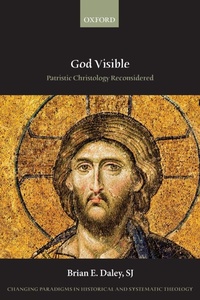
God Visible
Patristic Christology Reconsidered
Published on 7. November 2019
Book
Paperback/Softback
312 pages
978-0-19-884589-8 (ISBN)
Description
God Visible: Patristic Christology Reconsidered considers the early development and reception of what is today the most widely professed Christian conception of Christ. The development of this doctrine admits of wide variations in expression, understanding, and interpretation that are as striking in authors of the first millennium as they are among modern writers. The seven early ecumenical councils and their dogmatic formulations were crucial facilitators in defining the shape of this study. Focusing primarily on the declaration of the Council of Chalcedon in AD 451, Brian E. Daley argues that previous assessments that Christ was one Person in two natures - the Divine of the same substance as the Father and the human of the same substance as us - can sometimes be excessively narrow, even distorting our understanding of Christ's person. Daley urges us to look beyond the Chalcedonian formula alone, and to consider what some major Church Fathers - from Irenaeus to John Damascene - say about the person of Christ.
Reviews / Votes
This book certainly is a helpful study as Daley, a notable Patristics scholar, reflects on the complexities of Patristic Christology. * Shawn J. Wilhite, California Baptist University / Durham University, Religious Studies Review * Daley's work succeeds in a way few texts can in addressing technical concerns inorder to strengthen the proclaimed witness of the Christian church. The writing is clear and at times stunningly perfect: Daley's clarification that 'the divinity of Christ's human nature, one might say, is adverbial rather than substantial' (p. 222) is alone worth the price of the book. * Kirsten Sanders, Scottish Journal of Theology * In The Invisible God, Brian Daley picks up Grillmeier's two-volume work and says "yes, and." He takes Grillmeier's two categories and moves to enlarge them, to move beyond the dialectic of either/ or, to remind the reader that the God who is known in Christ exists not as the constellation of opposites, or a confusion or mixture of them, but in the one Christ, the God-man, the one who is seen and who teaches. * Kirsten Sanders, Theologian interested in Christology and questions of material embodiment, Marginalia * It offers those who are new to the subject a comprehensive overview... of the universe that is the Christology of the Early Church, while it reminds specialist patristic scholars and theologians generally of one of the deeper purposes of the discipline. It can therefore be recommended to all of these groups of potential readers. * Josef Loessl, Cardiff University, Journal of Ecclesiastical History * This book will be useful for scholars of early church theology, for people working in Christology, and for seminary students and clergy seeking a concise and informative treatment of the development of early church Christology. Every theological library should have it. * Don Schweitzer, Anglican Theological Review * This book appears in a series designed to re-examine the paradigms and presuppositions that have guided the historians of Christian thought. It is successful in fulfilling that objective. This is not just a work for scholars but for any Christian with an interest in how the church has understood the person of Christ. * Paul Richardson, Church of England Newspaper *More details
Series
Language
English
Place of publication
Oxford
United Kingdom
Target group
Professional and scholarly
Dimensions
Height: 234 mm
Width: 156 mm
Thickness: 17 mm
Weight
480 gr
ISBN-13
978-0-19-884589-8 (9780198845898)
Copyright in bibliographic data and cover images is held by Nielsen Book Services Limited or by the publishers or by their respective licensors: all rights reserved.
Schweitzer Classification
Person
Brian E. Daley, SJ, is Catherine F. Huisking Professor of Theology at the University of Notre Dame. He is a historical theologian, who specializes in the study of the early Church, particularly the development of Christian doctrine from the fourth to the eighth centuries. His publications include Light on the Mountain: Greek Patristic and Byzantine Homilies on the Transfiguration of the Lord (St Vladimir's Seminary Press, 2013) and Hope of the Early Church: A Handbook of Patristic Eschatology (Baker, 2002). In 2014, he co-edited The Harp of Prophecy: Early Christian Interpretation of the Psalms with Paul R. Kolbet (University of Notre Dame Press, 2014).
Content
1: The Christology of Chalcedon: Neither End nor Beginning
2: Second-Century Christology: The Word with Us
3: Irenaeus and Origen: A Christology of Manifestation
4: The Early Arian Controversy: Christology in Search of a Mediator
5: Apollinarius, Gregory of Nazianzus, and Gregory of Nyssa: Towards a Christology of Transformation
6: Augustine of Hippo: Christology as the "Way"
7: Antioch and Alexandria: Christology as Reflection on God's Presence in History
8: After Chalcedon: A Christology of Relationship
9: The Iconoclastic Controversy: Christology and Images
Epilogue: Christology and the Councils
Bibliography
2: Second-Century Christology: The Word with Us
3: Irenaeus and Origen: A Christology of Manifestation
4: The Early Arian Controversy: Christology in Search of a Mediator
5: Apollinarius, Gregory of Nazianzus, and Gregory of Nyssa: Towards a Christology of Transformation
6: Augustine of Hippo: Christology as the "Way"
7: Antioch and Alexandria: Christology as Reflection on God's Presence in History
8: After Chalcedon: A Christology of Relationship
9: The Iconoclastic Controversy: Christology and Images
Epilogue: Christology and the Councils
Bibliography