

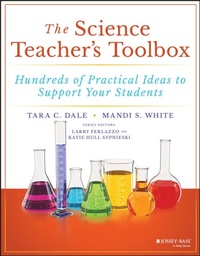
The Science Teacher's Toolbox: Hundreds of Practical Ideas to Support Your Students
Hundreds of Practical Ideas to Support Your Students
1st Edition
Published on 1. May 2020
Book
Paperback/Softback
544 pages
978-1-119-57010-3 (ISBN)
Description
A winning educational formula of engaging lessons and powerful strategies for science teachers in numerous classroom settings
The Teacher's Toolbox series is an innovative, research-based resource providing teachers with instructional strategies for students of all levels and abilities. Each book in the collection focuses on a specific content area. Clear, concise guidance enables teachers to quickly integrate low-prep, high-value lessons and strategies in their middle school and high school classrooms. Every strategy follows a practical, how-to format established by the series editors.
The Science Teacher's Toolbox is a classroom-tested resource offering hundreds of accessible, student-friendly lessons and strategies that can be implemented in a variety of educational settings. Concise chapters fully explain the research basis, necessary technology, Next Generation Science Standards correlation, and implementation of each lesson and strategy.
Favoring a hands-on approach, this bookprovides step-by-step instructions that help teachers to apply their new skills and knowledge in their classrooms immediately. Lessons cover topics such as setting up labs, conducting experiments, using graphs, analyzing data, writing lab reports, incorporating technology, assessing student learning, teaching all-ability students, and much more. This book enables science teachers to:
* Understand how each strategy works in the classroom and avoid common mistakes
* Promote culturally responsive classrooms
* Activate and enhance prior knowledge
* Bring fresh and engaging activities into the classroom and the science lab
Written by respected authors and educators, The Science Teacher's Toolbox: Hundreds of Practical Ideas to Support Your Students is an invaluable aid for upper elementary, middle school, and high school science educators as well those in teacher education programs and staff development professionals.
More details
Other editions
Additional editions
Tara C. Dale | Mandi S. White
The Science Teacher's Toolbox
Hundreds of Practical Ideas to Support Your Students
E-Book
04/2020
1st Edition
Wiley
€24.99
Available for download
Tara C. Dale | Mandi S. White
The Science Teacher's Toolbox
Hundreds of Practical Ideas to Support Your Students
E-Book
04/2020
1st Edition
Wiley
€24.99
Available for download
Content
About the Authors
About the Editors
Acknowledgments
Foreword
Introduction
Part 1. Science Labs
1. Strategies for Teaching Lab Safety
What Is It?
Why We Like It
Supporting Research
Skills for Intentional Scholars/NGSS Standards
Application
Student Handouts and Examples
What Could Go Wrong?
Technology Connections
Attribution
Figures
2. Strategies for Teaching Lab Procedures
What Is It?
Why We Like It
Supporting Research
Skills for Intentional Scholars/NGSS Standards
Application
Student Handouts and Examples
What Could Go Wrong?
Technology Connections
Attributions
Figures
3. Strategies for Teaching the Scientific Method and Its Components
What Is It?
Why We Like It
Supporting Research
Skills for Intentional Scholars/NGSS Standards
Application
Student Handouts and Examples
What Could Go Wrong?
Technology Connections
Figures
4. Strategies for Teaching the Inquiry Process
What Is It?
Why We Like It
Supporting Research
Skills for Intentional Scholars/NGSS Standards
Application
Student Handouts and Examples
What Could Go Wrong?
Technology Connections
Attributions
Figures
5. Strategies for Using Project-Based Learning
What Is It?
Why We Like It
Supporting Research
Skills for Intentional Scholars/NGSS Standards
Application
Student Handouts and Examples
What Could Go Wrong?
Technology Connections
Attributions
Figures
6. Strategies for Teaching the Engineering Process
What Is It?
Why We Like It
Supporting Research
Skills for Intentional Scholars/NGSS Standards
Application
Student Handouts and Examples
What Could Go Wrong?
Technology Connections
Attributions
Figures
Part 2. Integration of ELA, Mathematics, and the Arts
7. Strategies for Teaching Vocabulary
What Is It?
Why We Like It
Supporting Research
Skills for Intentional Scholars/NGSS Standards
Application
Student Handouts and Examples
What Could Go Wrong?
Technology Connections
Attributions
Figures
8. Strategies for Teaching Reading Comprehension
What Is It?
Why We Like It
Supporting Research
Skills for Intentional Scholars/NGSS Standards
Application
Student Handouts and Examples
What Could Go Wrong?
Technology Connections
Attributions
Figures
9. Strategies for Teaching Writing
What Is It?
Why We Like It
Supporting Research
Skills for Intentional Scholars/NGSS Standards
Application
Student Handouts and Examples
What Could Go Wrong?
Technology Connections
Attributions
Figures
10. Strategies for Teaching Lab Procedures
What Is It?
Why We Like It
Supporting Research
Skills for Intentional Scholars/NGSS Standards
Application
Student Handouts and Examples
What Could Go Wrong?
Technology Connections
Figures
11. Strategies for Teaching Math
What Is It?
Why We Like It
Supporting Research
Skills for Intentional Scholars/NGSS Standards
Application
Student Handouts and Examples
Technology Connections
What Could Go Wrong?
Figures
12. Strategies for Incorporating Art and Kinesthetic Movement
What Is It?
Why We Like It
Supporting Research
Skills for Intentional Scholars/NGSS Standards
Application
Student Handouts and Examples
What Could Go Wrong?
Technology Connections
Attributions
Figures
13. Strategies for Activating Prior Knowledge
What Is It?
Why We Like It
Supporting Research
Skills for Intentional Scholars/NGSS Standards
Application
Student Handouts and Examples
What Could Go Wrong?
Technology Connections
Attributions
Figures
14. Strategies for Cultural Responsiveness
What Is It?
Why We Like It
Supporting Research
Skills for Intentional Scholars/NGSS Standards
Application
Student Handouts and Examples
What Could Go Wrong?
Technology Connections
Attributions
Figures
15. Strategies for the Beginning and End of Class
What Is It?
Why We Like It
Supporting Research
Skills for Intentional Scholars/NGSS Standards
Application
What Could Go Wrong?
Technology Connections
16. Strategies for Reviewing Content
What Is It?
Why We Like It
Supporting Research
Skills for Intentional Scholars/NGSS Standards
Application
Student Handouts and Examples
What Could Go Wrong?
Technology Connections
Figures
17. Strategies for Assessing Student Learning
What Is It?
Why We Like It
Supporting Research
Skills for Intentional Scholars/NGSS Standards
Application
Student Handouts and Examples
What Could Go Wrong?
Technology Connections
Attributions
Figures
18. Strategies for Co-Teaching
What Is It?
Why We Like It
Supporting Research
Skills for Intentional Scholars/NGSS Standards
Application
What Could Go Wrong?
Technology Connections
19. Strategies for Using Scientific Tools and Technology (Online only)
What Is It?
Why We Like It
Supporting Research
Skills for Intentional Scholars/NGSS Standards
Application
Student Handouts and Examples
What Could Go Wrong?
Technology Connections
Figures
Bibliography