

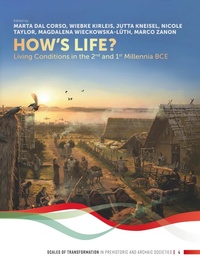
How's Life?
Living Conditions in the 2nd and 1st Millennia BCE
1st Edition
Published on 18. July 2019
Book
Paperback/Softback
210 pages
978-90-8890-801-9 (ISBN)
Description
The Bronze Age and Early Iron Age saw many developments in metalworking, social structure, food production, nutrition, and diet. At the same time, networks in Europe intensified and human impact on the environment changed in character. What influence did these transformations have on daily life? Which proxies can researchers use to study these topics?
This volume presents scientific contributions from different fields of expertise within modern archaeology in order to investigate past living conditions through aspects of the archaeological record related to production (e.g. of food and metal), well-being (e.g. diet, health), human relations (e.g. violence), and the local environment (e.g. pollution, waste disposal, and water management). It also critically addresses contemporary graphic representations of Bronze Age living conditions.
This volume compiles papers from a session with the same title organized for an international open workshop of the Graduate School 'Human Development in Landscapes', entitled 'Socio-Environmental Dynamics over the Last 12,000 Years: The Development of Landscapes IV', which took place in 2017, in Kiel, Germany. Publications detailing overarching core research on subsistence systems, societal transformations, and resilience versus rupture dynamics already exist. With this volume, we aim to provide a closer look at everyday life in past communities.
This volume presents scientific contributions from different fields of expertise within modern archaeology in order to investigate past living conditions through aspects of the archaeological record related to production (e.g. of food and metal), well-being (e.g. diet, health), human relations (e.g. violence), and the local environment (e.g. pollution, waste disposal, and water management). It also critically addresses contemporary graphic representations of Bronze Age living conditions.
This volume compiles papers from a session with the same title organized for an international open workshop of the Graduate School 'Human Development in Landscapes', entitled 'Socio-Environmental Dynamics over the Last 12,000 Years: The Development of Landscapes IV', which took place in 2017, in Kiel, Germany. Publications detailing overarching core research on subsistence systems, societal transformations, and resilience versus rupture dynamics already exist. With this volume, we aim to provide a closer look at everyday life in past communities.
More details
Series
Edition
1. Auflage
Language
English
Place of publication
Leiden
Netherlands
Target group
Professional and scholarly
Illustrations
43fc/29bw
Dimensions
Height: 280 mm
Width: 210 mm
Thickness: 15 mm
Weight
810 gr
ISBN-13
978-90-8890-801-9 (9789088908019)
DOI
https://doi.org/10.59641/e7245hq
Copyright in bibliographic data and cover images is held by Nielsen Book Services Limited or by the publishers or by their respective licensors: all rights reserved.
Schweitzer Classification
Persons
Marta Dal Corso is a postdoctoral researcher in the field of archaeobotany and palynology, interested in the understanding of plant cultivation and use in prehistory and of the relationships between human activities and natural environments. She is currently working at the Institute for Prehistoric and Protohistoric Archaeology at Kiel University (Germany), where she has been assistant to the chair of Environmental Archaeology and taught palynology and phytolith analysis among other classes.
After her bachelor and MA studies at the University of Padova (Italy), she carried out her PhD study in Kiel, on the environment at the time of the Late Bronze Age Terramare civilization in the Po Valley, in Northern Italy. Since some years, she works as research fellow within the CRC 1266 in a project focused on the Copper Age Cucuteni-Tripyllia (or Tripolye) groups in Ukraine and Moldova, where the reconstruction of economic and environmental conditions is necessary to understand the developments related to the earliest large settlements in Europe.
She still investigates the European Bronze Age, with the study of routine activities in southern alpine pile-dwellings (within the cluster of excellence ROOTS) and with the study of the earliest millet finds in Ukraine and adjacent areas in their cultural and economic contexts. A forthcoming study with the DEI-Amman (Jordan), already funded by the Gerda Henkel Foundation, will concern the preliminary investigation of the environment at Tall Zira'a in northern Jordan. These interdisciplinary research projects stem from international collaborations and brought to several publications, as author and editor. They include the book "How's life? Living conditions in Europe during the 2nd millennium BCE" published with Sidestone. She actively participated in the organisation of conference sessions and workshops and is currently following the organisation of the 12th International Meeting for Phytolith Research. Wiebke Kirleis is professor of environmental archaeology/archaeobotany at Kiel University, Germany. She is deputy director of the Collaborative Research Centre 'Scales of Transformation: Human-Environmental Interaction in Prehistoric and Archaic Societies' (CRC 1266, financed by the German Research Foundation/DFG) and a member of the Cluster of Excellence 'Roots' at Kiel University.
As an archaeobotanist, she is interested in all kinds of plant-related human activities, be they subsistence strategies or food processing, with their socio-cultural implications, as well as the reconstruction of human-environment interactions in the past. Geographically, her research areas span from northern Europe all way to Indonesia.
Key publications
Wiebke Kirleis and Ulrich Willerding. 2008. Die Pflanzenreste der linienbandkeramischen Siedlung von Rosdorf-Muehlengrund, Ldkr. Goettingen, im suedoestlichen Niedersachsen. Praehistorische Zeitschrift 83, 133-178.
Wiebke Kirleis, Valerio D. Pillar and Hermann Behling. 2011. Human-environment interactions in mountain rainforests: palaeo-botanical evidence from central Sulawesi, Indonesia. Vegetation History and Archaeobotany 20, 165-179. DOI: 10.1007/s00334-010-0272-0.
Wiebke Kirleis, Stefanie Klooss, Helmut Kroll and Johannes Mueller. 2012. Crop growing and gathering in the northern German Neolithic: a review supplemented by first new results. Vegetation History and Archaeobotany 21, 221-242. DOI: 10.1007/s00334-011-0328-9
Wiebke Kirleis and Stefanie Klooss. 2014. More than simply fallback food? Social context of plant use in the northern German Neolithic, in: Alexandre Chevalier, Elena Marinova, and Leonor Pena-Chocarro (eds.), Plants and people: choices and diversity through time. Oxford: Oxbow Books, 326-335.
Wiebke Kirleis and Elske Fischer. 2014. Neolithic cultivation of tetraploid free threshing wheat in Denmark and northern Germany: implications for crop diversity and societal dynamics of the Funnel Beaker Culture, in: Felix Bittmann et al. (eds.), Farming in the forest: ecology and economy of fire in prehistoric agriculture. Special issue. Vegetation History and Archaeobotany 23, Supplement 1, 81-96. DOI: 10.1007/s00334-014-0440-8
Nicki Whitehouse, Wiebke Kirleis, and Chris Hunt (eds.). 2014. The world reshaped: practices and impacts of early agrarian societies. Special Issue. Journal of Archaeological Science 51, 1-236.
Wiebke Kirleis and Marta Dal Corso. 2016. Trypillian subsistence economy: animal and plant exploitation, in: Johannes Mueller, Kurt Rassman, and Mykhailo Videiko (eds.), Trypillia-megasites and European prehistory 4100-3400 BCE. Themes in Contemporary Archaeology 2. London: Routledge, 195-205.
After her bachelor and MA studies at the University of Padova (Italy), she carried out her PhD study in Kiel, on the environment at the time of the Late Bronze Age Terramare civilization in the Po Valley, in Northern Italy. Since some years, she works as research fellow within the CRC 1266 in a project focused on the Copper Age Cucuteni-Tripyllia (or Tripolye) groups in Ukraine and Moldova, where the reconstruction of economic and environmental conditions is necessary to understand the developments related to the earliest large settlements in Europe.
She still investigates the European Bronze Age, with the study of routine activities in southern alpine pile-dwellings (within the cluster of excellence ROOTS) and with the study of the earliest millet finds in Ukraine and adjacent areas in their cultural and economic contexts. A forthcoming study with the DEI-Amman (Jordan), already funded by the Gerda Henkel Foundation, will concern the preliminary investigation of the environment at Tall Zira'a in northern Jordan. These interdisciplinary research projects stem from international collaborations and brought to several publications, as author and editor. They include the book "How's life? Living conditions in Europe during the 2nd millennium BCE" published with Sidestone. She actively participated in the organisation of conference sessions and workshops and is currently following the organisation of the 12th International Meeting for Phytolith Research. Wiebke Kirleis is professor of environmental archaeology/archaeobotany at Kiel University, Germany. She is deputy director of the Collaborative Research Centre 'Scales of Transformation: Human-Environmental Interaction in Prehistoric and Archaic Societies' (CRC 1266, financed by the German Research Foundation/DFG) and a member of the Cluster of Excellence 'Roots' at Kiel University.
As an archaeobotanist, she is interested in all kinds of plant-related human activities, be they subsistence strategies or food processing, with their socio-cultural implications, as well as the reconstruction of human-environment interactions in the past. Geographically, her research areas span from northern Europe all way to Indonesia.
Key publications
Wiebke Kirleis and Ulrich Willerding. 2008. Die Pflanzenreste der linienbandkeramischen Siedlung von Rosdorf-Muehlengrund, Ldkr. Goettingen, im suedoestlichen Niedersachsen. Praehistorische Zeitschrift 83, 133-178.
Wiebke Kirleis, Valerio D. Pillar and Hermann Behling. 2011. Human-environment interactions in mountain rainforests: palaeo-botanical evidence from central Sulawesi, Indonesia. Vegetation History and Archaeobotany 20, 165-179. DOI: 10.1007/s00334-010-0272-0.
Wiebke Kirleis, Stefanie Klooss, Helmut Kroll and Johannes Mueller. 2012. Crop growing and gathering in the northern German Neolithic: a review supplemented by first new results. Vegetation History and Archaeobotany 21, 221-242. DOI: 10.1007/s00334-011-0328-9
Wiebke Kirleis and Stefanie Klooss. 2014. More than simply fallback food? Social context of plant use in the northern German Neolithic, in: Alexandre Chevalier, Elena Marinova, and Leonor Pena-Chocarro (eds.), Plants and people: choices and diversity through time. Oxford: Oxbow Books, 326-335.
Wiebke Kirleis and Elske Fischer. 2014. Neolithic cultivation of tetraploid free threshing wheat in Denmark and northern Germany: implications for crop diversity and societal dynamics of the Funnel Beaker Culture, in: Felix Bittmann et al. (eds.), Farming in the forest: ecology and economy of fire in prehistoric agriculture. Special issue. Vegetation History and Archaeobotany 23, Supplement 1, 81-96. DOI: 10.1007/s00334-014-0440-8
Nicki Whitehouse, Wiebke Kirleis, and Chris Hunt (eds.). 2014. The world reshaped: practices and impacts of early agrarian societies. Special Issue. Journal of Archaeological Science 51, 1-236.
Wiebke Kirleis and Marta Dal Corso. 2016. Trypillian subsistence economy: animal and plant exploitation, in: Johannes Mueller, Kurt Rassman, and Mykhailo Videiko (eds.), Trypillia-megasites and European prehistory 4100-3400 BCE. Themes in Contemporary Archaeology 2. London: Routledge, 195-205.
Content
Introduction
Part 1. Life in Action: Metal Production, Health Conditions and Dietary choices
Copper Output, Demand for Wood and Energy Expenditure - Evaluating Economic Aspects of Bronze Age Metallurgy
Johanna Brinkmann
Warriors' Lives. The Skeletal Sample from the Bronze Age Battlefield Site in the Tollense Valley, Northeastern Germany
Gundula Lidke, Ute Brinker, Annemarie Schramm, Detlef Jantzen, Thomas Terberger
Environmental Imposition or Ancient Farmers' Choice? A Study of the Presence of "Inferior" Legumes in the Bronze Age Carpathian Basin (Hungary)
Sonja Filatova, Ferenc Gyulai, Wiebke Kirleis
Part 2. The Place of Living: Routine Activities, the Management of Waste and of Natural Resources
The Fossil Plant remains of the Early Bronze Age site Rothenkirchen on Ruegen. Inside Distribution Patterns as a Mirror of Housekeeping
Almuth Alsleben
Waste Disposal In The Bronze Age: Plants In Pits At Wismar-Wendorf, Northern Germany
Dragana Filipovic Frank Mewis, Lars Saalow, Jens-Peter Schmidt, Wiebke Kirleis
An Overview of Olive Trees in the Eastern Mediterranean during the Mid-Late Holocene: Selective Exploitation or Established Arboriculture?
Asli Oflaz, Walter Doerfler, Mara Weinelt
On-site Palaeoecological Investigations from the Huenenburg Hillfort-Settlement Complex, with Special Reference to Non-pollen Palynomorphs
Magdalena Wieckowska-Lueth, Immo Heske
Part 3. Living the Past: The (Graphic) Representation of Past Living Conditions
Creating an Understanding of Life in and around a Bronze Age House through Science-based Artist Impressions
Yvonne F. van Amerongen
Case Study "How Was Life in Early Bronze Age Bruszczewo" - Archaeology and the View of Prehistory in Reconstruction Images
Jutta Kneisel
Part 1. Life in Action: Metal Production, Health Conditions and Dietary choices
Copper Output, Demand for Wood and Energy Expenditure - Evaluating Economic Aspects of Bronze Age Metallurgy
Johanna Brinkmann
Warriors' Lives. The Skeletal Sample from the Bronze Age Battlefield Site in the Tollense Valley, Northeastern Germany
Gundula Lidke, Ute Brinker, Annemarie Schramm, Detlef Jantzen, Thomas Terberger
Environmental Imposition or Ancient Farmers' Choice? A Study of the Presence of "Inferior" Legumes in the Bronze Age Carpathian Basin (Hungary)
Sonja Filatova, Ferenc Gyulai, Wiebke Kirleis
Part 2. The Place of Living: Routine Activities, the Management of Waste and of Natural Resources
The Fossil Plant remains of the Early Bronze Age site Rothenkirchen on Ruegen. Inside Distribution Patterns as a Mirror of Housekeeping
Almuth Alsleben
Waste Disposal In The Bronze Age: Plants In Pits At Wismar-Wendorf, Northern Germany
Dragana Filipovic Frank Mewis, Lars Saalow, Jens-Peter Schmidt, Wiebke Kirleis
An Overview of Olive Trees in the Eastern Mediterranean during the Mid-Late Holocene: Selective Exploitation or Established Arboriculture?
Asli Oflaz, Walter Doerfler, Mara Weinelt
On-site Palaeoecological Investigations from the Huenenburg Hillfort-Settlement Complex, with Special Reference to Non-pollen Palynomorphs
Magdalena Wieckowska-Lueth, Immo Heske
Part 3. Living the Past: The (Graphic) Representation of Past Living Conditions
Creating an Understanding of Life in and around a Bronze Age House through Science-based Artist Impressions
Yvonne F. van Amerongen
Case Study "How Was Life in Early Bronze Age Bruszczewo" - Archaeology and the View of Prehistory in Reconstruction Images
Jutta Kneisel