

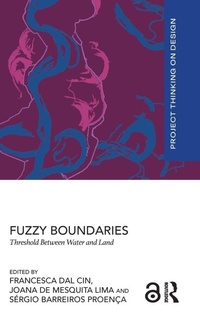
Fuzzy Boundaries
Threshold Between Water and Land
1st Edition
Will be published approx. on 28. November 2025
Book
Hardback
252 pages
978-1-032-83556-3 (ISBN)
Description
Fuzzy Boundaries: Threshold Between Water and Land is a curated selection of reflections on the boundaries between water and land, and its meaning amidst climate change, social, economic, and political challenges. By engaging with form and contemplating the frictions and quiet conflicts that inhabit transitional spaces, the authors suggest that fuzziness - viewed through varied geographical and cultural lenses - holds the potential to reveal deeper layers of meaning.
This book is structured as a journey 'from reading to design', guiding readers through stages that may be understood as moving from analysis and interpretation, to drawing, modelling, and designing, and ultimately to implementation and [un]building - offering deeper insight into the thresholds between land and water. Readers are invited to critically reflect on the representation of boundaries: What is depicted, how it is portrayed, and through which scales and perspectives. Fuzzy Boundaries brings together case studies from across the globe, revealing how distinct realities intersect and coexist, while exploring strategies to confront the challenges currently facing people, water, and land. The sequence of chapters forms a body of knowledge aimed at supporting future initiatives in conservation, adaptation, and transformation amid growing urban and environmental challenges.
This book is directed at students, researchers, practitioners, and decision-makers in a call to consider fuzziness in project design thinking.
This book is structured as a journey 'from reading to design', guiding readers through stages that may be understood as moving from analysis and interpretation, to drawing, modelling, and designing, and ultimately to implementation and [un]building - offering deeper insight into the thresholds between land and water. Readers are invited to critically reflect on the representation of boundaries: What is depicted, how it is portrayed, and through which scales and perspectives. Fuzzy Boundaries brings together case studies from across the globe, revealing how distinct realities intersect and coexist, while exploring strategies to confront the challenges currently facing people, water, and land. The sequence of chapters forms a body of knowledge aimed at supporting future initiatives in conservation, adaptation, and transformation amid growing urban and environmental challenges.
This book is directed at students, researchers, practitioners, and decision-makers in a call to consider fuzziness in project design thinking.
More details
Series
Language
English
Place of publication
London
United Kingdom
Publishing group
Taylor & Francis Ltd
Target group
College/higher education
Professional and scholarly
Academic, Postgraduate, and Undergraduate Advanced
Illustrations
35 s/w Zeichnungen, 1 s/w Tabelle, 52 s/w Abbildungen, 17 s/w Photographien bzw. Rasterbilder
1 Tables, black and white; 35 Line drawings, black and white; 17 Halftones, black and white; 52 Illustrations, black and white
Dimensions
Height: 240 mm
Width: 161 mm
Thickness: 19 mm
Weight
581 gr
ISBN-13
978-1-032-83556-3 (9781032835563)
Copyright in bibliographic data and cover images is held by Nielsen Book Services Limited or by the publishers or by their respective licensors: all rights reserved.
Schweitzer Classification
Other editions
Additional editions
Francesca Dal Cin | Joana de Mesquita Lima | Sergio Barreiros Proenca
Fuzzy Boundaries
Threshold Between Water and Land
E-Book
11/2025
Routledge
€0.00
Available for download
Francesca Dal Cin | Joana de Mesquita Lima | Sergio Barreiros Proenca
Fuzzy Boundaries
Threshold Between Water and Land
E-Book
11/2025
Routledge
€0.00
Available for download
Persons
Francesca Dal Cin holds a degree in Architecture with a specialisation in Urban Planning (Universita IUAV di Venezia, 2013 & 2017) and a PhD in Urbanism (Lisbon School of Architecture, Universidade de Lisboa, 2022). Since August 2023, she has been working in academia in Saudi Arabia and is currently an assistant professor at Prince Mohammad Bin Fahd University. Her research - developed since 2018 at CIAUD, Research Centre for Architecture, Urbanism and Design, Lisbon School of Architecture, Universidade de Lisboa - focuses on coastal urban forms vulnerable to sea-level rise.
Joana de Mesquita Lima is a geographer and development planner (University College London, 2001 and 2002) and a PhD candidate in Urbanism (Lisbon School of Architecture, Universidade de Lisboa). Her research interests include the urban global south, housing, and vulnerable territories.
Sergio Barreiros Proenca is an architect and holds a PhD in Urbanism (Lisbon School of Architecture, Universidade de Lisboa, 2001 and 2014). He is an assistant professor at the Lisbon School of Architecture, Universidade de Lisboa and in the Faculty of Arts and Humanities, University of Saint Joseph. His research interests focus on the urban form morphology and morphogenesis, on urban landscape time and temporality, and on the relation between the sea and the city.
Joana de Mesquita Lima is a geographer and development planner (University College London, 2001 and 2002) and a PhD candidate in Urbanism (Lisbon School of Architecture, Universidade de Lisboa). Her research interests include the urban global south, housing, and vulnerable territories.
Sergio Barreiros Proenca is an architect and holds a PhD in Urbanism (Lisbon School of Architecture, Universidade de Lisboa, 2001 and 2014). He is an assistant professor at the Lisbon School of Architecture, Universidade de Lisboa and in the Faculty of Arts and Humanities, University of Saint Joseph. His research interests focus on the urban form morphology and morphogenesis, on urban landscape time and temporality, and on the relation between the sea and the city.
Content
List of Figures
List of Tables
List of Contributors
Acknowledgements
At The Edge of Water and Land
A New Fuzzy Boundary?
Water Re-Claims
From Reading to Design: Framing the Fuzziness
1. Drawing With Water: The Bogota River Territory
2. We All Might Inhabit Margins: Hyperlocality in the Planetary Salt Marsh
3. The Form in the Fog: Revealing the Seashore Limenes
4. People-Water-City: Village Urban Form Shaped by Water-Retaining Pond System
5. Curating, Creating and Protecting Fuzziness in the Zambezi River Basin and in Maputo's Costa Do Sol, Mozambique
6. Touching Water: Modelling Urban River Sections as a Learning Experience
7. Floating Developments: The Next Chapter in Dutch Delta Management?
8. Blurred Lines: A Systems Thinking Approach to Water-Land Interaction in Semarang, Indonesia
9. Managing Sea Space Through Dynamic Boundaries: The Evolution Of Maritime Spatial Planning and the Italian Experience.
A Call for Fuzziness in Uncertain Times: Rethinking Thresholds
Beyond The Boundaries
Mapping Fuzzy Boundaries
Landscape With Characteristics. Against The Polytechnical Solution
Index
List of Tables
List of Contributors
Acknowledgements
At The Edge of Water and Land
A New Fuzzy Boundary?
Water Re-Claims
From Reading to Design: Framing the Fuzziness
1. Drawing With Water: The Bogota River Territory
2. We All Might Inhabit Margins: Hyperlocality in the Planetary Salt Marsh
3. The Form in the Fog: Revealing the Seashore Limenes
4. People-Water-City: Village Urban Form Shaped by Water-Retaining Pond System
5. Curating, Creating and Protecting Fuzziness in the Zambezi River Basin and in Maputo's Costa Do Sol, Mozambique
6. Touching Water: Modelling Urban River Sections as a Learning Experience
7. Floating Developments: The Next Chapter in Dutch Delta Management?
8. Blurred Lines: A Systems Thinking Approach to Water-Land Interaction in Semarang, Indonesia
9. Managing Sea Space Through Dynamic Boundaries: The Evolution Of Maritime Spatial Planning and the Italian Experience.
A Call for Fuzziness in Uncertain Times: Rethinking Thresholds
Beyond The Boundaries
Mapping Fuzzy Boundaries
Landscape With Characteristics. Against The Polytechnical Solution
Index