

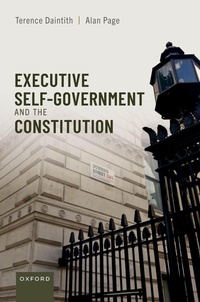
Executive Self-Government and the Constitution
Published on 15. April 2025
Book
Hardback
480 pages
978-0-19-886354-0 (ISBN)
Description
Over the last 25 years, UK governments have faced a series of challenges and changes of an intensity almost unprecedented in peacetime: some thrust upon them, some of their own making. Developments whose impact on the executive's place in the constitution are analysed in this volume include the global financial crisis in 2007/08, the 1997 Labour Government's programme of constitutional reform, the unexpected referendum result on withdrawal from the EU in 2016, the COVID-19 pandemic, the UK's withdrawal from the EU in 2020, and the energy and cost of living crisis that followed Russia's invasion of Ukraine in 2022.
The volume's conception of the UK's executive government is of an autonomous actor within the constitution, endowed with significant discretion in relation to its own organisation and modes of operation. By examining how governments have responded to those developments--through the reform of executive institutions and their deployment of the essential governmental resources of people, money, laws, and information--, Executive Self-Government and the Constitution opens a window on the internal operations of the contemporary executive and permits an assessment of the resilience of its key constitutional characteristics.
Building on the analysis of their original leading work The Executive in the Constitution (OUP 1999), Executive Self-Government and the Constitution assesses how the economic and political turbulence faced by successive governments since 1997 has affected its key constitutional features.
The volume's conception of the UK's executive government is of an autonomous actor within the constitution, endowed with significant discretion in relation to its own organisation and modes of operation. By examining how governments have responded to those developments--through the reform of executive institutions and their deployment of the essential governmental resources of people, money, laws, and information--, Executive Self-Government and the Constitution opens a window on the internal operations of the contemporary executive and permits an assessment of the resilience of its key constitutional characteristics.
Building on the analysis of their original leading work The Executive in the Constitution (OUP 1999), Executive Self-Government and the Constitution assesses how the economic and political turbulence faced by successive governments since 1997 has affected its key constitutional features.
More details
Language
English
Place of publication
Oxford
United Kingdom
Target group
Professional and scholarly
College/higher education
Product notice
sewn/stitched
Cloth over boards
Dimensions
Height: 238 mm
Width: 162 mm
Thickness: 34 mm
Weight
853 gr
ISBN-13
978-0-19-886354-0 (9780198863540)
Copyright in bibliographic data and cover images is held by Nielsen Book Services Limited or by the publishers or by their respective licensors: all rights reserved.
Schweitzer Classification
Persons
Terence Daintith is Emeritus Professor of Law, and Professorial Fellow at the Institute of Advanced Legal Studies, University of London, where he was Director from 1988 to 1995. Before that, he taught at the Universities of California (Berkeley), Edinburgh, and Dundee, and was a research professor at the European University Institute in Florence, Italy. From 1994 until 2002, he was Dean of the University of London's School of Advanced Study, grouping its research institutes in the humanities and social sciences. He holds honorary doctorates in law from De Montfort University and the University of Aberdeen.
Alan Page is Emeritus Professor of Public Law at the University of Dundee, where he was Professor of Public Law from 1985 to 2020. Before that he taught at the Universities of Cardiff and Westminster. He has acted as a specialist adviser to committees in the UK and Scottish Parliaments, most recently and extensively in connection with the UK's withdrawal from the EU. He has also acted as an adviser to international organisations including the OSCE Office for Democratic Institutions and Human Rights (ODIHR). He was a member of the Independent Review of Administrative Law (the Faulks Review, CP 407, 2021).
Alan Page is Emeritus Professor of Public Law at the University of Dundee, where he was Professor of Public Law from 1985 to 2020. Before that he taught at the Universities of Cardiff and Westminster. He has acted as a specialist adviser to committees in the UK and Scottish Parliaments, most recently and extensively in connection with the UK's withdrawal from the EU. He has also acted as an adviser to international organisations including the OSCE Office for Democratic Institutions and Human Rights (ODIHR). He was a member of the Independent Review of Administrative Law (the Faulks Review, CP 407, 2021).
Content
PART A. INTRODUCTION
1: The Executive in the Constitution: Forces for Change 1997-2024
PART B. THE STRUCTURE OF THE EXECUTIVE
2: The Centre of Government: Bigger and Stronger? Or Just Bigger?
3: The Ministerial Department: Making and Breaking, Structuring, Steering
4: Public Bodies: Creation, Culling, Classification, and Patronage
5: Devolution: From 'Devolve and Forget' to 'Protect and Respect'
PART C. THE RESOURCES OF THE EXECUTIVE: PEOPLE
6: The Civil Service: The Continuing Failure of Reform
PART D. THE RESOURCES OF THE EXECUTIVE: MONEY
7: Fiscal Responsibility and Expenditure Planning and Control
8: Spending Responsibly: Expenditure Principles and Treasury Control
PART E. THE RESOURCES OF THE EXECUTIVE: LAW
9: How Government Lawyers Advise Ministers and Manage Prosecutions
10: Shaping Legislation, Exploiting Delegated Legislation, Reining in Regulation
PART F. THE RESOURCES OF THE EXECUTIVE: INFORMATION
11: Government Information: Privileges, Constraints, and Obligations
12: Government Communications: Persuasion with Propriety
PART G. CONCLUSION
13: The Impact of 21st-Century Challenges
1: The Executive in the Constitution: Forces for Change 1997-2024
PART B. THE STRUCTURE OF THE EXECUTIVE
2: The Centre of Government: Bigger and Stronger? Or Just Bigger?
3: The Ministerial Department: Making and Breaking, Structuring, Steering
4: Public Bodies: Creation, Culling, Classification, and Patronage
5: Devolution: From 'Devolve and Forget' to 'Protect and Respect'
PART C. THE RESOURCES OF THE EXECUTIVE: PEOPLE
6: The Civil Service: The Continuing Failure of Reform
PART D. THE RESOURCES OF THE EXECUTIVE: MONEY
7: Fiscal Responsibility and Expenditure Planning and Control
8: Spending Responsibly: Expenditure Principles and Treasury Control
PART E. THE RESOURCES OF THE EXECUTIVE: LAW
9: How Government Lawyers Advise Ministers and Manage Prosecutions
10: Shaping Legislation, Exploiting Delegated Legislation, Reining in Regulation
PART F. THE RESOURCES OF THE EXECUTIVE: INFORMATION
11: Government Information: Privileges, Constraints, and Obligations
12: Government Communications: Persuasion with Propriety
PART G. CONCLUSION
13: The Impact of 21st-Century Challenges