

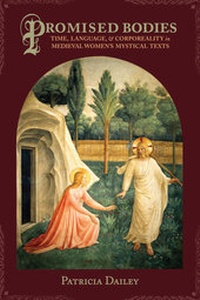
Promised Bodies
Time, Language, and Corporeality in Medieval Women's Mystical Texts
Will be published approx. on 27. August 2013
Book
Hardback
272 pages
978-0-231-16120-6 (ISBN)
Description
In the Christian tradition, especially in the works of Paul, Augustine, and the exegetes of the Middle Ages, the body is a twofold entity consisting of inner and outer persons that promises to find its true materiality in a time to come. A potentially transformative vehicle, it is a dynamic mirror that can reflect the work of the divine within and substantially alter its own materiality if receptive to divine grace. The writings of Hadewijch of Brabant, a thirteenth-century beguine, engage with this tradition in sophisticated ways both singular to her mysticism and indicative of the theological milieu of the twelfth and thirteenth centuries. Crossing linguistic and historical boundaries, Patricia Dailey connects the embodied poetics of Hadewijch's visions, writings, and letters to the work of Julian of Norwich, Hildegard of Bingen, Marguerite of Oingt, and other mystics and visionaries.
She establishes new criteria to more consistently understand and assess the singularity of women's mystical texts and, by underscoring the similarities between men's and women's writings of the time, collapses traditional conceptions of gender as they relate to differences in style, language, interpretative practices, forms of literacy, and uses of textuality.
She establishes new criteria to more consistently understand and assess the singularity of women's mystical texts and, by underscoring the similarities between men's and women's writings of the time, collapses traditional conceptions of gender as they relate to differences in style, language, interpretative practices, forms of literacy, and uses of textuality.
Reviews / Votes
Promised Bodies is a contribution at once to the study of medieval Christian mystical theology and to that of medieval women's religious writing. These two fields are adjacent and have been in dialogue for more than a century, yet they have never engaged with the intellectual energy that Patricia Dailey brings to bear on them here. -- Nicholas Watson, Harvard University Both learned and delightful, both sweeping and precise, Promised Bodies sets a new standard for the study of the mystical tradition in the Western Middle Ages. Reading across linguistic, temporal, and institutional boundaries, Patricia Dailey provides a compelling new perspective on the eternally perplexing nature of embodiment and its formal incarnation in writing. -- Bruce Holsinger, University of Virginia Patricia Dailey's Promised Bodies is a truly remarkable study that will transform the way we read and teach medieval mystical texts. Analyzing the thirteenth-century Middle Dutch writings of the gifted mystic Hadewijch and placing her writings in the context of Pauline and Augustinian conceptions of the body as a "twofold entity" of considerable complexity and their medieval reception, it works out the problem of the body in mystical writing that has plagued literary scholars since they first took on such texts as objects of study in the mid-twentieth century. Integrating her deep knowledge of medieval theology and philosophy, Dailey not only explains why the use of bodily metaphors in the description of mystical experience can be so perplexing, she also makes sense of them. In so doing, she offers us a new means of reading women's mysticism that allows us to appreciate the sophistication of these texts without compartmentalizing them as "merely" somatic and irrational and therefore feminine and incidental. -- Sara Poor, Princeton University Excellent and very full of notes. Choice This work of historical theology will be essential for libraries, graduate students, and scholars of medieval theology in general and of women's mysticism in particular, along with all those interested in the question of embodiment and the relationship between theology and poetics. Horizons An insightful and profound reading of medieval women mystics... Dailey's work is highly recommended for graduate students and scholars of medieval theology and mysticism, as well as scholars of religious literature. Religious Studies Review Represents an important and fresh addition to the debate surrounding gender and the religious literature written by women. Ons Geestelijk Erf Dailey presents a bold new approach to the study of medieval women's mystical literature. -- Jessica A. Boon Modern Philology Dailey's work will now be indispensable for anyone who wants to understand this most elusive of mystics, or to think in a more sophisticated way about mystical bodies. Church HistoryMore details
Series
Language
English
Place of publication
New York
United States
Target group
Professional and scholarly
Product notice
Trade binding
Dimensions
Height: 229 mm
Width: 152 mm
Weight
524 gr
ISBN-13
978-0-231-16120-6 (9780231161206)
Copyright in bibliographic data and cover images is held by Nielsen Book Services Limited or by the publishers or by their respective licensors: all rights reserved.
Schweitzer Classification
Other editions
Additional editions
E-Book
08/2015
1st Edition
De Gruyter
from
€69.95
Available for download
Person
Patricia Dailey is an associate professor of English and comparative literature at Columbia University.
Content
Acknowledgments Abbreviations Introduction 1. Children of Promise, Children of the Flesh: Augustine's Two Bodies 2. The Mystic's Two Bodies: The Temporal and Material Poetics of Visionary Texts 3. Werke and the Postscriptum of the Soul 4. Living Song: Dwelling in Hadewijch's Liederen Conclusion Notes Bibliography Index
Read the introduction: