

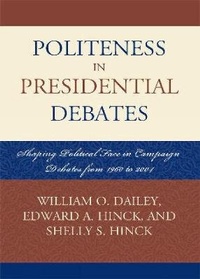
Politeness in Presidential Debates
Shaping Political Face in Campaign Debates from 1960 to 2004
Published on 29. August 2007
Book
Hardback
212 pages
978-0-7425-2974-8 (ISBN)
Description
Politeness and Political Debate analyzes politeness theory and political debate, categorically evaluating politeness strategies in presidential and vice presidential debates from 1960 to 2004. The book also features an introduction to politeness theory and how to apply it to debates. To remedy the lack of information on relational dimensions of debates, politeness theory offers a compelling way of explaining audience assessments of leadership and advocacy skills. The authors summarize the results for each candidate's politeness strategies, relate them to the historical context of the campaign in which they take place, and consider them in relation to other studies conducted on the campaign debates. Debates fall into one of three sections: debating policies; attacking policies and the opponent; and directly attacking the opponent. This well-researched book ends with implications for debate planners, politicians, citizens, and scholars, including an insightful chapter on the electorate's ideal debate.
Reviews / Votes
Because of the precision of this study's methodology, presented in an academic manner, this book can be helpful to scholars of rhetoric. -- Susan Gonders * Journalism & Mass Communication Quarterly, Spring 2009 * In an age where winning elections depends on candidates' images as much as, if not more than, campaign issues, this exceptional analysis is a welcome addition to political communication scholarship. Covering forty-five years of U.S. presidential and vice presidential debates, the authors provide a compelling account of the role politeness plays when political images are at stake. -- John S. Seiter, Utah State University; coauthor, Persuasion: Social Influence and Compliance GainingMore details
Series
Language
English
Place of publication
United States
Publishing group
Bloomsbury Publishing Plc
Product notice
Laminated cover
Dimensions
Height: 236 mm
Width: 163 mm
Thickness: 22 mm
Weight
454 gr
ISBN-13
978-0-7425-2974-8 (9780742529748)
Copyright in bibliographic data and cover images is held by Nielsen Book Services Limited or by the publishers or by their respective licensors: all rights reserved.
Schweitzer Classification
Persons
William O. Dailey is associate professor of communication and dramatic arts at Central Michigan University. Edward A. Hinck is professor and director of forensics at Central Michigan University. Shelly S. Hinck is professor of communication and dramatic arts at Central Michigan University.
Content
Part 1 I: POLITENESS THEORY AND THE STUDY OF CAMPAIGN DEBATES Chapter 2 1 Introduction: Politeness and Political Image in Campaign Debates Chapter 3 2 Politeness in Presidential Campaign Debates: An Overview Chapter 4 3 Vice Presidential Debates Part 5 II: THE ROLE OF POLITENESS IN CAMPAIGN OUTCOMES Chapter 6 4 Debating Policies: The 1960, 1976, and 1980 Campaigns Chapter 7 5 The 1992 and 2000 Presidential Debates Chapter 8 6 Directly Attacking the Opponent: The 1984, 1988, 1996, and 2004 Presidential Debates Part 9 III: IMPLICATIONS FOR DEBATE PLANNERS, POLITICIANS, CITIZENS, AND SCHOLARS Chapter 10 7 Debate Formats and Politeness Chapter 11 8 Politeness, Debates, and Campaign Outcomes Chapter 12 9 An Ideal Debate for the Electorate Chapter 13 10 Conclusions and Recommendations for Future Research Chapter 14 Appendix A: Coding Politeness: Units and Schema Chapter 15 Appendix B: Politeness Schema Chapter 16 References