

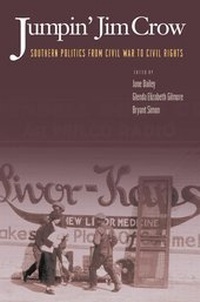
Jumpin' Jim Crow
Southern Politics from Civil War to Civil Rights
Published on 29. October 2000
Book
Hardback
1 pages
978-0-691-00192-0 (ISBN)
Description
White supremacy shaped all aspects of post-Civil War southern life, yet its power was never complete or total. The form of segregation and subjection nicknamed Jim Crow constantly had to remake itself over time even as white southern politicians struggled to extend its grip. Here, some of the most innovative scholars of southern history question Jim Crow's sway, evolution, and methods over the course of a century. These essays bring to life the southern men and women--some heroic and decent, others mean and sinister, most a mixture of both--who supported and challenged Jim Crow, showing that white supremacy always had to prove its power. Jim Crow was always in motion, always adjusting to meet resistance and defiance by both African Americans and whites. Sometimes white supremacists responded with increased ferocity, sometimes with more subtle political and legal ploys. Jumpin' Jim Crow presents a clear picture of this complex negotiation. For example, even as some black and white women launched the strongest attacks on the system, other white women nurtured myths glorifying white supremacy.
Even as elite whites blamed racial violence on poor whites, they used Jim Crow to dominate poor whites as well as blacks. Most important, the book portrays change over time, suggesting that Strom Thurmond is not a simple reincarnation of Ben Tillman and that Rosa Parks was not the first black woman to say no to Jim Crow. From a study of the segregation of household consumption to a fresh look at critical elections, from an examination of an unlikely antilynching campaign to an analysis of how miscegenation laws tried to sexualize black political power, these essays about specific southern times and places exemplify the latest trends in historical research. Its rich, accessible content makes Jumpin' Jim Crow an ideal undergraduate reader on American history, while its methodological innovations will be emulated by scholars of political history generally. In addition to the editors, the contributors are Edward L. Ayers, Elsa Barkley Brown, W. Fitzhugh Brundage, Laura F. Edwards, Kari Frederickson, David F. Godshalk, Grace Elizabeth Hale, Jacquelyn Dowd Hall, Stephen Kantrowitz, Nancy MacLean, Nell Irwin Painter, and Timothy B. Tyson.
Even as elite whites blamed racial violence on poor whites, they used Jim Crow to dominate poor whites as well as blacks. Most important, the book portrays change over time, suggesting that Strom Thurmond is not a simple reincarnation of Ben Tillman and that Rosa Parks was not the first black woman to say no to Jim Crow. From a study of the segregation of household consumption to a fresh look at critical elections, from an examination of an unlikely antilynching campaign to an analysis of how miscegenation laws tried to sexualize black political power, these essays about specific southern times and places exemplify the latest trends in historical research. Its rich, accessible content makes Jumpin' Jim Crow an ideal undergraduate reader on American history, while its methodological innovations will be emulated by scholars of political history generally. In addition to the editors, the contributors are Edward L. Ayers, Elsa Barkley Brown, W. Fitzhugh Brundage, Laura F. Edwards, Kari Frederickson, David F. Godshalk, Grace Elizabeth Hale, Jacquelyn Dowd Hall, Stephen Kantrowitz, Nancy MacLean, Nell Irwin Painter, and Timothy B. Tyson.
Reviews / Votes
In its linking of culture and social relations with politics, Jumpin' Jim Crow is cutting edge history and belongs in every academic library. Library Journal Jumpin Jim Crow offers a valuable contribution to the study of race relations in the American South. -- Junius P. Rodriguez History This is a very important book. It might easily have been subtitled A Treatise on the New Southern Political History. The essays in it are important ones, and they hold together very well. -- Glen Feldman The Virginia Magazine In short, this collection is a revision of how historians think about the postbellum South... It is an important and provocative book. -- Clarence E. Walker The Journal of Southern History A central contribution to these essays ... is to our understanding of how the conflation of notions of manhood, paternalism, and white supremacy blurred and bridged the distinction between the public and private spheres in Southern life and politics. -- Robert P. Green Jr. The HistorianMore details
Language
English
Place of publication
New Jersey
United States
Target group
Professional and scholarly
College/higher education
Product notice
Trade binding
Dimensions
Height: 229 mm
Width: 152 mm
Weight
624 gr
ISBN-13
978-0-691-00192-0 (9780691001920)
Copyright in bibliographic data and cover images is held by Nielsen Book Services Limited or by the publishers or by their respective licensors: all rights reserved.
Schweitzer Classification
Other editions
Additional editions

Jane Dailey | Glenda Elizabeth Gilmore | Bryant Simon
Jumpin' Jim Crow
Southern Politics from Civil War to Civil Rights
E-Book
10/2020
1st Edition
Princeton University Press
€52.49
Available for download
Persons
Jane Dailey is Assistant Professor of History at Rice University and author of Before Jim Crow: The Politics of Race in Post-Emancipation Virginia.
Glenda Elizabeth Gilmore is Professor of History at Yale and author of Gender and Jim Crow: Women and the Politics of White Supremacy in North Carolina, 1896-1920.
Bryant Simon is Associate Professor of History at the University of Georgia and author of A Fabric of Defeat: The Politics of South Carolina Millhands, 1910-1948.
Glenda Elizabeth Gilmore is Professor of History at Yale and author of Gender and Jim Crow: Women and the Politics of White Supremacy in North Carolina, 1896-1920.
Bryant Simon is Associate Professor of History at the University of Georgia and author of A Fabric of Defeat: The Politics of South Carolina Millhands, 1910-1948.
Content
Preface ix Acknowledgments xiii Introduction 3 Chapter 1: by Laura Edwards The Politics of Marriage and Households in North Carolina during Reconstruction 7 Chapter 2: by Elsa Barkely Brown Negotiating and Transforming the Public Sphere: African American Political Life in the Transition from Slavery to Freedom 28 Chapter 3: by Stephen Kantrowwitz One Man's Mob Is Another Man's Militia: Violence, Manhood, and Authority in Reconstruction South Carolina 67 Chapter 4: by Jane Daily The Limits of Liberalism in the New South: The Politics of Race, Sex, and Patronage in Virginia, 1879-1883 88 Chapter 5: by W. Fitzhugh Brundage White Women and the Politics of Historical Memory in the New South, 1880-1920 115 Chapter 6: by David F. Godshalk William J. Northen's Public and Personal Struggles against Lynching 140 Chapter 7: by Grace Elizabeth Hale "For Colored" and "For White": Segregating Consumption in the South 162 Chapter 8: by Nancy MacLean The Leo Frank Case Reconsidered: Vender and Sexual Politics in the Making of Reactionary Populism 183 Chapter 9: by Glenda Elizabeth Gilmore False Friends and Avowed Enemies: Southern African Americans and Party Allegiances in the 1920s 219 Chapter 10: by Bryant Simon Race Reactions: African American Organizing, Liberalism, and White Working-Class Politics in Postwar South Carolina 239 Chapter 11: by Kari Frederickson "As a Man, I Am Interested in States' Rights": Gender, Race, and the Family in the Dixiecrat Party, 1948-195O 260 Chapter 12: by Timothy B. Tyson Dynamite and "The Silent South": A Story from the Second Reconstruction in South Carolina 275 Afterwards Portraying Power by Edward Ayers 301 Reflections by Jacquelyn Dowd Hall 304 The Shoah and Southern History by Nell Irvin Painter 308 Contributors 311 Index 315