

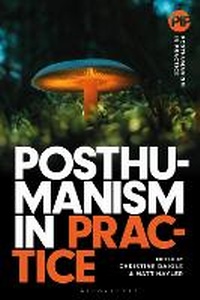
Posthumanism in Practice
Published on 22. August 2024
Book
Paperback/Softback
264 pages
978-1-350-29384-7 (ISBN)
Description
Problematic assumptions which see humans as special and easily defined as standing apart from animals, plants, and microbiota, both consciously and unconsciously underpin scientific investigation, arts practice, curation, education, and research across the social sciences and humanities. This is the case particularly in those traditions emerging from European and Enlightenment philosophies. Posthumanism disrupts these traditional humanist outlooks and interrogates their profound shaping of how we see ourselves, our place in the world, and our role in its protection.
In Posthumanism in Practice, artists, researchers, educators, and curators set out how they have developed and responded to posthumanist ideas across their work in the arts, sciences, and humanities, and provide examples and insights to support the exploration of posthumanism in how we can think, create, and live. In capturing these ideas, Posthumanism in Practice shows how posthumanist thought can move beyond theory, inform action, and produce new artefacts, effects, and methods that are more relevant and more useful for the incoming realities for all life in the 21st century.
In Posthumanism in Practice, artists, researchers, educators, and curators set out how they have developed and responded to posthumanist ideas across their work in the arts, sciences, and humanities, and provide examples and insights to support the exploration of posthumanism in how we can think, create, and live. In capturing these ideas, Posthumanism in Practice shows how posthumanist thought can move beyond theory, inform action, and produce new artefacts, effects, and methods that are more relevant and more useful for the incoming realities for all life in the 21st century.
Reviews / Votes
This book inspires a critical reflection on the breadth of the posthumanist movement and raises questions on how we can tackle real problems of human attitude towards other (human and non-human) beings and the rest of creation. * Science & Christian Belief * This book offers an essential overview of how posthuman perspectives are intervening in the sciences, in the arts, and in education. Daigle and Hayler brought together a beautiful collection of texts, that are urgent, lucidly written and accessible to everyone interested in exploring the consequences of this inclusive and diverse movement. It should be included in every course that aims to map how study the contemporary. * Rick Dolphijn, Associate Professor, Utrecht University, the Netherlands * This transdisciplinary collection testifies to the rigour and ethical import of posthumanism. Traversing the humanities, social sciences, and sciences, Posthumanism in Practice is essential reading for all of us seeking methods, concepts, and creative new ways to bridge disciplines and to resist human exceptionalism in its many forms. * Ada S. Jaarsma, Professor of Philosophy, Mount Royal University, Canada *More details
Series
Language
English
Place of publication
London
United Kingdom
Publishing group
Bloomsbury Publishing PLC
Target group
Professional and scholarly
Dimensions
Height: 229 mm
Width: 150 mm
Thickness: 13 mm
Weight
400 gr
ISBN-13
978-1-350-29384-7 (9781350293847)
Copyright in bibliographic data and cover images is held by Nielsen Book Services Limited or by the publishers or by their respective licensors: all rights reserved.
Schweitzer Classification
Other editions
Additional editions
Christine Daigle | Matthew Hayler
Posthumanism in Practice
E-Book
01/2023
1st Edition
Bloomsbury Academic
€32.99
Available for download
Christine Daigle | Matthew Hayler
Posthumanism in Practice
E-Book
01/2023
1st Edition
Bloomsbury Academic
€32.99
Available for download
Persons
Christine Daigle is Director of the Posthumanism Research Institute at Brock University, Canada. Her work investigates ontological and ethical questions related to posthuman subjectivity and the environmental posthumanities. She currently collaborates with a theatre company on a Social Sciences and Humanities Research Council of Canada (SSHRC) funded project exploring the posthuman of tomorrow via creative practice.
Matt Hayler is Senior Lecturer in Contemporary Literature and Digital Cultures at the University of Birmingham, UK. He has taught courses related to trans- and posthumanism and digital cultures for the last 10 years. His research has looked at posthumanist approaches in the philosophy of technology (Challenging the Phenomena of Technology, 2015) and the production and reception of digital texts (Ambient Literature, 2020), and he now focuses on the meeting points of posthumanism, weird fiction, human enhancement, disability studies, and digital cultures.
Matt Hayler is Senior Lecturer in Contemporary Literature and Digital Cultures at the University of Birmingham, UK. He has taught courses related to trans- and posthumanism and digital cultures for the last 10 years. His research has looked at posthumanist approaches in the philosophy of technology (Challenging the Phenomena of Technology, 2015) and the production and reception of digital texts (Ambient Literature, 2020), and he now focuses on the meeting points of posthumanism, weird fiction, human enhancement, disability studies, and digital cultures.
Content
Introduction: Theory into Praxis, Matt Hayler (University of Birmingham, UK), Christine Daigle (Brock University, Canada)
1. Engineering the Posthuman: Conceiving Handedness and Constructing Disabled Prostheses, Stuart Murray (Leeds University, UK)
2. Posthumanising Biomedicine: The Role of Microbioia in Parkinson Disease Research, Aaron Bradshaw (UCL, UK)
3. Posthumanism and the Limits of Multispecies Relationality, Bryan Lim (Goldsmiths, University of London, UK)
4. Alien Embodiment and Nomadic Subjectivity: A Speculative Report, Steve Klee and Kirsten McKenzie (University of Lincoln, UK)
5. Sympoietic Art Practice with Plants: A Case for Posthuman Co-Expression, Lin Charlston (visual artist)
6. Kneading Bodies, Madaleine Trigg (Massey University, New Zealand)
7. Circus as Practices of Hope, Marie-Andree Robitaille (Stockholm University of the Arts, Sweden)
8. Posthumanism in Play: Entangled Subjects, Agentic Cutscenes, Vibrant Matter, and Species Hybridity, Poppy Wilde (Birmingham City University, UK)
9. Posthumanist Interfaces: Developing New Conceptual Frameworks for Museum Practices in the Context of a Major Museum Technology Collection, Deborah Lawler-Dormer (Museum of Applied Arts and Sciences, Australia) and Christopher John Mueller (Macquarie University, Australia)
10. Affirming Future(s): Towards a Posthumanist Conservation in Practice, Helia Marcal (UCL, UK) and Rebecca Gordon
11. Water, Ice, and Dead 'Tadpoles': Discovering within Undecided Boundaries in Early Childhood Education for Sustainability Research, Debra Harwood (Brock University, Canada)
12. Reflections On a Language Teacher Education Praxis from a Posthumanist Viewpoint, Laryssa Paulino de Queiroz Sousa and Rosane Rocha Pessoa (Federal University of Goias, Brazil)
13. Unlearning to Be Human? The Pedagogical Implications of 21st-Century Postanthropocentrism, Stefan Herbrechter (Heidelberg University, Germany)
14. Posthumanism and Postdisciplinarity: Breaking Our Old Teaching and Research Habits, Christine Daigle (Brock University, Canada)
1. Engineering the Posthuman: Conceiving Handedness and Constructing Disabled Prostheses, Stuart Murray (Leeds University, UK)
2. Posthumanising Biomedicine: The Role of Microbioia in Parkinson Disease Research, Aaron Bradshaw (UCL, UK)
3. Posthumanism and the Limits of Multispecies Relationality, Bryan Lim (Goldsmiths, University of London, UK)
4. Alien Embodiment and Nomadic Subjectivity: A Speculative Report, Steve Klee and Kirsten McKenzie (University of Lincoln, UK)
5. Sympoietic Art Practice with Plants: A Case for Posthuman Co-Expression, Lin Charlston (visual artist)
6. Kneading Bodies, Madaleine Trigg (Massey University, New Zealand)
7. Circus as Practices of Hope, Marie-Andree Robitaille (Stockholm University of the Arts, Sweden)
8. Posthumanism in Play: Entangled Subjects, Agentic Cutscenes, Vibrant Matter, and Species Hybridity, Poppy Wilde (Birmingham City University, UK)
9. Posthumanist Interfaces: Developing New Conceptual Frameworks for Museum Practices in the Context of a Major Museum Technology Collection, Deborah Lawler-Dormer (Museum of Applied Arts and Sciences, Australia) and Christopher John Mueller (Macquarie University, Australia)
10. Affirming Future(s): Towards a Posthumanist Conservation in Practice, Helia Marcal (UCL, UK) and Rebecca Gordon
11. Water, Ice, and Dead 'Tadpoles': Discovering within Undecided Boundaries in Early Childhood Education for Sustainability Research, Debra Harwood (Brock University, Canada)
12. Reflections On a Language Teacher Education Praxis from a Posthumanist Viewpoint, Laryssa Paulino de Queiroz Sousa and Rosane Rocha Pessoa (Federal University of Goias, Brazil)
13. Unlearning to Be Human? The Pedagogical Implications of 21st-Century Postanthropocentrism, Stefan Herbrechter (Heidelberg University, Germany)
14. Posthumanism and Postdisciplinarity: Breaking Our Old Teaching and Research Habits, Christine Daigle (Brock University, Canada)