

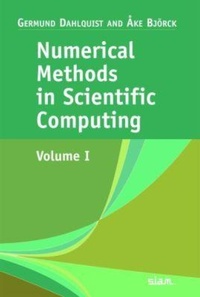
Numerical Methods in Scientific Computing
Volume 1
Will be published approx. on 30. May 2008
Book
Hardback
744 pages
978-0-89871-644-3 (ISBN)
Description
Addresses the increasingly-important role of numerical methods in science and engineering. While treating traditional and well-developed topics, it also emphasizes concepts and ideas of importance to the design of accurate and efficient algorithms with applications to scientific computing. Although this volume is self-contained, more comprehensive treatments of matrix computations will be given in a forthcoming volume.
Numerical Methods in Scientific Computing, Volume I enriches the traditional content of interpolation, approximation, Fourier analysis, quadrature, and root-finding with other material that is rarely found in numerical analysis texts, such as interval arithmetic, elementary functions, operator series, convergence acceleration, and continued fractions. The authors also include review questions, problems, and computer exercises drawn from 40 years of teaching. More than 60 short biographical notes on mathematicians who have made significant contributions to numerical analysis illustrate the connections that pervade the discipline.
A supplementary Website contains three appendices: an introduction to matrix computations; a description of Mulprec, a MATLAB (R) multiple precision package; and a guide to literature, algorithms, and software in numerical analysis.
Numerical Methods in Scientific Computing, Volume I enriches the traditional content of interpolation, approximation, Fourier analysis, quadrature, and root-finding with other material that is rarely found in numerical analysis texts, such as interval arithmetic, elementary functions, operator series, convergence acceleration, and continued fractions. The authors also include review questions, problems, and computer exercises drawn from 40 years of teaching. More than 60 short biographical notes on mathematicians who have made significant contributions to numerical analysis illustrate the connections that pervade the discipline.
A supplementary Website contains three appendices: an introduction to matrix computations; a description of Mulprec, a MATLAB (R) multiple precision package; and a guide to literature, algorithms, and software in numerical analysis.
Reviews / Votes
'This work is a monumental undertaking and represents the most comprehensive textbook survey of numerical analysis to date. It will be an important reference in the field for many years to come.' Nicholas J. Higham, University of ManchesterMore details
Language
English
Place of publication
New York
United States
Target group
Professional and scholarly
Product notice
sewn/stitched
Cloth over boards
Dimensions
Height: 267 mm
Width: 187 mm
Thickness: 45 mm
Weight
1446 gr
ISBN-13
978-0-89871-644-3 (9780898716443)
Copyright in bibliographic data and cover images is held by Nielsen Book Services Limited or by the publishers or by their respective licensors: all rights reserved.
Schweitzer Classification
Persons
Germund Dahlquist (1925-2005) founded the Department of Numerical Analysis at the Royal Institute of Technology in Stockholm, Sweden, in 1962. He was a pioneer in the field of numerical analysis, whose fundamental work on the solution of differential equations has been recognised by the International Germund Dahlquist Prize, awarded biennially by SIAM since 1995. Ake Bjoerck is a professor in the Department of Mathematics at Linkoeping University in Sweden.
Content
List of Figures
List of Tables
List of Conventions
Preface
Chapter 1: Principles of Numerical Calculations
Chapter 2: How to Obtain and Estimate Accuracy
Chapter 3: Series, Operators, and Continued Fractions
Chapter 4: Interpolation and Approximation
Chapter 5: Numerical Integration
Chapter 6: Solving Scalar Nonlinear Equations
Bibliography
Index
Online Appendix A: Introduction to Matrix Computations
Online Appendix B: A MATLAB Multiple Precision Package
Online Appendix C: Guide to Literature.
List of Tables
List of Conventions
Preface
Chapter 1: Principles of Numerical Calculations
Chapter 2: How to Obtain and Estimate Accuracy
Chapter 3: Series, Operators, and Continued Fractions
Chapter 4: Interpolation and Approximation
Chapter 5: Numerical Integration
Chapter 6: Solving Scalar Nonlinear Equations
Bibliography
Index
Online Appendix A: Introduction to Matrix Computations
Online Appendix B: A MATLAB Multiple Precision Package
Online Appendix C: Guide to Literature.