

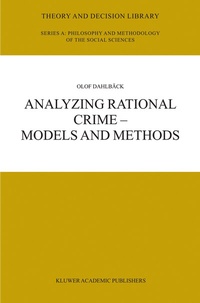
Analyzing Rational Crime - Models and Methods
Published on 31. October 2003
Book
Hardback
X, 218 pages
978-1-4020-1657-8 (ISBN)
Description
Olof Dahlbäck's book breaks new ground for the analysis of crime from a rationality perspective by presenting models and methods that go far beyond those with which researchers have hitherto been equipped. The book examines single crimes, individual criminality, and societal crime, and it discusses thoroughly the general decision theoretical presuppositions necessary for analyzing these various types of crime. An expected utility maximization model for a single discrete choice regarding the commission of a crime is the foundation of most of the analyses presented. A version of this model is developed that permits interpersonal comparisons, and this basic model is used when deriving more complex models of crime as well as when analyzing the potential for such derivations. The rigorous, powerful methods suggested provide considerable opportunities for improving research and for seeing old problems in a new light.
More details
Series
Edition
2003 ed.
Language
English
Place of publication
Dordrecht
Netherlands
Target group
Professional and scholarly
Research
Illustrations
X, 218 p.
Dimensions
Height: 241 mm
Width: 160 mm
Thickness: 18 mm
Weight
518 gr
ISBN-13
978-1-4020-1657-8 (9781402016578)
DOI
10.1007/978-94-017-0721-3
Schweitzer Classification
Other editions
Additional editions
Olof Dahlbäck
Analyzing Rational Crime - Models and Methods
E-Book
04/2013
Springer
€96.29
Available for download
Olof Dahlbäck
Analyzing Rational Crime - Models and Methods
Book
12/2010
Springer
€106.99
Shipment within 15-20 days
Content
1. The Assumption of Rationality.- 2. Rational Decisions under Conditions of Risk.- 3. Descriptive Validity of the Rationality Theories of Expected Utility Maximization.- 4. Interpersonal Comparison of Utility.- 5. Previous Research.- 6. Research Strategies.- 7. Analyzing the Bivariate Linear Relationships between Choice and Punishment Factors.- 8. Experimental Analysis.- 9. Nonexperimental Analysis.- 10. Applying the Rationality Model to Individual Criminality.- 11. Rationality and Proneness to Taking Risks.- 12. Societal Crime.- 13. Previous Research on Individual Criminality.- 14. Previous Research on Societal Crime.- 15. An Aggregation Model.- 16. Basing the Analysis on Crime Opportunity and Crime Propensity Factors.- Summary and Conclusions.- References.- Appendix 1. A General Method for the Simultaneous Determination of Outcome Utility and Risk-Taking.- Equivalencies in utility Problems in determining the functions The method.- Appendix 2. Derivation of Formulas in Chapter 7.- Appendix 3. Proof of Statement in Chapter 7.