

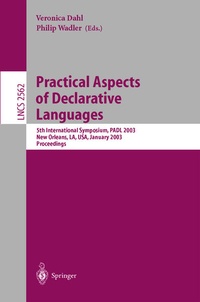
Practical Aspects of Declarative Languages
5th International Symposium, PADL 2003, New Orleans, LA, USA, January 13-14, 2003, Proceedings
Published on 13. December 2002
Book
Paperback/Softback
X, 414 pages
978-3-540-00389-2 (ISBN)
Description
The Fifth International Symposium on Practical Aspects of Declarative L- guages (PADL 2003) was held in New Orleans on 13-14 January 2003. It was colocatedwiththe30thAnnualACMSymposiumonPrinciplesofProgramming Languages(POPL2003). We received 57 submissions, a record for PADL. One of the strengths of PADL is that it draws papers from both sides of the declarative divide, from boththefunctionalandlogicprogrammingcommunities.Ofthe57submissions, 25werefunctionaland32werelogical,withsomenotableoverlaps. The program committee was divided on the approach to take to the con- rence.Thosefromthelogicprogrammingcommunitypreferredtohaveparallel sessionsinordertoacceptmorepapers,thosefromthefunctionalprogramming communitypreferredtoavoidparallelsessionsthoughitmeantacceptingfewer papers. We decided to ?nd strength in diversity, and experiment with taking both paths. We accepted 8 papers on functional programming, each presented initsownslot,and15papersonlogicprogramming,10ofwhicharepresentedin parallelsessions.Wefeltthatpapersfrombothcommunitieswerecomparablein quality.Theratioof4hoursoffunctionaltalksto5hoursoflogictalksmatches theratioofsubmissions.
WhilemostpaperssubmittedtoPADLaretraditionalresearchpapers,some weresubmittedasApplicationLettersorDeclarativePearls.Traditionalpapers maybejudgedonwhethertheypresentacrispnewresearchresult;Application Lettersmaybejudgedaccordingtotheinterestintheapplicationandthenovel useofdeclarativelanguages;andDeclarativePearlsmaybejudgedaccordingto theeleganceofthedevelopmentandtheclarityoftheexpression. This year PADL instituted a "Most Practical" paper award, for the paper that best exempli?ed the goals of PADL. The award went to "Data mining the yeast genome in a lazy functional language", Amanda Clare and Ross D. King,UniversityofWales,Aberystwyth,whichdescribesareal-wordapplication runningonmultiprocessors,drawingontechniquesfromboththefunctionaland logicprogrammingcommunities. Special thanks are due: to Shriram Krishnamurthi, Dave Tucker, and Paul Graunke of Brown University, for running the website of the PADL submission andreviewprocess(seeKrishnamurthi'sinvitedtalkinthisvolume);toMartina SharpofAvayaLabsandKimberlyVollofSimonFraserUniversity,forhelpwith preparingthisvolume;andtoGopalGuptaoftheUniversityofTexasatDallas, for serving as general chair.
We thank Avaya Labs, Brown University, Simon FraserUniversity,Universit' edeProvence,andtheUniversityofTexasatDallas fortheirsupport. Ourthankstotheprogramcommitteemembersandrefereesfortheirrev- wingandfortheiradvice.Finally,ourthankstoallthosewhosubmittedpapers toorparticipatedinPADL2003.
WhilemostpaperssubmittedtoPADLaretraditionalresearchpapers,some weresubmittedasApplicationLettersorDeclarativePearls.Traditionalpapers maybejudgedonwhethertheypresentacrispnewresearchresult;Application Lettersmaybejudgedaccordingtotheinterestintheapplicationandthenovel useofdeclarativelanguages;andDeclarativePearlsmaybejudgedaccordingto theeleganceofthedevelopmentandtheclarityoftheexpression. This year PADL instituted a "Most Practical" paper award, for the paper that best exempli?ed the goals of PADL. The award went to "Data mining the yeast genome in a lazy functional language", Amanda Clare and Ross D. King,UniversityofWales,Aberystwyth,whichdescribesareal-wordapplication runningonmultiprocessors,drawingontechniquesfromboththefunctionaland logicprogrammingcommunities. Special thanks are due: to Shriram Krishnamurthi, Dave Tucker, and Paul Graunke of Brown University, for running the website of the PADL submission andreviewprocess(seeKrishnamurthi'sinvitedtalkinthisvolume);toMartina SharpofAvayaLabsandKimberlyVollofSimonFraserUniversity,forhelpwith preparingthisvolume;andtoGopalGuptaoftheUniversityofTexasatDallas, for serving as general chair.
We thank Avaya Labs, Brown University, Simon FraserUniversity,Universit' edeProvence,andtheUniversityofTexasatDallas fortheirsupport. Ourthankstotheprogramcommitteemembersandrefereesfortheirrev- wingandfortheiradvice.Finally,ourthankstoallthosewhosubmittedpapers toorparticipatedinPADL2003.
More details
Series
Edition
2003 ed.
Language
English
Place of publication
Berlin
Germany
Publishing group
Springer Berlin
Target group
Professional and scholarly
Research
Illustrations
X, 414 p.
Dimensions
Height: 235 mm
Width: 155 mm
Thickness: 23 mm
Weight
639 gr
ISBN-13
978-3-540-00389-2 (9783540003892)
DOI
10.1007/3-540-36388-2
Schweitzer Classification
Other editions
Additional editions
Veronica Dahl | Philip Wadler
Practical Aspects of Declarative Languages
5th International Symposium, PADL 2003, New Orleans, LA, USA, January 13-14, 2003, Proceedings
E-Book
07/2003
Springer
€53.49
Available for download
Persons
Content
Invited Papers.- The Role of Declarative Languages in Mining Biological Databases.- The Continue Server (or, How I Administered PADL 2002 and 2003).- Zen and the Art of Symbolic Computing: Light and Fast Applicative Algorithms for Computational Linguistics.- Papers.- Data Mining the Yeast Genome in a Lazy Functional Language.- Non-monotonic Reasoning on Beowulf Platforms.- Datalog with Constraints: A Foundation for Trust Management Languages.- Web Programming with SMLserver.- An Integrated Information System Powered by Prolog.- JMatch: Iterable Abstract Pattern Matching for Java.- Sequence Quantification.- Roll: A Language for Specifying Die-Rolls.- Reconstructing the Evolutionary History of Indo-European Languages Using Answer Set Programming.- Multi-agent Reactive Systems.- ACTILOG: An Agent Activation Language.- Logic Programs for Querying Inconsistent Databases.- A CLP-Based Tool for Computer Aided Generation and Solving of Maths Exercises.- A Logical Framework for Modelling eMAS.- SXSLT: Manipulation Language for XML.- Type-Based XML Processing in Logic Programming.- WAM Local Analysis.- Garbage Collection Algorithms for Java-Based Prolog Engines.- Solving Combinatorial Problems with a Constraint Functional Logic Language.- Logic Programs as Compact Denotations.- A Strafunski Application Letter.- Functional Hybrid Modeling.- Lambda Goes to Hollywood.