

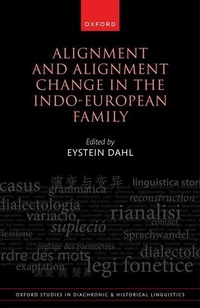
Alignment and Alignment Change in the Indo-European Family
Published on 26. August 2022
Book
Hardback
388 pages
978-0-19-885790-7 (ISBN)
Description
This volume brings together work from leading specialists in Indo-European languages to explore the macro- and micro-dynamic factors that contribute to variation and change in alignment and argument realization. Alignment is taken to include both basic alignment patterns associated with major construction types, as well as various valency-decreasing constructions such as passives, anticausatives, and impersonals. The chapters explore synchronic and diachronic aspects of alignment morphosyntax based on data from Anatolian, Indo-Iranian, Greek, Italic, Armenian, and Slavic. All have a strong empirical focus, drawing on both qualitative and quantitative methods, and range from broad comparative studies to detailed investigations of specific constructions in individual languages. The book is one of very few studies to examine variation and change in alignment typology across languages in a single family. It contributes to a greater understanding of the roles played by analogy/extension, reanalysis, and areal factors in alignment change, and demonstrates the extent of variation found in the morphosyntax of argument realization in genetically-related languages.
More details
Series
Language
English
Place of publication
Oxford
United Kingdom
Target group
College/higher education
Product notice
sewn/stitched
Cloth over boards
Dimensions
Height: 237 mm
Width: 164 mm
Thickness: 27 mm
Weight
866 gr
ISBN-13
978-0-19-885790-7 (9780198857907)
Copyright in bibliographic data and cover images is held by Nielsen Book Services Limited or by the publishers or by their respective licensors: all rights reserved.
Schweitzer Classification
Other editions
Additional editions
E-Book
08/2022
1st Edition
OUP eBook
€75.49
Available for download
Person
Eystein Dahl is a Research Associate in the Department of Language and Culture at UiT - The Arctic University of Norway. He has previously held positions at the University of Bergen, and at Goethe University in Frankfurt. His primary research interests lie in the interface between comparative philology and diachronic typology, and much of his recent work focuses on tense/aspect semantics, alignment typology, and morphosyntactic change in Vedic Sanskrit, Latin, Ancient Greek, and Hittite.
Content
- 1: Eystein Dahl: Alignment and alignment change in the Indo-European family and beyond
- 2: Eystein Dahl: Alignment in Proto-Indo-European
- 3: Paola Cotticelli and Eystein Dahl: Split-alignment, mixed alignment, and non-canonical argument marking in some archaic Indo-European languages
- 4: Silvia Luraghi and Guglielmo Inglese (with an appendix by Petra Goedegebuure): The origin of ergative case markers: The case of Hittite revised
- 5: Hans Henrich Hock: Passives and anticausatives in Vedic Sanskrit: Synchronic and diachronic perspectives
- 6: Michela Cennamo and Claudia Fabrizio: Non-nominative arguments, active impersonals, and control in Latin
- 7: Claudia Fabrizio: Infinitives and subjecthood between Latin and Old Italian
- 8: Chantal Melis: Alignment changes with Spanish experiential verbs
- 9: Robin Meyer: Armenian morphosyntactic alignment in diachrony
- 10: Ilja A. Ser?ant, Björn Wiemer, Eleni Bu?arovska, Martina Ivanová, Maxim Makartsev, Stefan Savi¿, Dmitri Sitchinava, Karolína Skwarska, and Mladen Uhlik: Areal and diachronic trends in argument flagging across Slavic