

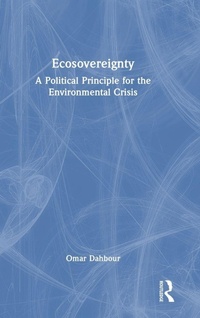
Ecosovereignty
A Political Principle for the Environmental Crisis
1st Edition
Published on 23. December 2024
Book
Hardback
254 pages
978-1-032-93902-5 (ISBN)
Description
In this book, Omar Dahbour develops the idea of ecosystem sovereignty, calling for a reinterpretation of some essential concepts in political philosophy, including territoriality, self-determination, peoplehood, and sovereignty, in order to make the case for peoples' rights to protect and maintain their natural environments. In doing so, he theorizes current and historical struggles against resource extractions and land grabs, especially by food sovereignty and indigenous rights movements.
The basic idea of ecosovereignty is that peoples living in relation to particular ecosystems have a collective right to ultimate authority over those systems and the resources they contain-provided they manage them sustainably. Dahbour argues that this authority has a legitimacy that overrides that of larger states, at least with regard to matters of environmental management. Ecosovereignty claims may strengthen challenges by peoples to states and corporations seeking to control and transform lands and waters for development, against the wishes of their inhabitants. Dahbour hopes the idea will provide a powerful tool for halting extractivism and ecocide, along with the extreme violence that these processes use against farming, indigenous peoples, and nature.
Connecting political and environmental philosophy in an innovative way, Ecosovereignty: A Political Principle for the Environmental Crisis will keep scholars and students informed about an increasingly important topic.
The basic idea of ecosovereignty is that peoples living in relation to particular ecosystems have a collective right to ultimate authority over those systems and the resources they contain-provided they manage them sustainably. Dahbour argues that this authority has a legitimacy that overrides that of larger states, at least with regard to matters of environmental management. Ecosovereignty claims may strengthen challenges by peoples to states and corporations seeking to control and transform lands and waters for development, against the wishes of their inhabitants. Dahbour hopes the idea will provide a powerful tool for halting extractivism and ecocide, along with the extreme violence that these processes use against farming, indigenous peoples, and nature.
Connecting political and environmental philosophy in an innovative way, Ecosovereignty: A Political Principle for the Environmental Crisis will keep scholars and students informed about an increasingly important topic.
More details
Language
English
Place of publication
London
United Kingdom
Publishing group
Taylor & Francis Ltd
Target group
College/higher education
Postgraduate, Undergraduate Advanced, and Undergraduate Core
Dimensions
Height: 235 mm
Width: 157 mm
Thickness: 19 mm
Weight
540 gr
ISBN-13
978-1-032-93902-5 (9781032939025)
Copyright in bibliographic data and cover images is held by Nielsen Book Services Limited or by the publishers or by their respective licensors: all rights reserved.
Schweitzer Classification
Other editions
Additional editions
E-Book
12/2024
1st Edition
Routledge
€51.49
Available for download
E-Book
12/2024
1st Edition
Routledge
€51.49
Available for download
Book
12/2024
1st Edition
Routledge
€59.90
Shipment within 10-20 days
Person
Omar Dahbour is Professor of Philosophy at Hunter College and Graduate School, City University of New York, and author of Illusion of the Peoples (2003), Self-Determination without Nationalism (2013), and other writings on global ethics, environmental philosophy, and critical theory.
Content
Introduction. Part 1: The Social Movements 1. Food Sovereignty and Ecological Distribution Conflicts 2. Indigenous and Place-Based Rights Part 2: Territorial Rights 3. The New Importance of Land and Territory 4. An Ecosystem-Based Right to Territory Part 3: Sovereignty Claims 5. The Revival of Political Sovereignty 6. From Self-Determination to Ecosovereignty Part 4: The Political Struggle 7. Extractivism and Environmental Justice 8. Environmental Governance and Ecosovereignty. Conclusion