

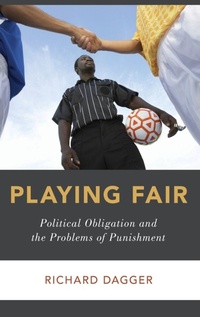
Playing Fair
Political Obligation and the Problems of Punishment
Published on 12. July 2018
Book
Hardback
320 pages
978-0-19-938883-7 (ISBN)
Description
While much has been written on both political obligation and the justification of punishment, there has been little sustained effort to link the two.
In Playing Fair, Richard Dagger aims to fill this gap and provide a unified theory of political obligation and the justification of punishment that takes its bearings from the principle of fair play. To do this, he first establishes the principle of fair playthe idea that people in a cooperative venture have obligations to one another to shoulder a fair share of the burdens because they receive a fair share of the benefits of cooperationas the basis of political obligation. Dagger then argues that the members of a reasonably just polity have an obligation to obey its laws because they have an obligation of reciprocity, or fair play, to one another. This theory of political obligation provides answers to fundamental and still debated questions about how to justify punishment, who has the right to carry it out, and how much to punish.
Playing Fair brings two long-standing concerns of political and legal philosophy together to rebut those who deny the possibility of a general obligation to obey the law, to defend the link between political authority and obligation, and to establish the proper scope of criminal law.
In Playing Fair, Richard Dagger aims to fill this gap and provide a unified theory of political obligation and the justification of punishment that takes its bearings from the principle of fair play. To do this, he first establishes the principle of fair playthe idea that people in a cooperative venture have obligations to one another to shoulder a fair share of the burdens because they receive a fair share of the benefits of cooperationas the basis of political obligation. Dagger then argues that the members of a reasonably just polity have an obligation to obey its laws because they have an obligation of reciprocity, or fair play, to one another. This theory of political obligation provides answers to fundamental and still debated questions about how to justify punishment, who has the right to carry it out, and how much to punish.
Playing Fair brings two long-standing concerns of political and legal philosophy together to rebut those who deny the possibility of a general obligation to obey the law, to defend the link between political authority and obligation, and to establish the proper scope of criminal law.
Reviews / Votes
Do we have a duty to obey the law?' and What gives us the right to punish?' are two pressing yet seemingly separate questions. Richard Dagger connects them more clearly than anyone else has. Both are, he explains, a matter of fairness. Agree or not, after reading Dagger you will see these perennial questions in a fresh light. * William A. Edmundson, Georgia State University, and author of Three Anarchical Fallacies * Richard Dagger, for the first time, presents both a theory of political obligation and a theory of punishment under the principle of fair play. Forceful arguments on the two subjects combine for a powerful overall theory. * George Klosko, Henry L. and Grace Doherty Professor of Politics, University of Virginia * Playing Fair expertly canvasses a number of debates on the justification of political obligation and the justification of punishment in order to develop a unified account of these two problems. Dagger's arguments are compelling and elegantly presented. This is a timely and important book. * Massimo Renzo, King's College London *More details
Series
Language
English
Place of publication
New York
United States
Target group
Professional and scholarly
Dimensions
Height: 240 mm
Width: 161 mm
Thickness: 22 mm
Weight
640 gr
ISBN-13
978-0-19-938883-7 (9780199388837)
Copyright in bibliographic data and cover images is held by Nielsen Book Services Limited or by the publishers or by their respective licensors: all rights reserved.
Schweitzer Classification
Other editions
Additional editions

E-Book
06/2018
1st Edition
OUP eBook
€34.99
Available for download

E-Book
06/2018
1st Edition
OUP eBook
€26.49
Available for download
Person
Richard Dagger is E. Claiborne Robins Distinguished Chair in the Liberal Arts and Professor of Political Science and Philosophy, Politics, Economics and Law at the University of Richmond. He is the author of Civic Virtue: Rights, Citizenship, and Republican Liberalism (OUP).
Author
E. Claiborne Robins Distinguished Chair in the Liberal Arts, Professor of Political Science and Philosophy, Politics, Economics and LawE. Claiborne Robins Distinguished Chair in the Liberal Arts, Professor of Political Science and Philosophy, Politics, Economics and Law, University of Richmond
Content
Acknowledgments
Introduction
Part I: Political Obligation as Fair Play
1. Political Obligation: Concepts and Challenges
2. Fair Play and Cooperative Practices
3. Fair Play and Its Rivals
4. Political Obligation as Fair Play: Elaboration and Defense
Part II: Punishment as Fair Play
5. Justifying Punishment: Concepts and Challenges
6. Playing Fair with Punishment: Elaboration and Defense
7. Punishing Fairly
Part III: Fair Play and the Polity
8. Authority, Deference, and Fair Play
9. Political Obligation, Punishment, and the Polity
Index
Introduction
Part I: Political Obligation as Fair Play
1. Political Obligation: Concepts and Challenges
2. Fair Play and Cooperative Practices
3. Fair Play and Its Rivals
4. Political Obligation as Fair Play: Elaboration and Defense
Part II: Punishment as Fair Play
5. Justifying Punishment: Concepts and Challenges
6. Playing Fair with Punishment: Elaboration and Defense
7. Punishing Fairly
Part III: Fair Play and the Polity
8. Authority, Deference, and Fair Play
9. Political Obligation, Punishment, and the Polity
Index