

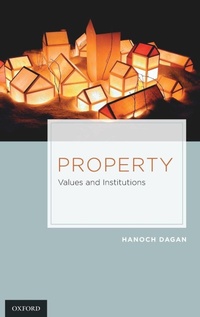
Property
Values and Institutions
Published on 17. March 2011
Book
Hardback
352 pages
978-0-19-973786-4 (ISBN)
Description
Property: Values and Institutions, by Hanoch Dagan, offers an original understanding of property, different from the dominant voices in the field, yet loyal to the practice of property. It rejects the misleading dominant binarism in which property is either one monistic form, structured around Blackstone's (in)famous formula of sole and despotic dominion, or a formless bundle of rights. Instead, it conceptualizes property as an umbrella for a set of institutions bearing a mutual family resemblance. It resists the prevailing tendency to discuss property through the prism of only one particular value, notably efficiency. Dagan argues that property can, and should, serve a pluralistic set of liberal values. These property values include not only autonomy and utility, which are emphasized by many contemporary scholars, but also labor, personhood, community, and distributive justice.
Dagan claims that property law, at least at its best, tailors different configurations of entitlements to different property institutions, with each such institution designed to match the specific balance between property values best suited to its characteristic social setting. Dagan develops this theoretical account and applies it to key doctrinal contexts. In particular, he analyzes the normative underpinnings of the doctrines regulating the interactions between landowners and governments (both eminent domain and regulatory takings doctrines) and those regulating the governance of property owned by multiple owners (such as co-ownership, marital property, and the law of common interest communities).
Dagan claims that property law, at least at its best, tailors different configurations of entitlements to different property institutions, with each such institution designed to match the specific balance between property values best suited to its characteristic social setting. Dagan develops this theoretical account and applies it to key doctrinal contexts. In particular, he analyzes the normative underpinnings of the doctrines regulating the interactions between landowners and governments (both eminent domain and regulatory takings doctrines) and those regulating the governance of property owned by multiple owners (such as co-ownership, marital property, and the law of common interest communities).
Reviews / Votes
"Professor Dagan's theory of property is unique and profoundly important. He offers the possibility of a via media between two poles prominent in American property scholarship: the law-and-economics approach and the Aristotelian approach. His book addresses questions that are central to the fundamental controversies in property theory today, and it should be read by anyone even remotely interested in matters of property and the state."--Gregory S. Alexander, A. Robert Noll Professor of Law, Cornell University
"Professor Dagan's central focus is that property is neither a singular right nor a collection of values. Rather, it is an institution which takes on different forms in different social settings; different in the context of marriage or common interest communities than in commerce or industry, and differently still in the context of copyright. This passionately argued book is full of insights. For anyone interested in property law, property theory, or
intellectual property, its careful study will be richly repaid."
--Thomas W. Merrill, Charles Evans Hughes Professor of Law, Columbia Law School
"Equal parts sophisticated and sensible, ambitious and precise, this book is an important re-assessment of the debates that define today's study of property. Its discussion is also a meditation-by-example on legal scholarship. Hanoch Dagan's morally sensitive pluralism and careful attention to institutions identify this work as both an essential treatment of property and a model for all normative approaches to the law."
--Jedediah Purdy, Professor of Law, Duke Law School
"This book is a heartfelt call to a new understanding of what property is and what it does for us. Dagan argues for a clear but nuanced approach that recognizes that property contains multiple institutions and plural values; that property rights vary depending on social context; that property rights change over time as values and circumstances change; and that rights to acquire property are as important as rights to exclude others from what one owns. This book
is a tour de force."
--Joseph William Singer, Bussey Professor of Law, Harvard Law School
More details
Language
English
Place of publication
New York
United States
Target group
Professional and scholarly
Dimensions
Height: 240 mm
Width: 161 mm
Thickness: 24 mm
Weight
734 gr
ISBN-13
978-0-19-973786-4 (9780199737864)
Copyright in bibliographic data and cover images is held by Nielsen Book Services Limited or by the publishers or by their respective licensors: all rights reserved.
Schweitzer Classification
Other editions
Additional editions
E-Book
03/2011
1st Edition
OUP eBook
€58.99
Available for download
Person
Hanoch Dagan is the Dean of the Tel Aviv University Faculty of Law and the founding director of the Zvi Meitar Center of Advanced Legal Studies at TAU. He is also a member of the American Law Institute and of the International Academy of Comparative Law. Professor Dagan wrote Unjust Enrichment: A Study of Private Law and Public Values and The Law and Ethics of Restitution (both with Cambridge University Press) as well as numerous articles on property, restitution, and private law theory. His articles were published in leading legal journals such as Yale Law Journal, Columbia Law Review, New York University Law Review, California Law Review, Virginia Law Review, Michigan Law Review, Cornell Law Review, and University of Toronto Law Journal.
Content
Prologue: Property and Realism ; Part One: Property ; 1. The Craft of Property ; 2. Exclusion and Inclusion in Property ; 3. From Independence and Interdependence to the Pluralism of Property ; 4. Property and the Public Domain ; Part Two: State ; 5. Takings and Distributive Justice ; 6. Just Compensation, Incentives, and Social Meanings ; 7. Re-Imagining Takings Law ; Part Three: Community ; 8. The Liberal Commons ; 9. Properties of Marriage ; 10. Conflicts in Property