

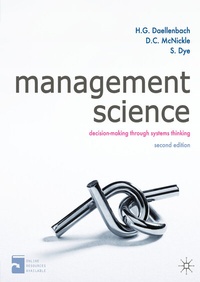
Management Science
Description
The book bases management science within a clear systems thinking framework. Ideas and concepts are demonstrated with real-life examples and case studies. Readers are shown how decision making over time, under uncertainty, and subject to constraints, multiple objectives, and value and perception conflicts can be modelled, all within this system thinking framework.
The second edition of Management Science offers:
an emphasis on problem formulation, indicating how management science and operational research techniques fit into the wider problem-solving process
revised chapters on queuing, simulation, and problem structuring methods
updated coverage of forecasting, linear and integer programming
new sections on the role of management science consultants
improved pedagogy, navigation and design
up-to-date coverage of software
real-world case studies, encouraging the reader to apply the concepts studied
Comprehensive student and lecturer resources are available at www.palgrave.com/business/daellenbach2.
Reviews / Votes
'For those wishing to understand how MS/OR work is really done, Management Science provides an excellent introduction. Instead of assuming that MS/OR is a set of techniques and demonstrating its use on simple artificial problems, this book places MS/OR in the context of real decision-making and the processes by which decisions are made.' - Professor Stewart Robinson, Associate Dean Research, Loughborough University, UKMore details
Other editions
Previous edition
Persons
DONALD McNICKLE is a senior lecturer in the Department of Management at the University of Canterbury, Christchurch, New Zealand.
SHANE DYE is a senior lecturer in Management Science at the University of Canterbury, Christchurch, New Zealand.
Content
Preface.- Introduction.- PART I: SYSTEMS AND SYSTEMS THINKING: INTRODUCTION.- Systems Thinking and Systems Methodology.- Systems Concepts.- The Problem Situation.- System Models and Diagrams.- PART II: MANAGEMENT SCIENCE METHODOLOGIES: INTRODUCTION.- Overview of Hard OR Methodology.- Soft System Thinking.- Implementation and Code of Ethics.- PART III: ASSESSING COSTS AND BENEFITS, DEALING WITH TIME.- Relevant Costs and Benefits.- Discounted Cash Flows.- Decision Making Over Time.- PART IV: HARD MS/OR METHODS.- Marginal and Incremental Analysis.- Constrained Decision Making.- Multiple Constraints Linear Programming.- Uncertainty.- Waiting Lines: Stochastic Systems.- Simulation in Management Science.- Decision and Risk Analysis.- Decisions with Multiple Objectives.- Bibliography.- Glossary of Technical Terms.- Index.