

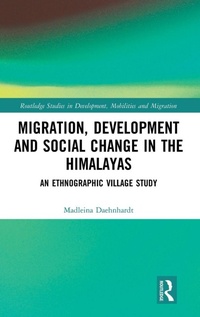
Migration, Development and Social Change in the Himalayas
An Ethnographic Village Study
1st Edition
Published on 31. July 2019
Book
Hardback
244 pages
978-0-367-15096-9 (ISBN)
Description
This book teases out the reasons for, and the socio-economic impacts of, different types of migration on contemporary rural households and individuals. The author creatively depicts the dynamic microcosm of one village in the North Indian Kumaun Himalayas, near the border with Chinese Tibet, giving voice to the life stories of a range of migrants. Through this ethnography, migration is revealed as a fundamental part of the multifaceted 21st-century changes which the village is experiencing.
From elderly women, to unemployed men, young farm women and local children, the book demonstrates how village life is continually constituted socially and economically by overlapping migration patterns - including outmigration, return migration, in-migration and even non-migration. Extending the argument, the author demonstrates that the village microcosm is linked to many other villages which are microcosms in their own right as well as in relation to the main village across a spatial hierarchy.
The theoretical implications of the study are teased out to inform our understanding of rural-urban migration trends and impacts more generally, and as such the book will be of interest to researchers of the South Asian region but also of internal migration in the global context.
From elderly women, to unemployed men, young farm women and local children, the book demonstrates how village life is continually constituted socially and economically by overlapping migration patterns - including outmigration, return migration, in-migration and even non-migration. Extending the argument, the author demonstrates that the village microcosm is linked to many other villages which are microcosms in their own right as well as in relation to the main village across a spatial hierarchy.
The theoretical implications of the study are teased out to inform our understanding of rural-urban migration trends and impacts more generally, and as such the book will be of interest to researchers of the South Asian region but also of internal migration in the global context.
Reviews / Votes
"There is a fast-growing literature on the causes and consequences of migration within developing countries. Madleina's study is based on rich empirical material derived from in-depth fieldwork, combined with multi-disciplinary and highly original analytical methods. Her study makes a significant contribution to the literature in this important area of academic research. It enriches the debate among academics, policy-makers and NGOs, on internal migration in developing countries." - Professor Peter Nolan, Founding Director, Centre of Development Studies, University of Cambridge and Director, China Centre, Jesus College, Cambridge, UK"Migration, Development and Social Change in the Himalayas is a rich book, both in its challenging ideas of contemporary forms of migration and a vivid ethnography of a multi-caste village in the Himalayan state of Uttarakhand in India. Embracing an interdisciplinary, multi-theoretical approach, it drives home the multidimensionality and interconnectedness of various forms of migratory movements. At the same time it addresses deep intergenerational legacies of socio-economic relations and emergent inequalities. Most noteworthy is its contribution to a new perspective on the "left behind" in Migration Studies. The book will be an important reading for scholars across many disciplines, development workers and policy makers." - Professor Ramila Bisht, Centre of Social Medicine and Community Health, School of Social Sciences, Jawaharlal Nehru University, New Delhi, India
"One very important feature of Dr Madleina Daehnhardt's research, among others, is the incorporation of immobility and non-migration into the field of human migration. By highlighting the dynamics of movers and non-movers alike, she develops a comprehensive field of study where no one is left out, contributing to enriching the understanding of the migration phenomenon. Indeed, the socio-economic reasons for not moving are clearly understated in the policy discourse and hopefully this study will change the ways migration is analysed and studied in the future." -Marina Faetanini, Section Chief, Social and Human Sciences, UNESCO New Delhi, India
More details
Series
Language
English
Place of publication
London
United Kingdom
Publishing group
Taylor & Francis Ltd
Target group
College/higher education
Illustrations
55 s/w Abbildungen, 55 s/w Photographien bzw. Rasterbilder, 6 s/w Tabellen
6 Tables, black and white; 55 Halftones, black and white; 55 Illustrations, black and white
Dimensions
Height: 240 mm
Width: 161 mm
Thickness: 19 mm
Weight
570 gr
ISBN-13
978-0-367-15096-9 (9780367150969)
Copyright in bibliographic data and cover images is held by Nielsen Book Services Limited or by the publishers or by their respective licensors: all rights reserved.
Schweitzer Classification
Other editions
Additional editions
Madleina Daehnhardt
Migration, Development and Social Change in the Himalayas
An Ethnographic Village Study
Book
03/2021
1st Edition
Routledge
€65.90
Shipment within 15-20 days
Madleina Daehnhardt
Migration, Development and Social Change in the Himalayas
An Ethnographic Village Study
E-Book
07/2019
1st Edition
Routledge
€59.49
Available for download
Madleina Daehnhardt
Migration, Development and Social Change in the Himalayas
An Ethnographic Village Study
E-Book
07/2019
1st Edition
Routledge
€59.49
Available for download
Person
Madleina Daehnhardt, PhD, is currently Tutor in International Development at the Institute of Continuing Education, University of Cambridge, and Research Advisor at the relief and development NGO Tearfund. Whilst carrying out the village study presented in this book (2015-2016), she was based at the Centre of Development Studies, Cambridge, and affiliated at the Centre for Public Policy at Doon University in Dehradun, Uttarakhand.
Content
Foreword 0. Introduction 1. Tejam village features introduced 2. The history of migration from Tejam 3. Reasons for out-migration from Tejam 4. Out-migration from Tejam: multidimensional impacts 5. Non-migration in Tejam 6. Return migration to Tejam 7. In-migration into Tejam: a repeat story Conclusion Appendices Author reflections on the village study process