

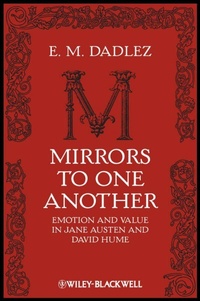
Mirrors to One Another
Emotion and Value in Jane Austen and David Hume
1st Edition
Will be published approx. on 9. April 2009
Book
Hardback
256 pages
978-1-4051-9348-1 (ISBN)
Description
A compelling exploration of the convergence of Jane Austen's literary themes and characters with David Hume's views on morality and human nature.
Argues that the normative perspectives endorsed in Jane Austen's novels are best characterized in terms of a Humean approach, and that the merits of Hume's account of ethical, aesthetic and epistemic virtue are vividly illustrated by Austen's writing.
Illustrates how Hume and Austen complement one another, each providing a lens that allows us to expand and elaborate on the ideas of the other
Proposes that literature may serve as a thought experiment, articulating hypothetical cases which allow the reader to test her moral intuitions
Contributes to ongoing debates on the philosophy of literature, ethics, and emotion
Argues that the normative perspectives endorsed in Jane Austen's novels are best characterized in terms of a Humean approach, and that the merits of Hume's account of ethical, aesthetic and epistemic virtue are vividly illustrated by Austen's writing.
Illustrates how Hume and Austen complement one another, each providing a lens that allows us to expand and elaborate on the ideas of the other
Proposes that literature may serve as a thought experiment, articulating hypothetical cases which allow the reader to test her moral intuitions
Contributes to ongoing debates on the philosophy of literature, ethics, and emotion
Reviews / Votes
"Dadlez unpacks the major philosophical trends evident in both Austen and Hume to show that Austen's works were influenced by the intellectual climate resulting from Hume's studies." (Consciousness, Literature and the Arts, December 2009)"Dadlez says explicitly that her argument is intended to be cumulative: that is, the text reveals the posited relationship between Hume and Austen gradually, through a series of smaller demonstrations as she moves from topic to topic. This makes her book an extremely pleasant read for an Austen aficionado.... Indeed, that the book's strength lies in the details... suggests that it will be of particular value in interdisciplinary contexts: it has the double function of introducing Austen and her literature to philosophers, and Hume and his moral philosophy to students of literature." (Notre Dame Philosophical Reviews, February 2010)
More details
Series
Language
English
Place of publication
Hoboken
United Kingdom
Publishing group
John Wiley and Sons Ltd
Target group
College/higher education
Product notice
sewn/stitched
Cloth over boards
With dust jacket
Dimensions
Height: 231 mm
Width: 155 mm
Thickness: 25 mm
Weight
558 gr
ISBN-13
978-1-4051-9348-1 (9781405193481)
Copyright in bibliographic data and cover images is held by Nielsen Book Services Limited or by the publishers or by their respective licensors: all rights reserved.
Schweitzer Classification
Other editions
Additional editions
E-Book
03/2009
Wiley-Blackwell
€30.99
Available for download
Person
E.M. Dadlez is Professor of Philosophy at the University of Central Oklahoma. She has published in the Journal of Aesthetics and Art Criticism, the British Journal of Aesthetics, Philosophy and Literature, and Hume Studies. She is also the author of What's Hecuba to Him? Fictional Events and Actual Emotions (1997).
Content
Preface. 1. How Literature Can Be a Thought Experiment: Alternatives to and Elaborations of Original Accounts.
2. Literary Form and Philosophical Content.
3. Kantian and Artistotelian Accounts of Austen.
4. Hume and Austen on Pleasure, Sentiment, and Virtue.
5. Hume and Austen on Sympathy.
6. Hume's General Point of View and the Novels of Jane Austen.
7. The Useful and the Good in Hume and Austen.
8. Aesthetics and Humean Aesthetic Norms in the Novels of Jane Austen.
9. Hume and Austen on Good People and Good Reasoning.
10. 'Lovers,' 'Friends,' and other Endearing Appellations.
11. Hume and Austen on Pride.
12. Hume and Austen on Jealousy, Envy, Malice and the Principle of Comparison.
13. Indolence and Industry in Hume and Austen.
14. What Hume's Philosophy Contributes to Our Understanding of Austen's Fiction; What Austen's Fiction Contributes to Our Understanding of Hume's Philosophy
2. Literary Form and Philosophical Content.
3. Kantian and Artistotelian Accounts of Austen.
4. Hume and Austen on Pleasure, Sentiment, and Virtue.
5. Hume and Austen on Sympathy.
6. Hume's General Point of View and the Novels of Jane Austen.
7. The Useful and the Good in Hume and Austen.
8. Aesthetics and Humean Aesthetic Norms in the Novels of Jane Austen.
9. Hume and Austen on Good People and Good Reasoning.
10. 'Lovers,' 'Friends,' and other Endearing Appellations.
11. Hume and Austen on Pride.
12. Hume and Austen on Jealousy, Envy, Malice and the Principle of Comparison.
13. Indolence and Industry in Hume and Austen.
14. What Hume's Philosophy Contributes to Our Understanding of Austen's Fiction; What Austen's Fiction Contributes to Our Understanding of Hume's Philosophy