

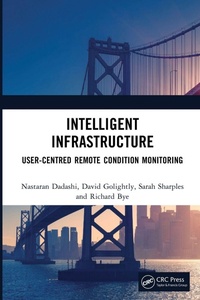
Intelligent Infrastructure
User-centred Remote Condition Monitoring
1st Edition
Published on 30. January 2025
Book
Paperback/Softback
144 pages
978-1-032-52116-9 (ISBN)
Description
With the development of sensor technology, wireless communications, big data, and machine learning, there is an increasing interest in technologies and solutions that assess and predict the state of equipment and assets within various industrial settings. These technologies aim to collect information from multiple sources about infrastructure asset status. Then, through current and historical data analysis, this configuration of technologies delivers intelligence on current and future asset status to a maintenance operator or manager to inform optimal maintenance decision-making. These technologies are known under different terms - remote condition monitoring, e-maintenance, prognostic systems, predictive maintenance, and smart or intelligent infrastructure. Despite the promise of remote condition monitoring and predictive technologies, there is a growing concern with such technologies because they can be difficult or impractical to use.
Understanding and mitigating potential human factors issues could ensure that such vast investments are not wasted. This book considers, in depth, the challenges placed on users of current and future condition monitoring systems. Its primary focus is to understand the cognitive processes, including managing alarms, interpreting data, and collaborating with automation. The book describes a range of human factors methods that can be used to understand the current and future functioning of people and technology in an enhanced maintenance and asset monitoring context. The book also presents a framework for describing these issues systematically and presents the resulting design considerations to increase the effectiveness of individual operators and organisations as a whole.
Understanding and mitigating potential human factors issues could ensure that such vast investments are not wasted. This book considers, in depth, the challenges placed on users of current and future condition monitoring systems. Its primary focus is to understand the cognitive processes, including managing alarms, interpreting data, and collaborating with automation. The book describes a range of human factors methods that can be used to understand the current and future functioning of people and technology in an enhanced maintenance and asset monitoring context. The book also presents a framework for describing these issues systematically and presents the resulting design considerations to increase the effectiveness of individual operators and organisations as a whole.
More details
Language
English
Place of publication
London
United Kingdom
Publishing group
Taylor & Francis Ltd
Target group
Professional and scholarly
Academic
Illustrations
38 s/w Abbildungen, 7 s/w Photographien bzw. Rasterbilder, 31 s/w Zeichnungen, 17 s/w Tabellen
17 Tables, black and white; 31 Line drawings, black and white; 7 Halftones, black and white; 38 Illustrations, black and white
Dimensions
Height: 234 mm
Width: 156 mm
Thickness: 9 mm
Weight
248 gr
ISBN-13
978-1-032-52116-9 (9781032521169)
Copyright in bibliographic data and cover images is held by Nielsen Book Services Limited or by the publishers or by their respective licensors: all rights reserved.
Schweitzer Classification
Other editions
Additional editions
Nastaran Dadashi | David Golightly | Sarah Sharples
Intelligent Infrastructure
User-centred Remote Condition Monitoring
E-Book
07/2023
1st Edition
CRC Press
€62.99
Available for download
Nastaran Dadashi | David Golightly | Sarah Sharples
Intelligent Infrastructure
User-centred Remote Condition Monitoring
E-Book
07/2023
1st Edition
CRC Press
€63.49
Available for download
Nastaran Dadashi | David Golightly | Sarah Sharples
Intelligent Infrastructure
User-centred Remote Condition Monitoring
Book
07/2023
1st Edition
CRC Press
€115.60
Shipment within 10-20 days
Persons
Dr Nastaran Dadashi is a researcher, educator and a Chartered human factors specialist. She has a PhD in Human Factors (Future Railway Intelligent Infrastructure) from the University of Nottingham (Human Factors Research Group), where she worked as a research fellow. As a researcher, she applies human factors principles to a broad range of industries, including nuclear, health care, and the creative sector. As an educator, Nastaran works with digital experience designers at George Brown College, Canada (School of Design), to ensure that the next generation of digital innovations is accessible, ethical, and responsible.
Dr David Golightly is Lecturer in Human-Systems Integration within the Future Mobility Group, School of Engineering, Newcastle University, UK. David is a Chartered Psychologist and Chartered Ergonomist, researching user-centred design for transport innovation and operations. This has included application of knowledge elicitation from experts for rail socio-technical systems modelling, and in the human aspects of operational safety and performance for transport systems. David has also applied knowledge elicitation and decision-making analyses in support accident and incident investigation, for manufacturing, and in hospital care co-ordination. Prior to his research career, David led commercial usability and user-centred design programmes at a global telecoms provider, and a FTSE100 fintech provider.
Professor Sarah Sharples is Professor of Human Factors at the University of Nottingham. From 2015-16 she was President of the Chartered Institute of Ergonomics and Human Factors. She is co-Editor of the Ergonomics and Human Factors text book 'Evaluation of Human Work: 4th edition'. In 2021 she was appointed as Chief Scientific Adviser to the Department for Transport.
Richard Bye is Head of Ergonomics and Human Factors at Network Rail. With more than 15 years of hands-on human factors experience in the rail industry, he has been involved in a wide range of physical, cognitive and organisational ergonomics projects. Richard has worked on initiatives as diverse as the assurance of safety-critical operational processes, the introduction of smartphones and tablets for frontline track workers, the development of decision support tools for the railway's internet of things, and the implementation of new technology to increase the resilience of real-time rail operations.
Dr David Golightly is Lecturer in Human-Systems Integration within the Future Mobility Group, School of Engineering, Newcastle University, UK. David is a Chartered Psychologist and Chartered Ergonomist, researching user-centred design for transport innovation and operations. This has included application of knowledge elicitation from experts for rail socio-technical systems modelling, and in the human aspects of operational safety and performance for transport systems. David has also applied knowledge elicitation and decision-making analyses in support accident and incident investigation, for manufacturing, and in hospital care co-ordination. Prior to his research career, David led commercial usability and user-centred design programmes at a global telecoms provider, and a FTSE100 fintech provider.
Professor Sarah Sharples is Professor of Human Factors at the University of Nottingham. From 2015-16 she was President of the Chartered Institute of Ergonomics and Human Factors. She is co-Editor of the Ergonomics and Human Factors text book 'Evaluation of Human Work: 4th edition'. In 2021 she was appointed as Chief Scientific Adviser to the Department for Transport.
Richard Bye is Head of Ergonomics and Human Factors at Network Rail. With more than 15 years of hands-on human factors experience in the rail industry, he has been involved in a wide range of physical, cognitive and organisational ergonomics projects. Richard has worked on initiatives as diverse as the assurance of safety-critical operational processes, the introduction of smartphones and tablets for frontline track workers, the development of decision support tools for the railway's internet of things, and the implementation of new technology to increase the resilience of real-time rail operations.
Content
1. Introducing human factors for remote condition monitoring. 2. Remote condition monitoring and predictive maintenance. 3. Challenges of Remote Condition Monitoring. 4. Human factors to explore remote condition monitoring. 5. Understanding cognition within maintenance contexts. 6. Understanding alarm handling: a case in railway Electrical Control Systems. 7. Cognitive Work Analysis to understand asset monitoring and management. 8. Defining Intelligent Infrastructure and identifying the key challenges. 9. Final remarks.