

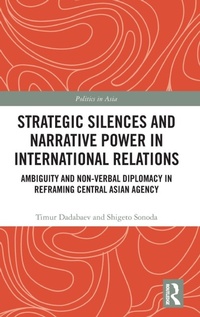
Strategic Silences and Narrative Power in International Relations
Ambiguity and Non-verbal Diplomacy in Reframing Central Asian Agency
1st Edition
Published on 22. May 2026
Book
Hardback
194 pages
978-1-041-15798-4 (ISBN)
Description
Developing a conceptual framework of strategic silence and applying it to various domains of Central Asian international relations, this book uncovers how silence allows states to navigate structural constraints, maintain flexibility, and assert subtle forms of resistance or alignment.
Strategic ambiguity and restraint often characterise Central Asia's response to major geopolitical shifts. This book frames these silences as forms of soft power and subtle resistance that reflect regional logics of survival, dignity, and diplomacy. By exploring the multifaceted ways in which the region's states employ silence as part of their international behaviour, the book introduces a new conceptual vocabulary in order to understand subaltern agency and regional identity construction in the post-Soviet space. Chapters explore strategic silence not as a uniform doctrine but as a contextual practice-emerging differently in response to Russian imperial nostalgia, Chinese economic expansion, Western engagement, and internal post-Soviet memory struggles. The result is a reconceptualisation of silence as an intentional, strategic, and communicative device within international relations.
This book will be of interest to researchers and postgraduate students working in international relations, Central Asian studies, area studies, and global politics. Policymakers and diplomatic practitioners working on Eurasian, Indo-Pacific, or post-Soviet affairs may also benefit from the book.
Strategic ambiguity and restraint often characterise Central Asia's response to major geopolitical shifts. This book frames these silences as forms of soft power and subtle resistance that reflect regional logics of survival, dignity, and diplomacy. By exploring the multifaceted ways in which the region's states employ silence as part of their international behaviour, the book introduces a new conceptual vocabulary in order to understand subaltern agency and regional identity construction in the post-Soviet space. Chapters explore strategic silence not as a uniform doctrine but as a contextual practice-emerging differently in response to Russian imperial nostalgia, Chinese economic expansion, Western engagement, and internal post-Soviet memory struggles. The result is a reconceptualisation of silence as an intentional, strategic, and communicative device within international relations.
This book will be of interest to researchers and postgraduate students working in international relations, Central Asian studies, area studies, and global politics. Policymakers and diplomatic practitioners working on Eurasian, Indo-Pacific, or post-Soviet affairs may also benefit from the book.
More details
Series
Language
English
Place of publication
London
United Kingdom
Publishing group
Taylor & Francis Ltd
Target group
Professional and scholarly
Academic
Product notice
Laminated cover
Illustrations
12 s/w Tabellen, 26 s/w Abbildungen, 26 s/w Zeichnungen
12 Tables, black and white; 26 Line drawings, black and white; 26 Illustrations, black and white
Dimensions
Height: 234 mm
Width: 156 mm
Thickness: 13 mm
Weight
465 gr
ISBN-13
978-1-041-15798-4 (9781041157984)
Copyright in bibliographic data and cover images is held by Nielsen Book Services Limited or by the publishers or by their respective licensors: all rights reserved.
Schweitzer Classification
Other editions
Additional editions
Timur Dadabaev | Shigeto Sonoda
Strategic Silences and Narrative Power in International Relations
Ambiguity and Non-verbal Diplomacy in Reframing Central Asian Agency
E-Book
05/2026
Routledge
€60.99
Available for download
Timur Dadabaev | Shigeto Sonoda
Strategic Silences and Narrative Power in International Relations
Ambiguity and Non-verbal Diplomacy in Reframing Central Asian Agency
E-Book
05/2026
Routledge
€60.99
Available for download
Persons
Timur Dadabaev is a Swedish Research Council Guest Professor at Lund University. He concurrently holds Professorships at the University of Tsukuba, Japan and the University of World Economy and Diplomacy.
Shigeto Sonoda is Professor of Sociology and Asian Studies at the University of Tokyo.
Shigeto Sonoda is Professor of Sociology and Asian Studies at the University of Tokyo.
Content
Chapter 1 - Introduction: The Politics of Silence in Central Asian International Relations
Chapter 2 - Rethinking IR Theory through Central Asia: Tacit Nationhood in Patchworked Neighborhoods
Chapter 3 - "Silence Is Golden"? Strategic Silences in Central Asian States' Response to the Ukrainian Crisis
Chapter 4 - Political Narratives and Public Recollection in Central Asia: Polyphonic silences and the manipulating of Post-Soviet nostalgia
Chapter 5 - Power of Non-verbal Diplomacy: Nudging Not Nagging in Sino-Uzbek Relations
Chapter 6 - Constructivist Framework for a Central Asian Regional Security Complex: Strategic Ambiguity
Chapter 7 - Strategic Silences and the Water Neighbourhood in Central Asia: Tacit Diplomacy in Hydropolitics
Chapter 8 - Normative Implications of Strategic Silence Beyond Russia and China: Prospects for U.S.-Japan Foreign Policy Coordination in Central Asia
Chapter 9 - Rethinking IR Theory through Silence and Neighborhood in Central Asia: Beyond Rationalism and Reflectivism
Chapter 2 - Rethinking IR Theory through Central Asia: Tacit Nationhood in Patchworked Neighborhoods
Chapter 3 - "Silence Is Golden"? Strategic Silences in Central Asian States' Response to the Ukrainian Crisis
Chapter 4 - Political Narratives and Public Recollection in Central Asia: Polyphonic silences and the manipulating of Post-Soviet nostalgia
Chapter 5 - Power of Non-verbal Diplomacy: Nudging Not Nagging in Sino-Uzbek Relations
Chapter 6 - Constructivist Framework for a Central Asian Regional Security Complex: Strategic Ambiguity
Chapter 7 - Strategic Silences and the Water Neighbourhood in Central Asia: Tacit Diplomacy in Hydropolitics
Chapter 8 - Normative Implications of Strategic Silence Beyond Russia and China: Prospects for U.S.-Japan Foreign Policy Coordination in Central Asia
Chapter 9 - Rethinking IR Theory through Silence and Neighborhood in Central Asia: Beyond Rationalism and Reflectivism