

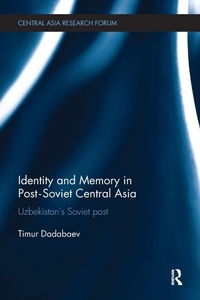
Identity and Memory in Post-Soviet Central Asia
Uzbekistan's Soviet Past
1st Edition
Published on 22. January 2018
Book
Paperback/Softback
226 pages
978-1-138-49335-3 (ISBN)
Description
Central Asian states have experienced a number of historical changes that have challenged their traditional societies and lifestyles. The most significant changes occurred as a result of the revolution in 1917, the incorporation of the region into the Soviet Union, and gaining independence after the collapse of the USSR. Impartial and informed public evaluation of the Soviet and post-Soviet periods has always been a complicated issue, and the 'official' descriptions have often contradicted the interpretations of the past viewed through the experiences of ordinary people.
Identity and Memory in Post-Soviet Central Asia looks at the tradition of history construction in Central Asia. By collecting views of the public's experiences of the Soviet past in Uzbekistan, the author examines the transformation of present-day Central Asia from the perspective of these personal memories, and analyses how they relate to the Soviet and post-Soviet official descriptions of Soviet life. The book discusses that the way in which people in Central Asia reconcile their Soviet past to a great extent refers to the three-fold process of recollecting their everyday experiences, reflecting on their past from the perspective of their post-Soviet present, and re-imagining. These three elements influence memories and lead to selectivity in memory construction, emphasising the aspects of the Soviet era people choose to recall in positive and negative lights.
Presenting a broader picture of Soviet everyday life at the periphery of the USSR, the book will be a useful contribution for students and scholars of Central Asian Studies, Ethnicity and Identity Politics.
Identity and Memory in Post-Soviet Central Asia looks at the tradition of history construction in Central Asia. By collecting views of the public's experiences of the Soviet past in Uzbekistan, the author examines the transformation of present-day Central Asia from the perspective of these personal memories, and analyses how they relate to the Soviet and post-Soviet official descriptions of Soviet life. The book discusses that the way in which people in Central Asia reconcile their Soviet past to a great extent refers to the three-fold process of recollecting their everyday experiences, reflecting on their past from the perspective of their post-Soviet present, and re-imagining. These three elements influence memories and lead to selectivity in memory construction, emphasising the aspects of the Soviet era people choose to recall in positive and negative lights.
Presenting a broader picture of Soviet everyday life at the periphery of the USSR, the book will be a useful contribution for students and scholars of Central Asian Studies, Ethnicity and Identity Politics.
More details
Series
Language
English
Place of publication
London
United Kingdom
Publishing group
Taylor & Francis Ltd
Target group
College/higher education
Illustrations
1 s/w Abbildung, 2 s/w Tabellen, 1 s/w Zeichnung
2 Tables, black and white; 1 Line drawings, black and white; 1 Illustrations, black and white
Dimensions
Height: 234 mm
Width: 156 mm
Thickness: 12 mm
Weight
354 gr
ISBN-13
978-1-138-49335-3 (9781138493353)
Copyright in bibliographic data and cover images is held by Nielsen Book Services Limited or by the publishers or by their respective licensors: all rights reserved.
Schweitzer Classification
Other editions
Additional editions
E-Book
08/2015
Routledge
€69.99
Available for download
E-Book
08/2015
Routledge
€69.99
Available for download
Book
08/2015
1st Edition
Routledge
€231.60
Shipment within 10-20 days
Person
Timur Dadabaev is an Associate Professor at the Graduate School of Social Sciences and Humanities, University of Tsukuba, Japan and Adjunct Associate Professor at the Graduate School of Humanities and Sociology, University of Tokyo, Japan.
Content
1. Selectivity in Recalling Soviet Past in Uzbekistan: Re-collecting, Reflecting and Re-imagining 2. Power, Social Life, and Public Memory in Uzbekistan 3. Recollections of Trauma and Public Responses to the Political Violence of State Policies in the Stalinist Era in Uzbekistan 4. The impact of World War II /Greater Patriotic War in Uzbekistan 5. Death of Stalin: Time of Despair and Hope 6 Post-Soviet Nostalgia in Central Asia: Oral Accounts of Everyday Life in Soviet Uzbekistan 7. Hybrid Ethnic Identities in Soviet Uzbekistan 8. Religiosity and Soviet 'modernisation' in Central Asia: Locating religious traditions and rituals in recollections of antireligious policies in Uzbekistan 9. Placing the Mahalla between Public and Private Life