

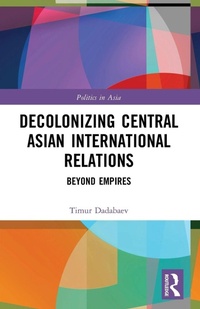
Decolonizing Central Asian International Relations
Beyond Empires
1st Edition
Published on 31. May 2023
Book
Paperback/Softback
168 pages
978-1-032-00938-4 (ISBN)
Description
This book unpacks the main narratives used in international relations to depict and explain existing inter-state relations in Central Asia, with a focus on the construction of fairer international relations along the Silk Road.
The book points to the need to decolonize international relations in the Central Asian region to present a fair representation of the regional states in international affairs. In doing so, the book exposes the concepts and stereotypes that have been imposed on the Central Asian region by dominant assumptions in contemporary international relations. Offering empirical grounding for alternative views, the author suggests that Western international relations make the same mistakes in the Central Asian region that the Russian Marxists made when they attributed a narrative of modernity along the lines of the progress made in Germany and Russia. In such a structure, both Russian Marxist attempts and liberalist Western ideas disregard the fact that the region has its own model of modernity and progress, which does not necessarily involve an appeal to the modern nation state, ethnicity and state building. The book sheds lights on the prospects of coordinated development of Central Asia and Afghanistan. It also provides insights into the development of post-Socialist Asia in its relations with Russia, China, Japan and South Korea.
Contributing to the task of placing Central Asia in discussions in the discipline of international relations, this book will be of interest to academics working in the fields of international relations and Asian politics, in particular Central Asian studies.
The book points to the need to decolonize international relations in the Central Asian region to present a fair representation of the regional states in international affairs. In doing so, the book exposes the concepts and stereotypes that have been imposed on the Central Asian region by dominant assumptions in contemporary international relations. Offering empirical grounding for alternative views, the author suggests that Western international relations make the same mistakes in the Central Asian region that the Russian Marxists made when they attributed a narrative of modernity along the lines of the progress made in Germany and Russia. In such a structure, both Russian Marxist attempts and liberalist Western ideas disregard the fact that the region has its own model of modernity and progress, which does not necessarily involve an appeal to the modern nation state, ethnicity and state building. The book sheds lights on the prospects of coordinated development of Central Asia and Afghanistan. It also provides insights into the development of post-Socialist Asia in its relations with Russia, China, Japan and South Korea.
Contributing to the task of placing Central Asia in discussions in the discipline of international relations, this book will be of interest to academics working in the fields of international relations and Asian politics, in particular Central Asian studies.
More details
Series
Language
English
Place of publication
London
United Kingdom
Publishing group
Taylor & Francis Ltd
Target group
College/higher education
Postgraduate
Illustrations
1 s/w Abbildung, 1 s/w Zeichnung, 15 s/w Tabellen
15 Tables, black and white; 1 Line drawings, black and white; 1 Illustrations, black and white
Dimensions
Height: 216 mm
Width: 140 mm
Thickness: 9 mm
Weight
223 gr
ISBN-13
978-1-032-00938-4 (9781032009384)
Copyright in bibliographic data and cover images is held by Nielsen Book Services Limited or by the publishers or by their respective licensors: all rights reserved.
Schweitzer Classification
Other editions
Additional editions
Book
09/2021
1st Edition
Routledge
€206.90
Shipment within 10-20 days
E-Book
09/2021
1st Edition
Routledge
€59.49
Available for download
E-Book
09/2021
1st Edition
Routledge
€59.49
Available for download
Person
Timur Dadabaev is a Professor of International Relations and the Director of the Special Program for Japanese and Eurasian Studies at the Faculty of Social Sciences and Humanities, University of Tsukuba, Japan. His recent books include Transcontinental Silk Road Strategies (2019), Chinese, Japanese and Korean In-roads into Central Asia (2019), Japan in Central Asia (2016) and Identity and Memory in Post-Soviet Central Asia (2015).
Content
1. Towards Decolonizing Central Asian International Relations 2. Critical Assessment of Contemporary Approaches to Central Asia 3. Manipulating Post-Soviet Nostalgia: Contrasting Political Narratives and Public Recollections in Central Asia 4. Emerging Japan-EU strategic partnership and its implications for Central Asia 5. De-securitizing the "Silk Road": Uzbekistan's cooperation agenda with Russia, China, Japan and South Korea in the Post-Karimov Era 6. Connectivity, Energy and Decolonization: Uzbekistan's strategy vis-a-vis Russia, China, South Korea and Japan 7. Decolonizing the Afghanistan-Central Asian relations Concluding remarks: Seven points for decolonizing agenda setting in Central Asia