

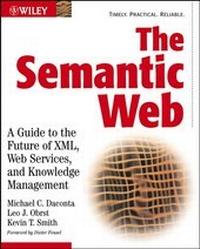
The Semantic Web
A Guide to the Future of XML, Web Services, and Knowledge Management
Published on 30. May 2003
Book
Paperback/Softback
312 pages
978-0-471-43257-9 (ISBN)
Description
* "The Semantic Web is an extension of the current Web in which information is given
* well-defined meaning, better enabling computers and people to work in cooperation."-Tim Berners-Lee, Scientific American, May 2001
* This authoritative guide shows how the Semantic Web works technically and how businesses can utilize it to gain a competitive advantage
* Explains what taxonomies and ontologies are as well as their importance in constructing the Semantic Web
* Companion Web site includes further updates as the framework develops and links to related sites
* well-defined meaning, better enabling computers and people to work in cooperation."-Tim Berners-Lee, Scientific American, May 2001
* This authoritative guide shows how the Semantic Web works technically and how businesses can utilize it to gain a competitive advantage
* Explains what taxonomies and ontologies are as well as their importance in constructing the Semantic Web
* Companion Web site includes further updates as the framework develops and links to related sites
Reviews / Votes
"...It is perfectly pitched at the level of computer-literate managers..." (British Journal of Healthcare Computing, February 2004)More details
Edition
1. Auflage
Language
English
Place of publication
New York
United States
Publishing group
John Wiley and Sons Ltd
Target group
Professional and scholarly
Illustrations
Illustrations
Dimensions
Height: 23.4 cm
Width: 18.9 cm
Thickness: 2 cm
Weight
462 gr
ISBN-13
978-0-471-43257-9 (9780471432579)
Schweitzer Classification
Persons
MICHAEL C. DACONTA is the Chief Scientist of the Advanced Programs Group at McDonald Bradley, where he serves as the Chief Architect on the DOD's Virtual Knowledge Base Project. He is the author of numerous programming books and a columnist for JavaWorld magazine and ZDNET.com.
DR. LEO J. OBRST is an Artificial Intelligence Scientist at the MITRE Corporation, where he leads the Information Semantics team, and is a key participating member of numerous Semantic Web standards.
KEVIN T. SMITH is a Principal Software Architect at McDonald Bradley, where he serves as Chief Security Architect on the DOD's Virtual Knowledge Base Project. He is an author of several programming books and speaks at industry conferences.
DR. LEO J. OBRST is an Artificial Intelligence Scientist at the MITRE Corporation, where he leads the Information Semantics team, and is a key participating member of numerous Semantic Web standards.
KEVIN T. SMITH is a Principal Software Architect at McDonald Bradley, where he serves as Chief Security Architect on the DOD's Virtual Knowledge Base Project. He is an author of several programming books and speaks at industry conferences.
Content
Introduction.
Acknowledgments.
Foreword.
Chapter 1: What Is the Semantic Web?
Chapter 2: The Business Case for the Semantic Web.
Chapter 3: Understanding XML and Its Impact on the Enterprise.
Chapter 4: Understanding Web Services.
Chapter 5: Understanding the Resource Description Framework.
Chapter 6: Understanding the Rest of the Alphabet Soup.
Chapter 7: Understanding Taxonomies.
Chapter 8: Understanding Ontologies.
Chapter 9: Crafting Your Company's Roadmap to the Semantic Web.
Appendix: References.
Index.
Acknowledgments.
Foreword.
Chapter 1: What Is the Semantic Web?
Chapter 2: The Business Case for the Semantic Web.
Chapter 3: Understanding XML and Its Impact on the Enterprise.
Chapter 4: Understanding Web Services.
Chapter 5: Understanding the Resource Description Framework.
Chapter 6: Understanding the Rest of the Alphabet Soup.
Chapter 7: Understanding Taxonomies.
Chapter 8: Understanding Ontologies.
Chapter 9: Crafting Your Company's Roadmap to the Semantic Web.
Appendix: References.
Index.